Staying active is a huge part of life for so many of us in Hershey, PA, but nothing sidelines you faster than an unexpected sports injury. Whether you're dealing with nagging back pain after a round of golf, persistent knee pain from running, or the lingering effects of an old auto injury, the goal is always the same: to get back to the activities you love without pain. Preventing an injury isn’t about avoiding risk altogether; it's about building a resilient body that can handle the demands you place on it.
This is where proactive chiropractic care comes in. As your local chiropractor in Hershey, PA, we don't just treat pain after it starts—we partner with you to build a foundation of strength, proper movement, and smart recovery to stop injuries before they happen. This guide will walk you through the proven strategies we use to help our patients stay in the game, hit their performance goals, and live pain-free.
Your Foundation for Lifelong Athletic Performance
Every athlete in Hershey, from the weekend trail runners at Governor Dick Park to dedicated high school players, wants to stay healthy and active. The fear of an injury knocking you out of your season or sidelining you from your favorite activity is very real, but it doesn't have to be a foregone conclusion.
The problem is, most people only seek treatment after the pain has already started. A far better strategy is to build a proactive defense to stop injuries before they ever get a chance to happen. If you're searching for a "chiropractor near me" because you're already in pain, know that there is a path to recovery and prevention.
This guide goes beyond generic advice. We'll dig into the practical, real-world strategies that form the pillars of an effective injury prevention plan. Instead of just reacting to problems, you'll learn how to anticipate and fix the underlying causes of common sports injuries, from that nagging low back pain to a sudden, sharp knee injury.
Building a Proactive Mindset
Real injury prevention starts with recognizing that your body is an interconnected system. A weakness in one area, like poor core stability, almost always creates stress somewhere else—often leading to back pain or hip issues. This is exactly why a trusted chiropractor in Hershey, PA, doesn't just look at where it hurts; we analyze the complete picture of how your body moves.
Here at Hershey Family Chiropractic, our approach is to team up with local athletes to build personalized prevention plans. We help you understand your body’s unique movement patterns and address underlying issues like poor spinal alignment so you can keep performing at your best, season after season.
An effective prevention strategy isn't about eliminating risk—that's impossible in sports. It's about managing that risk intelligently. By focusing on smart preparation, balanced conditioning, and mindful recovery, you empower yourself to stay in the game and enjoy the activities you love.
This all boils down to a few key components:
- Smart Warm-Ups and Cool-Downs: Preparing your muscles for action and helping them recover afterward are non-negotiable for preventing strains and sprains.
- Building a Resilient Body: Your strength and conditioning work is the best armor you have against the intense forces your body absorbs during sports.
- Optimizing Recovery: What you do between workouts is just as important as the training itself. This is when your body repairs tissue and gets stronger.
Throughout this guide, we'll break these ideas down into simple, actionable steps. Whether you're fighting off chronic aches from conditions like sciatica or just want to get ahead of potential problems, our mission is to give you the tools to maintain peak performance. As your local Hershey chiropractor, we're dedicated to helping our community stay active, healthy, and pain-free.
Mastering Your Warm-Up and Cool-Down
Skipping a warm-up is one of the quickest ways to find yourself sidelined with an injury. Many athletes treat it as an optional chore, but a proper warm-up isn't just about "getting loose." It's a strategic process of preparing your body for the specific demands of your sport—waking up the right muscles and priming your nervous system for action.
Thinking a few lazy stretches will cut it is a classic mistake, often leading directly to strains and sprains. Your body needs a gradual ramp-up, not a sudden jolt from zero to sixty. A dedicated warm-up systematically increases blood flow to your muscles, raises your core temperature, and improves joint mobility, making tissues more pliable and far less likely to tear.
The Power of Dynamic Movement
The secret to an effective pre-activity routine is dynamic stretching. These are active movements that take your body through its full range of motion. Unlike static stretching, where you hold a position, dynamic drills mimic the actions you're about to perform.
For instance, a runner about to hit the trails near Hershey needs to get their glutes, hips, and hamstrings firing. Their warm-up should include movements like:
- Leg Swings (forward and side-to-side): To open up the hip joints.
- Walking Lunges with a Twist: To engage the core and prepare for rotational stability.
- High Knees and Butt Kicks: To activate the primary running muscles and get the heart rate up.
A golfer, on the other hand, needs rotational power. Their warm-up should focus on thoracic (mid-back) mobility with exercises like torso twists and arm circles. This sport-specific approach ensures the right muscle groups are awake and ready, a cornerstone of any smart injury prevention plan.
The process flow below shows how a solid warm-up acts as the essential first step in a complete injury prevention strategy, setting the stage for building a resilient body and prioritizing recovery.
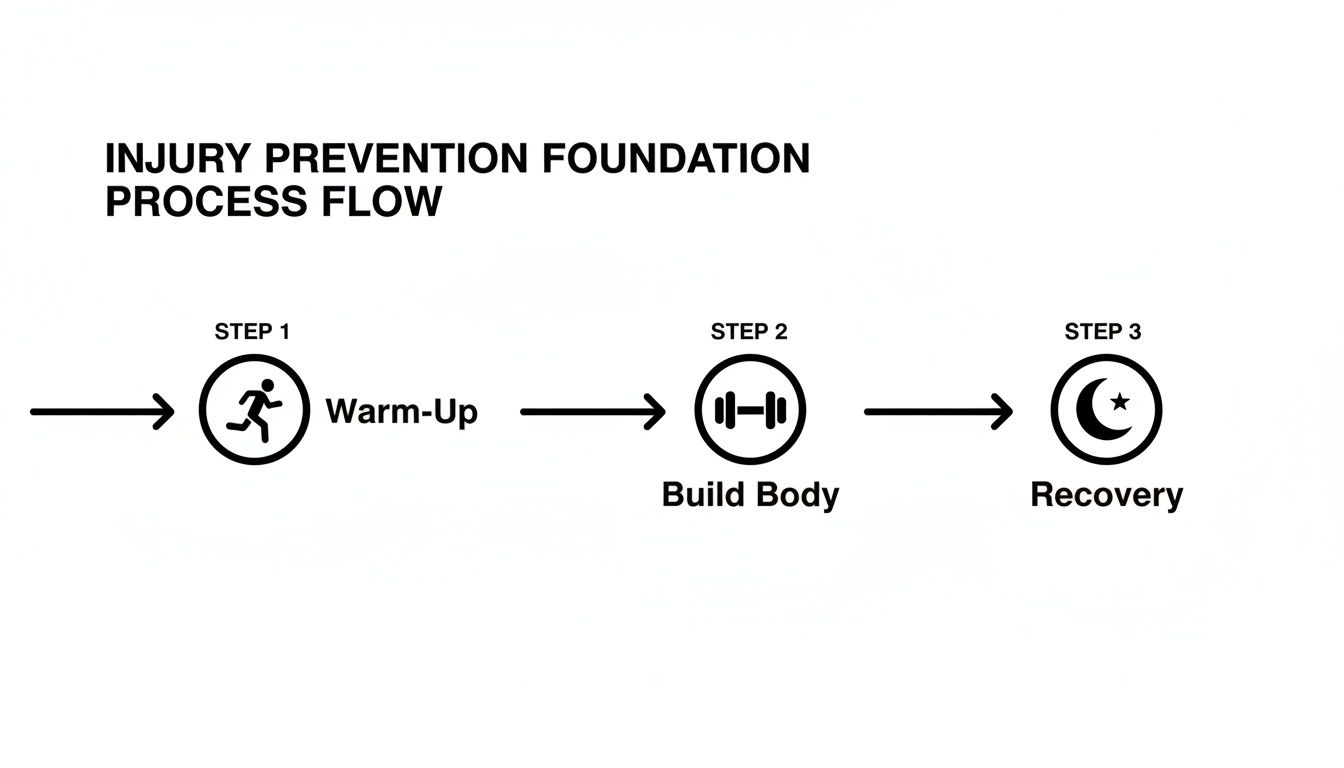
This visual drives home a key point: without the right preparation, the effectiveness of your training and recovery is seriously compromised, leaving you more vulnerable to getting hurt.
Don't Neglect the Cool-Down
Just as critical as the warm-up is the cool-down. After you’ve pushed yourself, your body needs to transition back to a resting state gradually. Stopping abruptly can cause blood to pool in your limbs, sometimes leading to dizziness. A simple 5- to 10-minute cool-down helps regulate blood flow, clear out metabolic waste products like lactic acid, and kickstart the recovery process.
This is where static stretching—holding a stretch for 20-30 seconds—really shines. It helps restore muscles to their resting length and improves your long-term flexibility.
Key Takeaway: Think of your warm-up as telling your body what's coming, and your cool-down as thanking it for its hard work. Both are non-negotiable for longevity in your sport.
At our Hershey chiropractic clinic, we see injuries all the time that could have been avoided with better preparation. We guide our patients on specific drills tailored to their movement patterns, turning their warm-up into a powerful, personalized tool. The impact of this simple habit is immense. Did you know that proper warm-up routines can slash sports injury rates by up to 50%? In the U.S., where over 2.6 million young athletes suffer sports injuries annually, many common issues like sprains and strains are preventable with the right preparation. You can learn more about these findings from recent research on the power of warm-ups.
Dynamic Warm-Up vs. Static Cool-Down
To make it simple, here’s a look at how the two essential components of your routine differ and why each one is so important at the right time.
| Component | Dynamic Warm-Up (Pre-Activity) | Static Cool-Down (Post-Activity) |
|---|---|---|
| Primary Goal | Prepare the body for performance and reduce injury risk. | Initiate recovery and improve long-term flexibility. |
| Movements | Active, continuous, and sport-specific (e.g., leg swings, torso twists). | Passive, holding stretches for 20-30 seconds (e.g., hamstring stretch). |
| Effect on Body | Increases heart rate, blood flow, and core temperature. Activates the nervous system. | Gradually lowers heart rate and helps clear metabolic byproducts. Relaxes muscles. |
| When to Do It | Immediately before your training session or competition. | Immediately after your activity is complete. |
By dedicating just 10-15 minutes to this process—a dynamic warm-up before you start and a static cool-down after you finish—you create a powerful buffer against injury. It's a small investment of time that pays massive dividends in keeping you healthy, active, and performing at your best.
Building a More Resilient Body Through Conditioning
True injury prevention is built in the gym, not just on the field. Think of your muscles as the body's natural shock absorbers; the stronger and more balanced they are, the better they protect your joints and ligaments from the forces generated during athletic activity. A smart conditioning program is your best defense against common injuries.
This process goes beyond just lifting heavy weights. It’s about building a well-rounded body that can handle the specific demands of your sport without breaking down. That means focusing on strength, stability, and clean movement patterns.
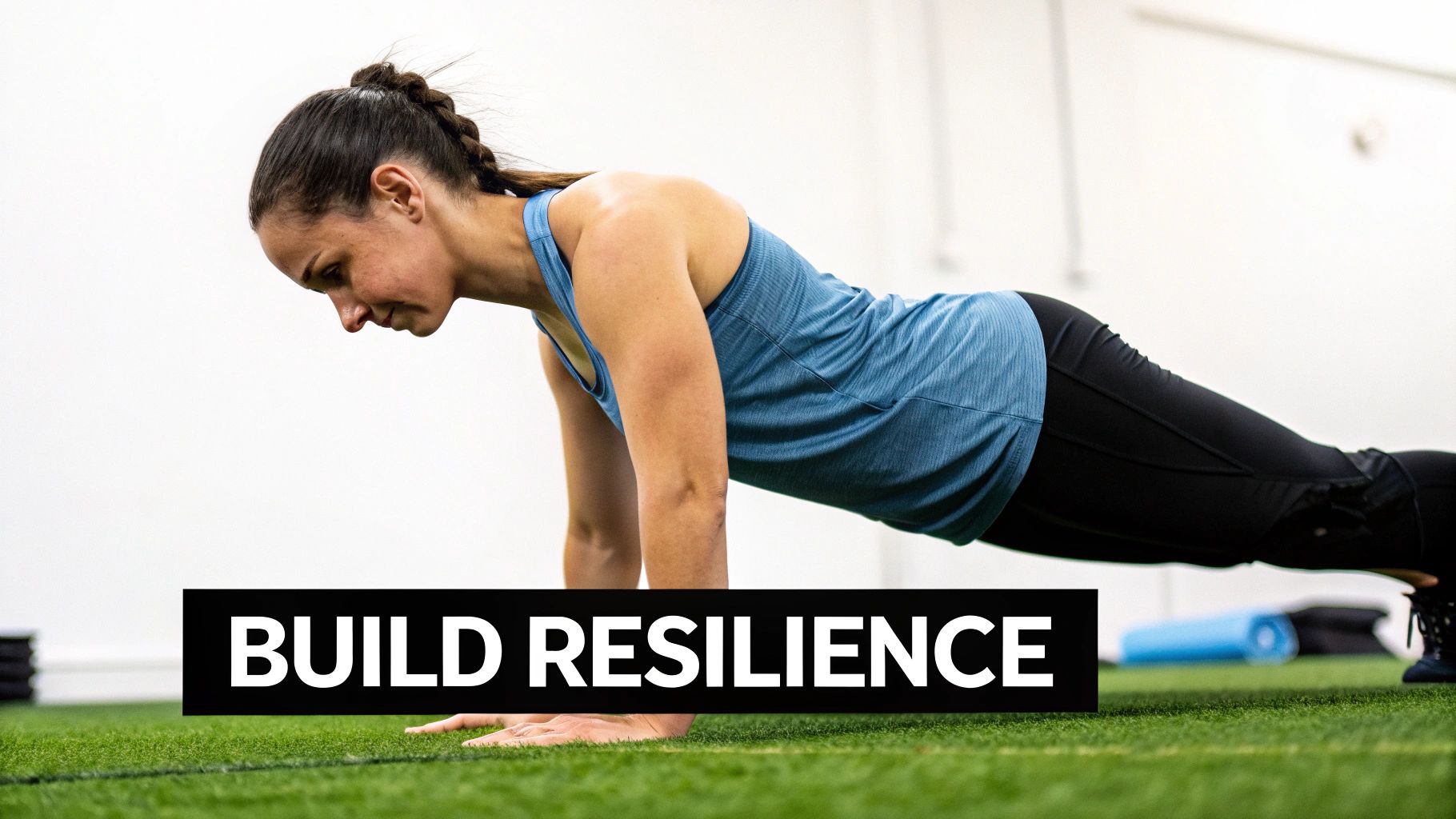
Many preventable injuries stem from muscular imbalances that creep in over time. These imbalances force your body to compensate, placing excessive strain on joints and tissues that were never designed to handle that kind of load.
Identifying and Correcting Muscular Imbalances
A classic example we see in runners from Hershey is runner's knee, which is frequently linked to weak gluteal muscles. When your glutes aren't firing properly to stabilize your pelvis, other muscles (like your quads) have to work overtime, pulling the kneecap out of alignment and causing that nagging pain. This is a common source of both knee and back pain that a chiropractor can address.
This is where a targeted, intelligent approach to conditioning becomes non-negotiable. Instead of just guessing, it's critical to identify these hidden weaknesses before they sideline you.
At Hershey Family Chiropractic, our doctors use functional movement screens to pinpoint these exact issues. By watching how you squat, lunge, and bend, we can spot asymmetries and weak links in your kinetic chain. This lets us build specific corrective exercises right into your chiropractic care plan, helping you forge a body that’s truly resilient.
Key Takeaway: Your body will always find a way to complete a movement. A smart conditioning program ensures it uses the right muscles to do so, protecting your joints and boosting performance.
Foundational Strength for Total-Body Resilience
To build a strong foundation, your training should prioritize movements that recruit multiple muscle groups at once. These compound exercises teach your body to function as an integrated system—which is exactly how it works during any sport.
Some of the most effective movements include:
- Squats: This fundamental lift builds strength in your glutes, quads, hamstrings, and core, all of which are critical for protecting your knees and lower back.
- Deadlifts: When done with proper form, deadlifts develop a powerful posterior chain (glutes, hamstrings, back) that supports good posture and explosive power.
- Push-Ups and Rows: These exercises create a balanced upper body, strengthening both the pushing muscles of the chest and the pulling muscles of the back to stabilize the shoulder girdle.
Focusing on these core lifts builds functional strength that directly translates to better performance and a lower risk of injury on the field, court, or trail.
The Critical Role of Core Stability
Your core is much more than just your abs. It's the entire muscular corset wrapping around your torso that connects your upper and lower body. A strong, stable core acts as a central power distributor, transferring force efficiently and protecting your spine from damaging stress.
Weak core muscles are a primary contributor to lower back pain, a complaint we hear all the time from athletes in the Hershey community. When the core can't provide enough support, smaller muscles in the lower back are forced to overcompensate, leading to strain and injury. To build a more resilient body, incorporating dedicated Exercise For Core Stability is fundamental to preventing these types of injuries.
Simple but incredibly effective core exercises include:
- Planks: Teaches you to maintain a rigid, neutral spine under tension.
- Bird-Dog: Improves coordination and stability across the entire body.
- Dead Bug: Challenges your ability to move your limbs while keeping your core locked in.
Integrating these exercises into your routine is a non-negotiable step in learning how to prevent sports injuries.
Our team provides expert guidance for local athletes looking to take their conditioning to the next level. We build personalized programs that combine smart conditioning with expert chiropractic care, helping you build a stronger, more durable body that's ready for anything.
Using Proper Gear and Technique to Your Advantage
Your gear and your movement patterns are your first and best lines of defense against injury. We see this play out all the time in our Hershey, PA, clinic. An athlete comes in with nagging knee pain, and it turns out they're running on shoes with 500+ miles on them. The cushioning is long gone.
Even the most well-conditioned body can break down if it’s forced into poor movement patterns by faulty gear. Think of your running shoes as the foundation of every step; if that foundation is unstable, the stress will travel right up the kinetic chain, impacting your ankles, knees, hips, and even your lower back.

This is a common issue we address at our Hershey clinic. It’s not unusual for us to trace a patient's pain directly back to equipment that isn’t right for their body or activity. By dialing in your technique and making sure your gear is truly supporting you, you can dramatically cut your risk of a preventable injury.
Choosing the Right Footwear
Your feet are unique, and your shoes should reflect that. A runner with flat feet who wears a shoe without proper arch support is practically inviting conditions like plantar fasciitis or shin splints to the party.
Here are a few things to keep in mind when you're shoe shopping:
- Foot Type: Do you have high arches, neutral arches, or flat feet? A specialty running store can perform a simple gait analysis to help you find a shoe that provides the right level of support. It's a game-changer.
- Sport-Specificity: Basketball shoes are built for lateral cuts and jumping. Running shoes are designed for forward motion. Using the wrong tool for the job compromises its protective features and puts you at risk.
- Wear and Tear: Most running shoes have a lifespan of about 300-500 miles. After that, the foam cushioning breaks down and loses its ability to absorb shock effectively. Track your mileage and replace them on schedule—your joints will thank you.
The Importance of Correct Form
Beyond your gear, how you move is everything. Proper technique is non-negotiable, especially in activities with repetitive motion or heavy loads. Poor lifting form, for example, is one of the leading causes of the disc injuries and sciatica we treat right here in Hershey. Finding a "sciatica chiropractor" who understands biomechanics is key to both recovery and prevention.
Lifting a heavy object with a rounded back puts incredible pressure on your lumbar spine. The correct technique—a hip hinge where you keep your back straight and lift with your legs and glutes—distributes that load across the strongest muscles in your body, protecting your spine from harm.
In sports and in life, your technique is your armor. Consistently practicing good form builds muscle memory that protects your joints and spine automatically, reducing the cumulative wear and tear that leads to chronic pain.
This principle applies across the board. A swimmer with poor shoulder mechanics can develop rotator cuff issues, while a golfer with an inefficient swing can easily strain their back. At Hershey Family Chiropractic, we don't just treat the pain; we analyze our patients' movements to offer personalized feedback and corrective exercises.
Gear as a Protective Shield
The right equipment does more than just support you; it actively protects you. Research consistently shows that wearing properly fitted protective gear and footwear can prevent up to 40% of common sports injuries like sprains, fractures, and dislocations.
This reality has fueled a massive sports medicine market, with top injuries in the U.S. being related to the knee, shoulder, and ankle—all areas where braces and supports can make a huge difference. For Hershey locals, from runners to active families, simply choosing the right shoes is a powerful step in cutting down repetitive stress. You can read more about the impact of sports medicine gear on injury prevention.
By paying close attention to both your equipment and your form, you take control of two of the biggest factors in injury prevention. This proactive approach not only keeps you healthier but also enhances your performance, allowing you to train harder and more consistently.
Optimizing Your Recovery to Stay in the Game
What you do between training sessions is every bit as important as the work you put in. Many athletes we see in our Hershey clinic make the mistake of thinking progress only happens during the workout, but true strength and resilience are built during rest.
Recovery isn't just kicking your feet up and waiting for the next session. It's an active process. Neglecting this crucial phase is a fast track to burnout and injury, leaving you sore, fatigued, and vulnerable.
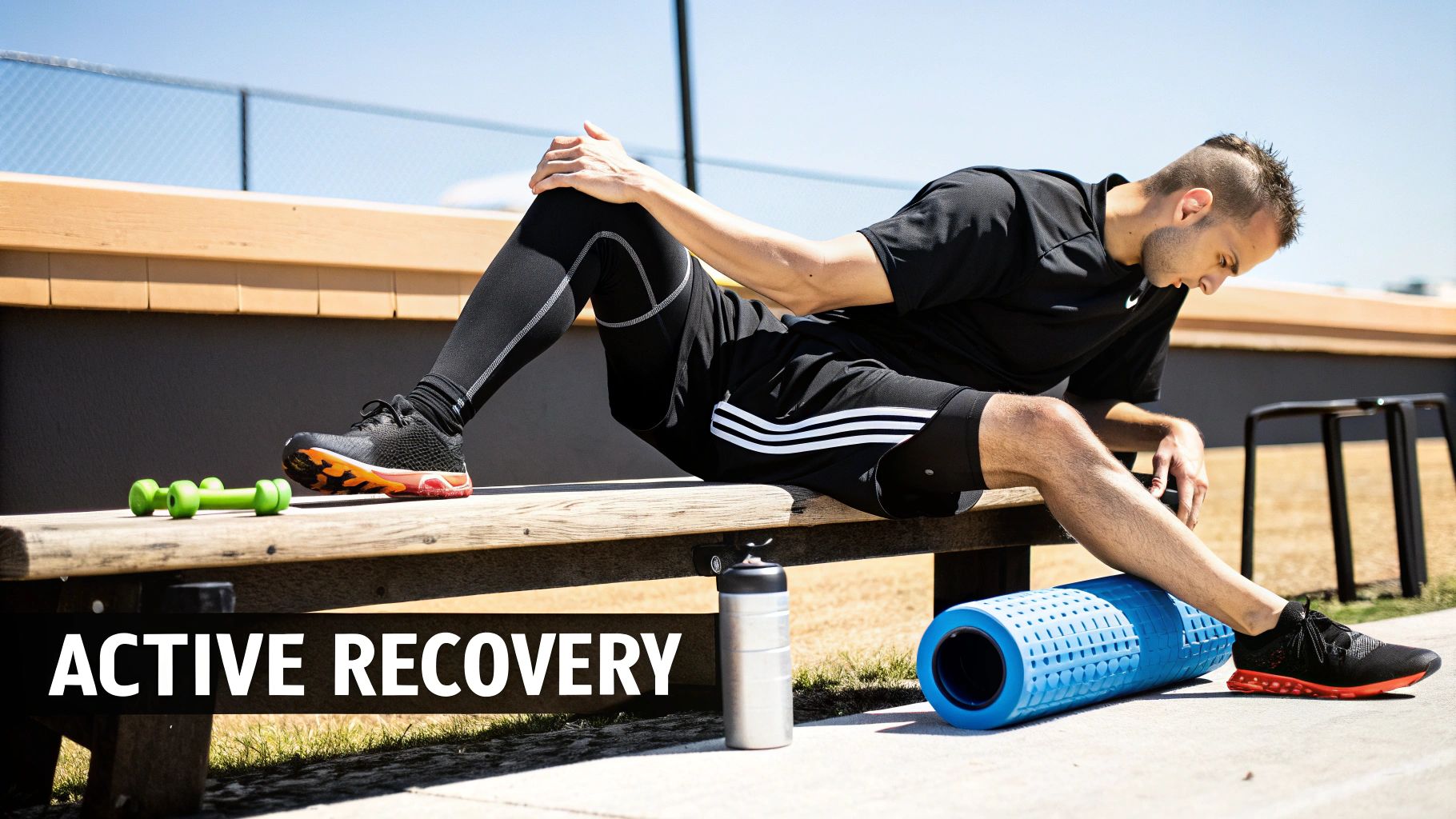
The Pillars of Smart Recovery
You can't out-train a poor recovery strategy. Effective recovery rests on a few key pillars that work together to keep your body in optimal condition. Prioritizing them is non-negotiable for anyone serious about staying in the game.
These foundational habits are your first line of defense against the cumulative wear and tear that leads to chronic issues.
- Quality Sleep: This is when your body does most of its heavy lifting for repair. During deep sleep, growth hormone is released, which is critical for rebuilding damaged muscle fibers. Aim for 7-9 hours of solid, high-quality sleep a night.
- Strategic Nutrition: Food is fuel, but it's also medicine. You need a balance of protein to repair muscles, carbs to restock your energy stores, and healthy fats to fight inflammation. Anti-inflammatory foods like leafy greens, berries, and fatty fish can give your recovery a serious boost.
- Consistent Hydration: Even mild dehydration can wreck your performance. It impairs muscle function, slows down nutrient delivery, and dramatically increases your risk of cramps and strains. Staying hydrated keeps your joints lubricated and your muscles firing correctly.
Mastering these basics creates an internal environment that promotes healing and makes you more resilient. It’s also crucial to understand how to prevent overtraining, which is a major driver of injuries that we often see.
Active Recovery and Professional Support
Beyond the basics, active recovery techniques can accelerate the healing process and ease next-day muscle soreness. These methods increase blood flow to tired muscles, which helps flush out metabolic waste and bring in fresh, oxygenated blood.
A few simple yet powerful tools to have in your arsenal:
- Foam Rolling: Think of this as self-massage. It helps break up knots in your muscles and connective tissues, improving flexibility and cutting down on soreness.
- Light Stretching: Gentle static stretching after your cool-down helps restore muscles to their normal resting length and improves your overall range of motion.
- Low-Intensity Activity: On your "off" days, think movement, not intensity. A walk, a swim, or a light bike ride promotes circulation without adding more training stress.
Recovery isn't a sign of weakness; it's the signature of a smart, sustainable athletic career. The best athletes understand that rest is a weapon that sharpens their performance and shields them from injury.
This is also where professional care from a trusted local chiropractor can make a huge difference. At Hershey Family Chiropractic, we help athletes accelerate their body's natural healing processes by addressing the mechanical and neurological stress that builds up from intense training.
Here’s how our chiropractic care can elevate your recovery:
- Chiropractic Adjustments: These restore proper joint motion and optimize nervous system function. When your body's communication pathways are clear, recovery happens more efficiently, providing headache relief and reducing neck pain.
- Therapeutic Massage: Targeted massage therapy can relieve deep muscle tension, improve circulation, and speed up the removal of metabolic waste.
- Advanced Therapies: We also offer services like spinal decompression and soft-tissue treatments for stubborn injuries, helping you bounce back faster.
By integrating professional chiropractic care in Hershey into your recovery routine, you can address minor issues before they become sidelining problems. This proactive partnership is key to staying consistently ready to perform at your best.
When to See a Chiropractor in Hershey, PA
As an athlete, you learn to live with a certain amount of discomfort. Sore muscles are a badge of honor, a sign that you're pushing your limits and getting stronger. But there's a fine line between the good ache of progress and the sharp warning of an injury.
Knowing how to tell the difference is one of the most important skills you can develop. Pushing through the wrong kind of pain is a classic mistake that can turn a small, fixable issue into a frustrating, season-ending problem. If you're active and training in the Hershey area, it’s critical to listen when your body sends up a red flag.
Recognizing the Red Flags
Don't just write off persistent pain as "part of the game." Your body is trying to tell you something isn't right. It's time to schedule a consultation with a chiropractor if you notice any of these signs:
- Pain That Lingers: If that "soreness" hasn't faded after 48-72 hours of rest and active recovery, it's not just fatigue.
- Sharp, Sudden Pain: Any stabbing or shooting pain during a specific movement is a major warning. Stop what you're doing immediately.
- Noticeable Drop in Performance: Are you suddenly weaker on a specific lift? Is your mile time getting slower despite training? An unexplained drop in performance often points to an underlying issue.
- Pain That Worsens with Activity: Discomfort should ease up as you warm up. If it gets worse the more you move, that’s a clear signal of a potential injury.
What to Expect at Hershey Family Chiropractic
Walking into a new doctor's office can be intimidating, especially if you've never seen a chiropractor before. Our first priority is to make the process clear, comfortable, and focused on you. Your first visit with us isn't about getting a quick crack and being sent on your way; it's about building a complete picture of your health, your sport, and your goals.
Our team—Dr. Davis, Dr. Epstein, and Dr. Tressler—always starts with a comprehensive evaluation. We won't just ask, "Where does it hurt?" We want to hear your story. We'll talk about your training schedule, the demands of your sport, and what you're trying to achieve. From there, we'll dive into a thorough assessment of your movement, posture, and biomechanics to find the root cause of the problem.
Your body is an interconnected system. Pain in your knee might actually start with an imbalance in your hip or a stability issue in your lower back. Our job is to connect those dots to create a plan that delivers lasting results.
We'll put together a personalized game plan that goes beyond just chasing the immediate pain. The real goal is to correct the underlying dysfunction so the problem doesn't keep coming back. This patient-first approach is the core of how we serve athletes in our community. You can get a better feel for our philosophy and see why so many local athletes and active families trust us as the sports chiropractors near me in Central Pennsylvania.
Ultimately, our mission is simple: to get you back to doing what you love, feeling stronger and more confident than before.
Answering Your Questions About Injury Prevention
When it comes to preventing sports injuries, we hear a lot of the same questions from active folks around Hershey. Let's clear up some of the most common ones.
Do I Have to Be Hurt to See a Sports Chiropractor?
Not at all. In fact, we’d much rather see you before something goes wrong.
Many of the athletes we work with in Central PA come in for proactive care to stay ahead of the game. We use functional movement screenings to spot and fix little imbalances long before they have a chance to turn into full-blown injuries. Think of regular adjustments as a tune-up for your body—they improve joint mobility and help your nervous system fire on all cylinders, which is a powerful way to build resilience.
How Can a Spinal Adjustment Help My Knee or Shoulder?
It's a great question, and the answer comes down to how your body is wired. Your spine is the superhighway for your nervous system, which controls every single muscle and joint you have.
If there's a misalignment in your spine, it can create "static" on the line, disrupting nerve signals to your limbs. This can lead to muscle weakness or faulty movement patterns you don't even notice. By ensuring your spine is aligned and your nervous system is communicating clearly, we help your entire body function as a single, coordinated unit. This takes a ton of unnecessary strain off joints like your knees and shoulders.
Proactive care is all about optimizing your body's function to build resilience. It's not just about fixing what's broken; it's about making sure the system is strong enough to avoid breaking in the first place.
What Kind of Athletes Do You See at Your Hershey Clinic?
We work with a huge range of active people, from high school athletes trying to make the varsity team to weekend warriors, dedicated runners, and avid golfers. We also offer specialized services like prenatal chiropractic care for expecting mothers and pediatric chiropractic for young athletes.
There’s no one-size-fits-all approach here. Every person gets a plan tailored to their specific sport, body, and goals. Whether you're trying to finally get rid of that nagging ache or you want to shave a few seconds off your personal best, we're here to help you get there.
Ready to build a more resilient body and stay in the game you love? The team at Hershey Family Chiropractic is here to create a personalized injury prevention plan that truly works for you. Schedule your appointment online today and take the first step toward peak performance.