
If you're dealing with nagging neck strain from hunching over a desk or a persistent backache that's become a part of your daily life here in Hershey, PA, you're not alone. Poor posture is a common problem, but finding a real solution can feel overwhelming. Many of our neighbors in Central Pennsylvania get stuck in a frustrating cycle—trying generic stretches or buying gadgets, only to have the discomfort creep right back in.
This guide is your starting point for real, sustainable change. We'll move beyond quick fixes to give you a practical plan you can start today. Here at Hershey Family Chiropractic, our team—Dr. Jennifer Davis, Dr. Jenifer Epstein, and Dr. Leanne Tressler—sees firsthand how our community's lifestyle contributes to these issues. From long commutes to hours spent at a desk, the result is often back pain, neck strain, and chronic headaches. This guide will empower you with tools to check your posture and effective exercises to start correcting it, while also showing how professional chiropractic care can deliver faster, more durable relief.
The Growing Concern Over Posture
Poor posture is more than just a bad habit; it's a significant health issue affecting millions. The global market for posture correction products was valued at a staggering USD 1.7 billion in 2024 and is expected to climb to USD 3.1 billion by 2030. This explosive growth reflects how our modern, sedentary lives and endless screen time are impacting our spines.
It’s not just adults, either. Conditions like Scheuermann’s kyphosis, a developmental spine abnormality often linked to poor posture, affect up to 8% of children in the U.S. You can discover more insights about this growing market and its implications.
Fixing your posture isn't just about "sitting up straight." It’s a process that involves understanding your current alignment, taking daily action with smart adjustments and targeted exercises, and knowing when to see a chiropractor in Hershey, PA, to correct the underlying spinal issues.
This flowchart breaks down the straightforward process for correcting posture, moving from an initial self-check to building proactive habits and, when needed, getting professional guidance.
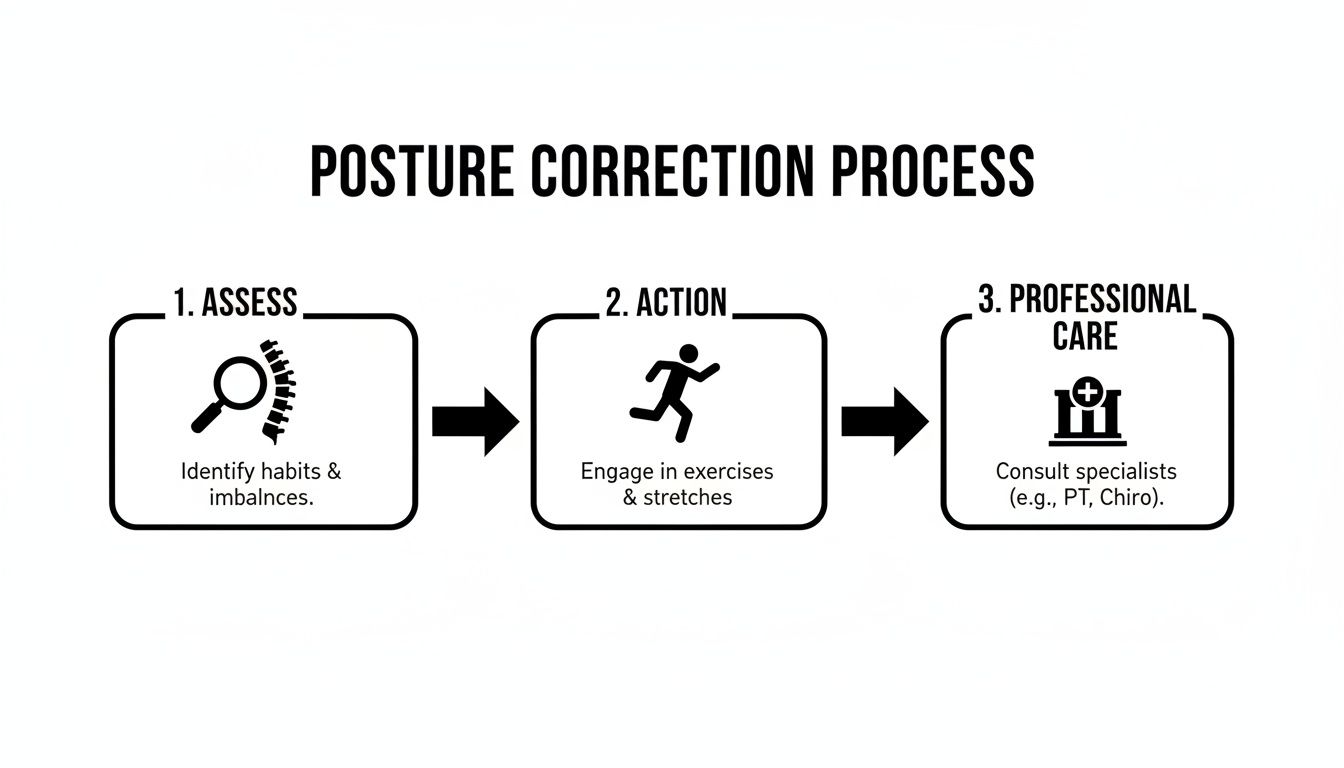
Lasting improvement comes from a structured approach, not just random exercises you do when you remember.
Why a Personalized Plan from Your Hershey Chiropractor Matters
Everyone’s body is different. A one-size-fits-all approach to posture correction often fails because the forward head position from phone use requires a different strategy than the lower back arch from standing all day. An effective plan must consider your specific imbalances, which is where professional guidance becomes invaluable. As your local chiropractors in Hershey, PA, we don't just treat symptoms; we diagnose the root cause of your postural problems to provide lasting relief from back and neck pain.
Your posture is a direct reflection of your spinal health. Correcting it involves retraining muscles, realigning joints, and creating healthier movement patterns that support your body for the long haul.
We build personalized care plans that get to the heart of the issue, which might include:
- Chiropractic Adjustments: To restore proper motion and alignment to vertebrae in your neck and back that have become "stuck," helping with everything from back pain to sciatica.
- Targeted Rehabilitation: Specific exercises designed to strengthen weak, overstretched muscles and release tight, overworked ones, creating a stable support system for your spine.
- Lifestyle Recommendations: Practical, real-world advice on ergonomics for your workspace and daily habits to stop postural strain from returning.
This comprehensive method ensures you not only feel better quickly but also build the foundation for a healthier, more active life right here in the Hershey area.
Simple Posture Checks You Can Do at Home
Before you can fix a problem, you have to understand it. These quick at-home checks require no special equipment and will give you powerful insights into your alignment. This isn’t about self-criticism; it's about gathering the information you need to move forward with a real plan. By becoming aware of these imbalances, you can start connecting them to the symptoms you feel every day.
Let's walk through three easy assessments you can do right now.
The Wall Test for Spinal Curves
One of the fastest ways to check your natural spinal curves is the wall test. It helps you see if you have an excessive arch in your lower back (a common cause of back pain) or if your head is drifting too far forward.
Find a flat wall and stand with the back of your head, your shoulder blades, and your glutes touching it. Your heels should be about two to four inches away from the wall. Now, slide your hand into the space behind your lower back.
Ideally, there's just enough room for your hand. If there’s a large gap, it might point to an excessive curve, or lordosis. If there’s no space at all, that can signal other alignment issues. Also, pay attention to your head. If you have to tilt your chin up to make contact, that's a classic sign of forward head posture, a major contributor to neck pain and headaches.
The Mirror Test for Symmetry
While our bodies are never perfectly symmetrical, significant imbalances often signal underlying postural strain. The mirror test is a fantastic way to spot these issues.
Stand in front of a full-length mirror and relax. Now, take a quick visual inventory:
- Are your shoulders level?
- Is your head tilted?
- Are your hips at the same height?
- Do your arms hang evenly?
Next, turn to the side. Imagine a plumb line dropping from your ear. In ideal alignment, it should pass through your shoulder, hip, just behind your kneecap, and slightly in front of your ankle. Most people are surprised to find their ear is far in front of their shoulder, another sign of forward head posture.
Common Postural Problems and Their Telltale Signs
| Postural Problem | What to Look For (Self-Check) | Common Symptoms You May Feel |
|---|---|---|
| Forward Head Posture | Ear is significantly forward of the shoulder line (side view). | Neck pain, tension headaches, upper back stiffness. |
| Rounded Shoulders | Shoulders slump forward, creating a hunched appearance. | Shoulder pain, tightness in the chest, mid-back ache. |
| Anterior Pelvic Tilt | Excessive curve in the lower back (large gap in wall test). | Lower back pain, tight hip flexors, weak glutes. |
| Uneven Shoulders/Hips | One shoulder or hip is visibly higher than the other (mirror test). | One-sided back or neck pain, feeling "unbalanced." |
This table is a starting point for becoming more aware of how your body's alignment might be affecting your daily comfort.
The Seated Check for Desk Workers
If you spend your day at a desk, your seated posture is a massive factor in your spinal health. Sit down as you normally would. Your feet should be flat on the floor, with your knees at a 90-degree angle. Are you slumped forward in a “C” shape, or perched on the edge of your seat with an arched back?
Notice your head and neck. Is your chin jutting toward your monitor? This "tech neck" position puts incredible strain on the cervical spine and is a primary driver of the neck pain and headaches we treat in patients here in Hershey every day. Even if you aren't in pain now, this misalignment can cause future problems. Learn more by reading our article on why poor posture is a problem even without pain.
Key Takeaway: These self-checks provide a baseline. Seeing an uneven shoulder or confirming forward head posture helps you understand the specific areas that need attention, turning a vague goal into a clear, actionable plan.
Building a Foundation with Daily Habits and Ergonomic Fixes
Lasting posture improvement is built on small, consistent changes. The self-checks give you awareness; these habits and ergonomic fixes are where you start retraining your body and taking pressure off your spine. Think of this as creating a supportive environment for your body, whether you're at your desk in Hershey or driving around town.
Optimizing Your Workstation for Spinal Health
For many of us in the Hershey area, a desk is where we spend a huge portion of our day. An unsupportive workstation constantly pulls your body out of alignment. A few simple adjustments can make a world of difference. Your goal is to create a setup that encourages a neutral spine, where your ears are aligned over your shoulders, and your shoulders are over your hips.
Here’s how to dial in your workspace:
- Monitor Height is Key: The top of your screen should be at or slightly below eye level. Use a monitor stand or a stack of books to get it right and avoid "tech neck."
- Support Your Lower Back: Your chair should have good lumbar support. If not, a rolled-up towel or small cushion in the curve of your lower back can prevent slouching.
- Mind Your Arms and Wrists: Your elbows should be at a 90-degree angle, with your keyboard and mouse close enough that you aren't reaching forward and rounding your shoulders.
Mindful Movement Beyond the Desk
Poor posture isn't just a 9-to-5 problem. Becoming mindful of your alignment during everyday activities is what builds healthier habits that stick. Think about how you use your phone—most of us look down, stressing our necks. Instead, try lifting your phone to eye level. This small change dramatically reduces spinal strain.
Poor posture isn't just an aesthetic issue; it's a major health concern. In the U.S., nearly 30% of the population grappled with lower back pain and spine issues in 2024. This problem often starts young, with conditions like Scheuermann’s kyphosis, or 'hunchback,' affecting up to 8% of American kids. You can read the full research about these posture trends to understand the scale of the issue.
Practical Tips for Everyday Activities
Driving Your Car
Your car seat can be just as problematic as an office chair. Adjust your seat so your knees are slightly lower than your hips. Sit all the way back, ensuring your lower back is supported, and adjust the headrest so the middle of it is level with the top of your ears to prevent your head from jutting forward.
Sleeping Positions
The way you sleep impacts your spine for hours every night.
- If you sleep on your back: Place a small pillow under your knees to maintain the natural curve of your lower back.
- If you sleep on your side: Tuck a pillow between your knees to keep your hips, pelvis, and spine aligned.
- Avoid sleeping on your stomach: This position forces you to twist your neck and can flatten your spine's natural curve.
By making these small, conscious adjustments, you begin to rewire your muscle memory and teach your body to hold a healthier, more balanced position—the first step toward lasting pain relief.
Targeted Exercises for Mobility and Strength
Now that you’ve laid the groundwork with smarter habits, it’s time to retrain your body. Correcting poor posture isn’t just about sitting up straight; it’s about restoring balance between muscles that have become tight and those that have grown weak.
This section provides practical, targeted exercises to fix common muscle imbalances. We'll start by unlocking tightness with mobility work, then move to strengthening the key postural muscles that will help you hold a healthier alignment effortlessly.

Unlocking Tightness with Mobility Work
Years of slouching can shorten muscles in the chest and hips. These mobility drills gently lengthen those tissues, allowing your body to return to a more neutral position.
Chest Opener (Doorway Stretch)
This is one of the best ways to counteract the rounded shoulders that come from desk work.
- Stand in a doorway and place your forearms on the frame, with your elbows bent at a 90-degree angle, just below shoulder height.
- Gently step forward with one foot until you feel a comfortable stretch across your chest.
- Hold for 30 seconds while breathing deeply. Repeat 2-3 times.
Hip Flexor Release (Kneeling Lunge)
Sitting all day shortens the hip flexors at the front of your hips, a major contributor to lower back pain.
- Kneel on one knee on a soft surface. Your other foot is flat on the floor in front of you, knee bent at 90 degrees.
- Keeping your back straight, gently tuck your pelvis under. You should feel a stretch in the front of the hip on your kneeling leg.
- Hold for 30 seconds on each side, repeating 2-3 times.
A common mistake is leaning too far forward. The key is the pelvic tuck; this isolates the hip flexor and protects your spine.
Building a Stronger Foundation with Strengthening Exercises
Once you’ve regained mobility, the next step is to strengthen the muscles that hold you upright. These are often the "forgotten" muscles of the upper back, core, and glutes. Dynamic movements like Posture Kicks can also help build control and improve posture.
Activating Your Upper Back
Wall Angels
This move improves mid-back mobility and strengthens the muscles between your shoulder blades.
- Stand with your back flat against a wall. Your head, shoulder blades, and butt should all touch the surface.
- Bring your arms up against the wall into a "goalpost" position, elbows bent at 90 degrees.
- Slowly slide your arms up the wall, keeping your wrists and elbows in contact. Only go as high as you can without your lower back arching.
- Slide your arms back down. Aim for 10-12 repetitions.
Band Pull-Aparts
This exercise targets crucial muscles for shoulder stability and posture.
- Stand tall, holding a light resistance band with both hands, palms down, arms straight out at shoulder height.
- Keeping your arms straight, pull the band apart by squeezing your shoulder blades together.
- Hold the squeeze, then slowly return. Do 12-15 repetitions.
Strengthening Your Core and Glutes
Plank
The plank engages your entire core without stressing your spine.
- Get into position on your forearms and toes, keeping your body in a straight line from head to heels.
- Engage your core and squeeze your glutes. Don't let your hips sag or rise.
- Hold for 20-30 seconds, working your way up to a minute.
Glute Bridges
This exercise "wakes up" glute muscles weakened by sitting.
- Lie on your back with knees bent and feet flat on the floor.
- Squeeze your glutes and lift your hips until your body forms a straight line from your shoulders to your knees.
- Hold, then slowly lower. Aim for 15-20 repetitions.
Consistently incorporating these exercises will retrain your muscles to support a healthier, more comfortable posture automatically.
How a Chiropractor in Hershey Accelerates Your Recovery
While better habits and exercises are foundational, sometimes they aren't enough. If you’ve hit a plateau or nagging pain persists, it’s a sign that deeper structural issues are holding you back. This is where seeing a chiropractor near you becomes essential for lasting change.
At Hershey Family Chiropractic, we don’t just treat your symptoms. We use expert diagnostics and hands-on therapies to get to the root cause of your poor posture. Our goal as your local back pain and neck pain chiropractor is to speed up your recovery so your exercises and new habits can finally work.
Chiropractic Adjustments Restore Your Foundation
Years of slouching can cause spinal joints to become restricted or "stuck." Chiropractic adjustments are the key to unlocking these dysfunctional joints. Using precise, gentle force, our doctors restore proper motion, which:
- Improves spinal alignment, taking pressure off compressed nerves that can cause issues like sciatica.
- Eases inflammation and reduces pain signals.
- Allows your muscles to function correctly, making your exercises far more effective.
Think of it this way: you can't build a straight house on a crooked foundation. Until your spine moves correctly, your muscles can't hold you in the right position.
A Personalized, Multi-Faceted Approach to Care
We know every patient here in Hershey is different. That’s why we build a care plan just for you, often combining several powerful therapies.
Your body has an incredible capacity to heal and adapt. Our job is to remove the interference—the misalignments and muscle imbalances—so you can retrain your posture on a solid, functional foundation.
Depending on what you need, your plan might include:
- Therapeutic Massage: To release deep-seated muscle tension and knots that pull your skeleton out of alignment.
- Targeted Rehabilitation: We'll guide you through specific exercises in our office to ensure perfect form and activate the right muscles.
- Shockwave Therapy: For stubborn, chronic pain points, this advanced technology breaks up scar tissue and jump-starts healing.
This combined approach addresses both the structural (your joints) and muscular (your soft tissues) components of your posture problem. For anyone struggling with persistent discomfort, check out our guide on relieving lower back pain naturally for more insights.
What to Expect on Your First Visit
Your journey begins with a thorough evaluation. We'll listen to your concerns, review your health history, and perform a detailed physical and postural exam to understand what’s causing your pain. We analyze your movement patterns to pinpoint specific areas of spinal restriction and muscle imbalance. From there, we’ll explain our findings in simple terms and lay out a personalized care plan. You’ll leave your first visit with a clear understanding of your condition and the exact steps we’ll take together to fix it.
The demand for posture solutions is clear: the posture correction market in the U.S. was worth USD 505.1 million last year. For Hershey locals, fixing poor posture starts with professional care that gets to the root of the problem. You can learn more about these posture findings and see why expert intervention is so critical.
Your Posture Correction Questions Answered
Deciding to fix your posture is a huge step, but it's normal to have questions. To provide clarity and confidence, the expert doctors at Hershey Family Chiropractic have answered some of the most common concerns we hear from our patients in the community. Our goal is to give you trustworthy information so you feel empowered to move toward a life with less pain.
How Long Does It Take to Fix Poor Posture?
There’s no magic number. For minor habits, you could see a difference in a few weeks as you build awareness and retrain your muscle memory.
However, for deep-rooted posture issues that have caused chronic pain and significant muscle imbalances, lasting change can take several months. At Hershey Family Chiropractic, we map out a realistic timeline based on your specific condition. We're focused on retraining your body for a lifetime of good posture, not a temporary fix.
Can Chiropractic Adjustments Alone Fix My Posture?
Chiropractic adjustments are vital. They restore proper joint motion and spinal alignment—something you can't achieve alone. When your joints are stuck, the surrounding muscles can't function correctly.
But adjustments are most powerful as part of a complete strategy. The adjustment corrects the structure, and therapeutic exercises strengthen the muscles needed to hold that new, healthier alignment. Here at our Hershey clinic, we combine precise adjustments with personalized rehab to ensure your results are stable and long-lasting.
Your posture is a direct reflection of your spinal health. Chiropractic care corrects the spinal framework, and targeted exercises build the muscular support needed to maintain it. The combination is what creates true, sustainable change.
Is It Normal to Feel Sore After Posture Exercises?
Yes, mild muscle soreness is completely normal when you start using underworked postural muscles. It’s a sign that they are adapting and getting stronger. The feeling is usually a dull ache that fades within 48 hours.
However, you should never feel sharp, stabbing, or radiating pain. That's a red flag to stop immediately. If you experience that kind of discomfort, let your chiropractor know right away so we can modify your program.
Should I See a Chiropractor If I Do Not Have Pain?
Absolutely. Pain is often the last symptom to appear, long after a problem has started. Poor posture places constant stress on your spine, nerves, and muscles for years before you feel anything.
Think of it like a misaligned tire on your car—it wears down unevenly, but you don't notice the damage until the tire finally goes flat.
Addressing these imbalances proactively is the smartest way to prevent them from becoming serious issues like chronic neck pain, debilitating headaches, or disc problems. A postural assessment at our Hershey office is the best kind of preventative maintenance for your spine.
Are you ready to stop letting poor posture and pain dictate how you feel? The dedicated team at Hershey Family Chiropractic is here to provide the expert care and personalized guidance you need to stand taller and live pain-free. If you've been searching for a "chiropractor near me" who truly understands your needs, look no further. Schedule your appointment today and take the first step toward a healthier future.
