
When you first feel that sharp, nagging ache on the outside of your elbow, your first thought might be to power through it. But with tennis elbow, that’s often the last thing you should do. For many of our patients here in Hershey, the path to natural recovery begins with a simple, effective approach: giving the overworked tendon a break.
This means dialing back on the activities causing the strain, using immediate self-care like ice, and making smart adjustments to how you move. At Hershey Family Chiropractic, we guide our community through this process, focusing on calming the inflammation and giving those overused tendons the support they need to heal without relying on medications or invasive procedures. If you're looking for a chiropractor near me to help with elbow pain, you've come to the right place.
Understanding Tennis Elbow: A Local Perspective
If you’ve got that persistent pain on the outer part of your elbow, you're not alone. Here in Hershey, we see this condition frequently—not just in tennis players, but in office workers, carpenters, and anyone who repeatedly uses their forearm muscles. Known as lateral epicondylitis, it’s a repetitive strain injury caused by tiny tears in the tendons that connect your forearm muscles to your elbow.
The pain often comes with a surprisingly weak grip, making simple tasks like turning a doorknob or holding a coffee cup feel like a major effort. While it’s tempting to think this frustrating condition requires complex medical intervention, your body is remarkably good at healing itself when given the right professional support from a trusted chiropractor in Hershey, PA.
Why Natural, Conservative Care is So Effective
Patience is your best friend when it comes to tendon injuries. Study after study confirms that simple, conservative measures are incredibly effective for long-term recovery. A landmark study in the American Family Physician found that while injections might offer a quick fix, patients who chose physical therapy or a “wait-and-see” approach had much better, more permanent results after one year.
This highlights why a natural, chiropractic approach is such a powerful strategy. It focuses on true healing by addressing the root cause, not just temporarily masking the pain.
This infographic breaks down the crucial first steps you can take at home.
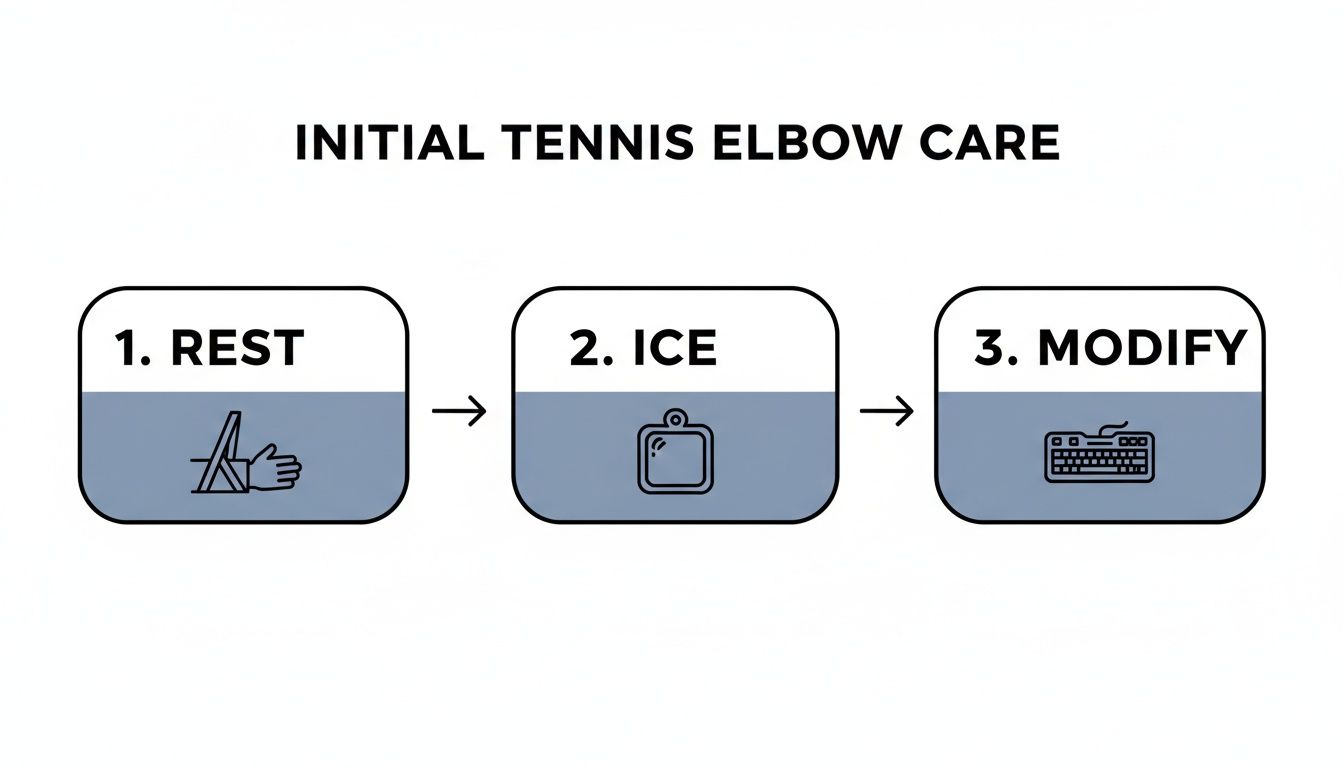
As the visual shows, healing begins when you reduce stress on the injured tendon. That means rest, ice, and modifying your activities are non-negotiable first steps.
Building a Foundation for Healing
The goal of natural treatment is to create the perfect environment for your tendons to repair themselves. This isn't a passive process. It requires a proactive plan that tackles both the symptoms and the root causes of the strain.
Common symptoms of tennis elbow include:
- A distinct pain or burning sensation on the outside of your elbow.
- A grip that feels noticeably weaker than usual.
- Pain that worsens when you use your forearm—shaking hands, using a screwdriver, or lifting objects.
Since tennis elbow is a specific type of tendonitis, it helps to understand the general principles for healing these injuries. For a broader overview, this guide on natural ways to treat tendonitis offers valuable insights.
Below is a quick reference guide for immediate self-care.
Immediate Self-Care Steps for Tennis Elbow Relief
| Action | How It Helps | Frequency/Duration |
|---|---|---|
| Relative Rest | Reduces ongoing strain and prevents further micro-tears in the tendon. | Avoid aggravating activities for 24-72 hours. |
| Ice Application | Constricts blood vessels to decrease inflammation and numb acute pain. | Apply an ice pack for 15 minutes, several times a day. |
| Activity Modification | Prevents re-injury by changing how you perform tasks (e.g., using two hands to lift). | Ongoing; focus on ergonomics and mindful movement. |
| Gentle Motion | Encourages blood flow and prevents stiffness without stressing the tendon. | Perform pain-free wrist and elbow range-of-motion exercises daily. |
These simple actions are your first line of defense. They calm the immediate irritation and set the stage for deeper healing.
At Hershey Family Chiropractic, our job is to guide you through this natural healing process. Our team—Dr. Jennifer Davis, Dr. Jenifer Epstein, and Dr. Leanne Tressler—helps pinpoint the exact movements contributing to your pain. We then build a personalized plan to restore function and get you back to your life in Hershey, pain-free.
Understanding muscle and tendon strains is key to a full recovery. To dive deeper, you can learn more about the best treatment for muscle strain in our article. Combining smart self-care with professional guidance is the most effective path to lasting relief.
How Chiropractic Care Helps You Move Smarter
True healing from tennis elbow isn't just about what you stop doing; it's about changing the repetitive motions that caused the problem. This is where we become detectives, examining your daily habits to pinpoint which movements are overloading your forearm tendons. The goal is to give the injured tendon a real break so it can finally heal.
For many of our patients here in Hershey, these small adjustments are the real game-changers. Something as simple as repositioning your computer mouse or learning to lift a grocery bag differently can eliminate the constant strain that has been holding back your recovery.
At Hershey Family Chiropractic, this is a core part of our approach. We help you analyze your daily movements to find the specific triggers. Once we identify the culprits, we build a plan with new habits that not only get you out of pain now but also prevent it from returning.
Optimizing Your Workspace for Elbow Health
If you work at a desk, your workstation could be the primary source of your tendon strain. Poor ergonomics force your forearm muscles to work overtime for hours, day after day. A few key changes can dramatically reduce that stress.
Your goal is to create a setup where your joints can rest in a neutral, relaxed position. This minimizes muscle tension and promotes better blood flow, which is essential for healing.
Here are a few practical adjustments we often recommend to our patients working in the Hershey area:
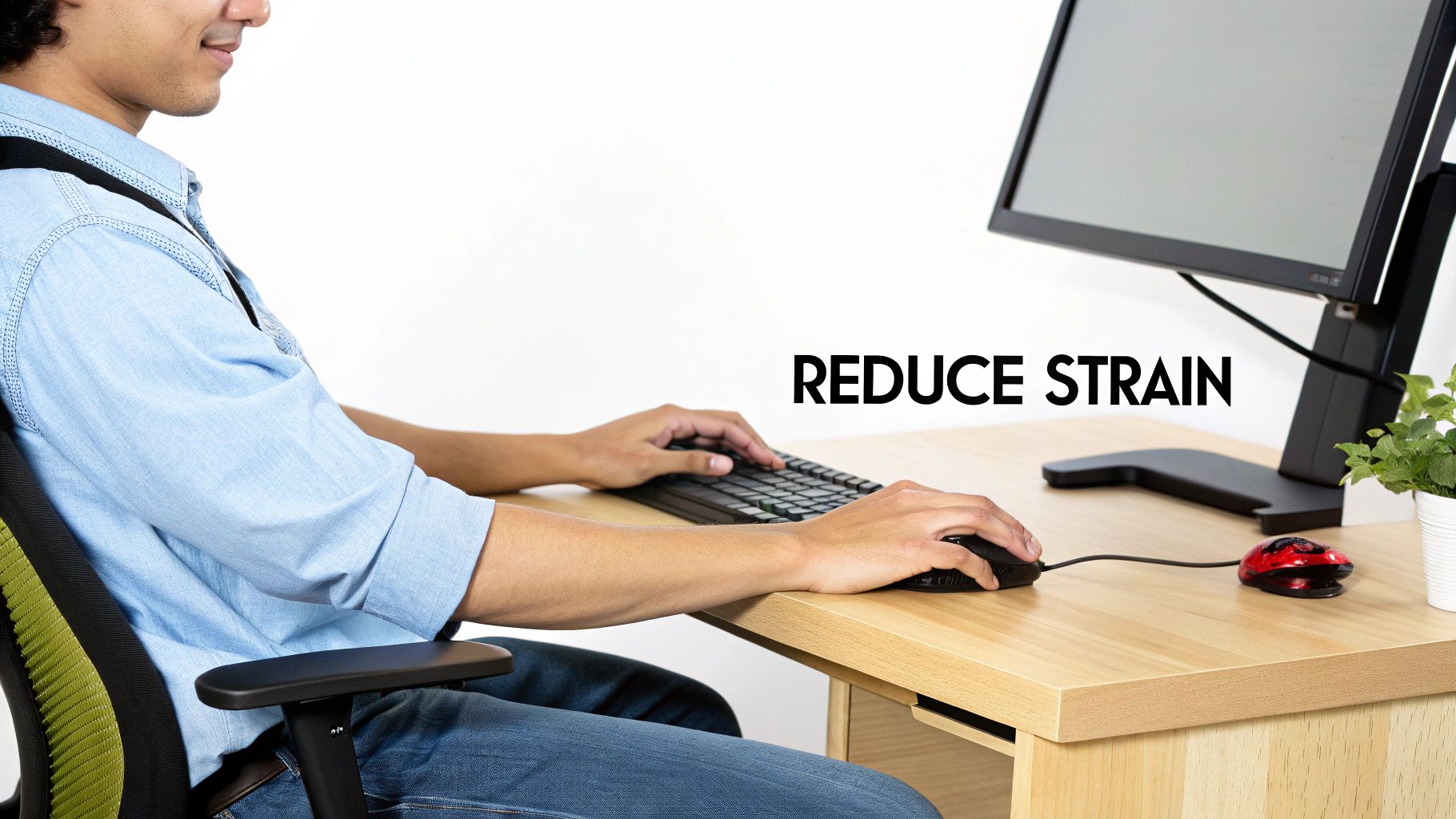
- Keyboard and Mouse Position: Your keyboard should be placed so your elbows can rest comfortably at a 90-degree angle, close to your body. Your wrists should stay straight while typing—not bent up or down. An ergonomic mouse can prevent the constant wrist extension that irritates the tendon.
- Chair Height and Posture: Adjust your chair so your feet are flat on the floor with your knees level with your hips. Sitting up straight helps your back and prevents your shoulders from rounding forward, which can create tension down your arm to your elbow. This is a common issue we address for patients seeking a back pain chiropractor.
- Embrace Micro-Breaks: Every 30 minutes, get up from your desk. Even a 60-second break to stand and stretch your arms can make a world of difference in interrupting the cumulative strain.
Modifying Manual Tasks and Athletic Activities
For athletes or anyone in a manual trade, the focus shifts to form, grip, and pacing. The repetitive, forceful movements common in sports and physical labor are classic causes of tennis elbow. Modifying how you perform these tasks is essential.
Healing requires a conscious effort to unload the injured tendon. This means temporarily avoiding forceful gripping, heavy lifting with your palm down, and repetitive twisting motions like using a screwdriver.
Making these changes not only protects the tendon while it heals but also retrains your body to move more efficiently.
Here’s how you can adapt some specific activities:
- Adjust Your Grip: Whether holding a tennis racket or a hammer, a wider grip can reduce stress on your forearm tendons. Building up the handle with tape is an easy trick. Focus on keeping your wrist firm and stable, avoiding excessive flicking motions.
- Correct Your Form: In sports, bad technique is a major contributor to injury. A tennis player using too much wrist in their backhand puts immense strain on the elbow. A session with a coach to refine your form can be a great long-term solution.
- Pace Yourself: Instead of powering through a demanding task all at once, break it into smaller chunks. Taking short breaks gives your muscles and tendons a chance to recover. Most importantly, listen to your body—if you feel pain, it’s a signal to stop and reassess.
Gentle Exercises for Strength and Flexibility
Once the initial pain has calmed down and you’ve adjusted your daily activities, it’s time to gently reintroduce movement. We need to gradually strengthen the tendon's fibers and restore its length to build resilience.
Starting a careful exercise program is the single most important step for rebuilding your forearm muscles, improving flexibility, and preventing this from becoming a recurring nightmare.
The golden rule is to start slow and listen to your body. The goal is to stimulate healing, not trigger more pain. One of the biggest mistakes we see in our Hershey practice is people pushing too hard, too soon, which can set recovery back by weeks.
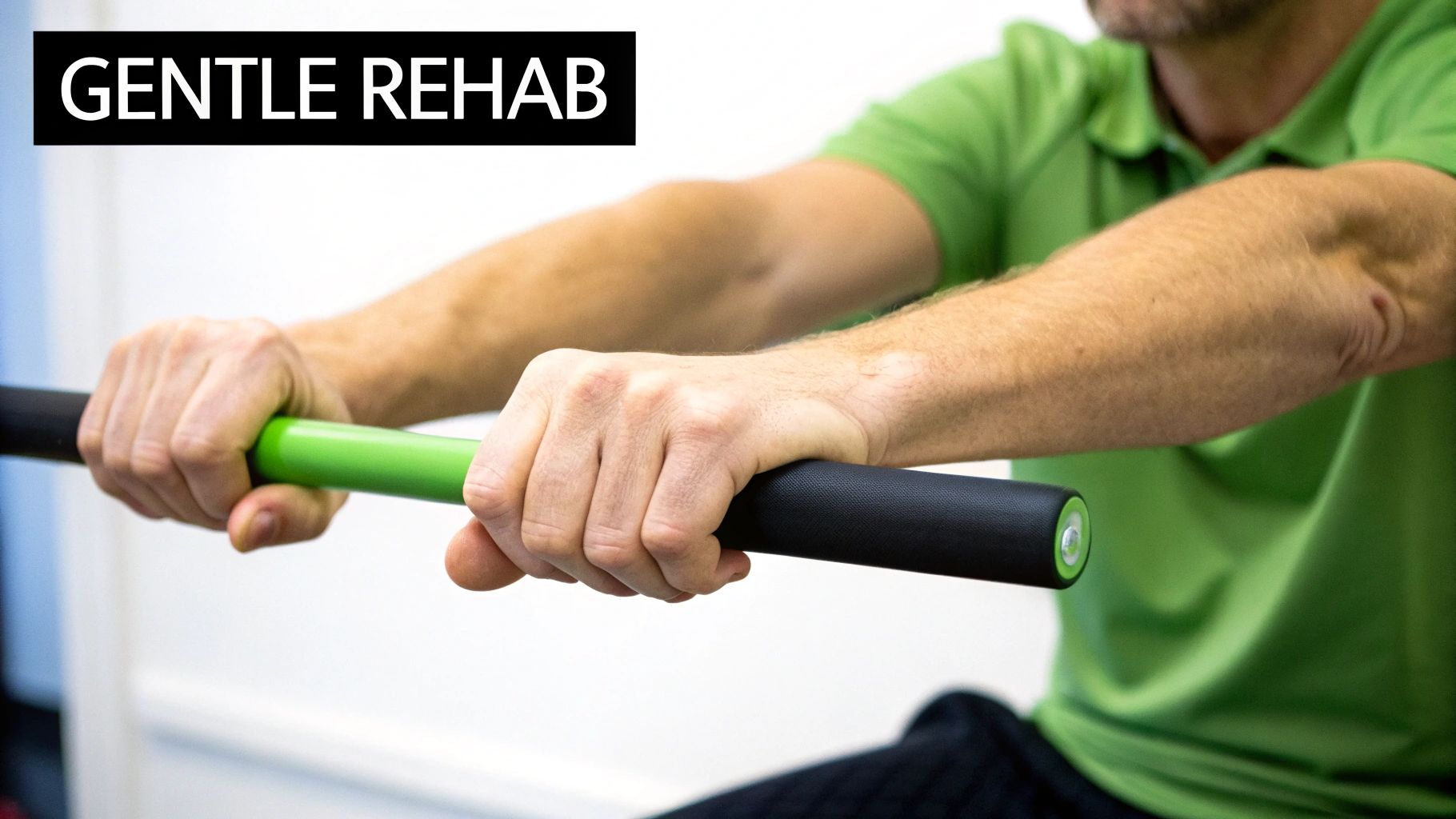
This process is about creating long-term strength and stability. Proper form is everything, which is why at Hershey Family Chiropractic, we integrate personalized exercise plans into our care.
Starting with Gentle Stretches
Before strengthening, you must restore flexibility. Chronically tight forearm muscles put constant tension on the elbow tendon. These simple stretches can be done several times a day to gently lengthen the muscles.
- Wrist Extensor Stretch: Hold your injured arm straight out, palm down. With your other hand, gently bend your wrist downward. You should feel a mild stretch on the top of your forearm. Hold for 20-30 seconds and repeat 3-4 times.
- Wrist Flexor Stretch: Extend your arm out again, but this time with your palm up. Use your other hand to gently bend your wrist down. This targets the muscles on the underside of your forearm. Hold for 20-30 seconds and repeat 3-4 times.
Remember, a stretch should feel like a release, not a strain. If you feel sharp pain, ease up.
The Importance of Eccentric Strengthening
Once the pain has faded and flexibility is improving, it's time for eccentric exercises. This type of exercise involves lengthening a muscle while it’s under tension, a key process for remodeling and fortifying tendon fibers.
The most famous eccentric exercise for tennis elbow is the "Tyler Twist," done with a flexible therapy bar.
- Hold the Bar: Grasp the bar vertically with the hand of your injured arm, keeping your wrist bent back (extended).
- Twist Up: Use your good hand to grab the top of the bar and twist it.
- Extend Arms: Straighten both arms out in front of you while holding the twist.
- Slowly Untwist: This is the key move. Slowly and with control, loosen the grip of your injured hand, letting the bar untwist. This controlled release rebuilds the tendon.
Start with one set of 15 repetitions daily and gradually work up to three sets. As you get stronger, you'll want more variety. This guide to resistance band exercises at home is a great resource for other low-impact options.
Trusting Your Body's Healing Process
It’s crucial to have confidence in your body's natural ability to repair itself. Science backs this up. Tennis elbow is often a self-limiting condition. A 2018 meta-analysis in the American Journal of Sports Medicine found that 99% of patients who received a placebo reported little to no pain after about six months.
This suggests the body is incredibly good at healing on its own, and many common treatments offered no real benefit over doing nothing.
This doesn't mean you should just wait. It means the goal of a natural approach is to create the ideal environment for your body to do its job. The exercises and stretches are a support system for your body's own repair crew.
At Hershey Family Chiropractic, we support this natural process. Our doctors guide patients through safe, progressive exercises to ensure they are helping, not hindering, recovery. By focusing on perfect form and gradual progression, we help you rebuild strength without risking re-injury. You can see how we structure these programs by learning more about our chiropractic rehab services. Our goal is to empower you with the right movements to restore function and get you back to your life in Hershey, pain-free.
Professional Chiropractic Care for Stubborn Elbow Pain
You’ve rested, iced, stretched, and changed how you lift things, but that nagging ache in your elbow just won’t let go. When self-care isn't enough, it's a sign that deeper mechanical issues are at play.
This is where professional, hands-on treatment from a chiropractor in Hershey, PA, can break the cycle of pain. At Hershey Family Chiropractic, we specialize in finding and fixing the underlying biomechanical faults that lead to chronic tendon strain. We don’t just focus on the sore spot; we look at the entire kinetic chain—from your neck and shoulder down to your wrist—to get everything working together again.
Chiropractic Adjustments for Elbow and Wrist Function
It might surprise you that a chiropractor near me in Hershey is often a key player in treating tennis elbow. The problem is frequently connected to poor joint mechanics in the elbow, wrist, and even your neck (cervical spine). When these areas are misaligned, it can irritate nerves and alter movement patterns, putting excessive stress on your forearm tendons.
Our doctors perform gentle, specific adjustments to restore proper joint motion. If the small carpal bones in your wrist are restricted, your forearm muscles are forced to overcompensate, leading directly to overuse and pain.
- Elbow and Wrist Adjustments: We use targeted manipulations to improve joint mobility and take pressure off the tendon's attachment point.
- Spinal Adjustments: By correcting misalignments in the neck, we can relieve nerve compression that may contribute to arm pain and weakness—a common complaint for those seeking a neck pain chiropractor or upper cervical chiropractor.
By optimizing how the entire arm functions, we help unload that overworked tendon so it can finally heal.
Advanced Soft Tissue and Massage Therapy
Chronic tendon injuries almost always come with a buildup of scar tissue, or adhesions. These dense, fibrous knots restrict movement, choke off blood flow, and keep the tendon inflamed.
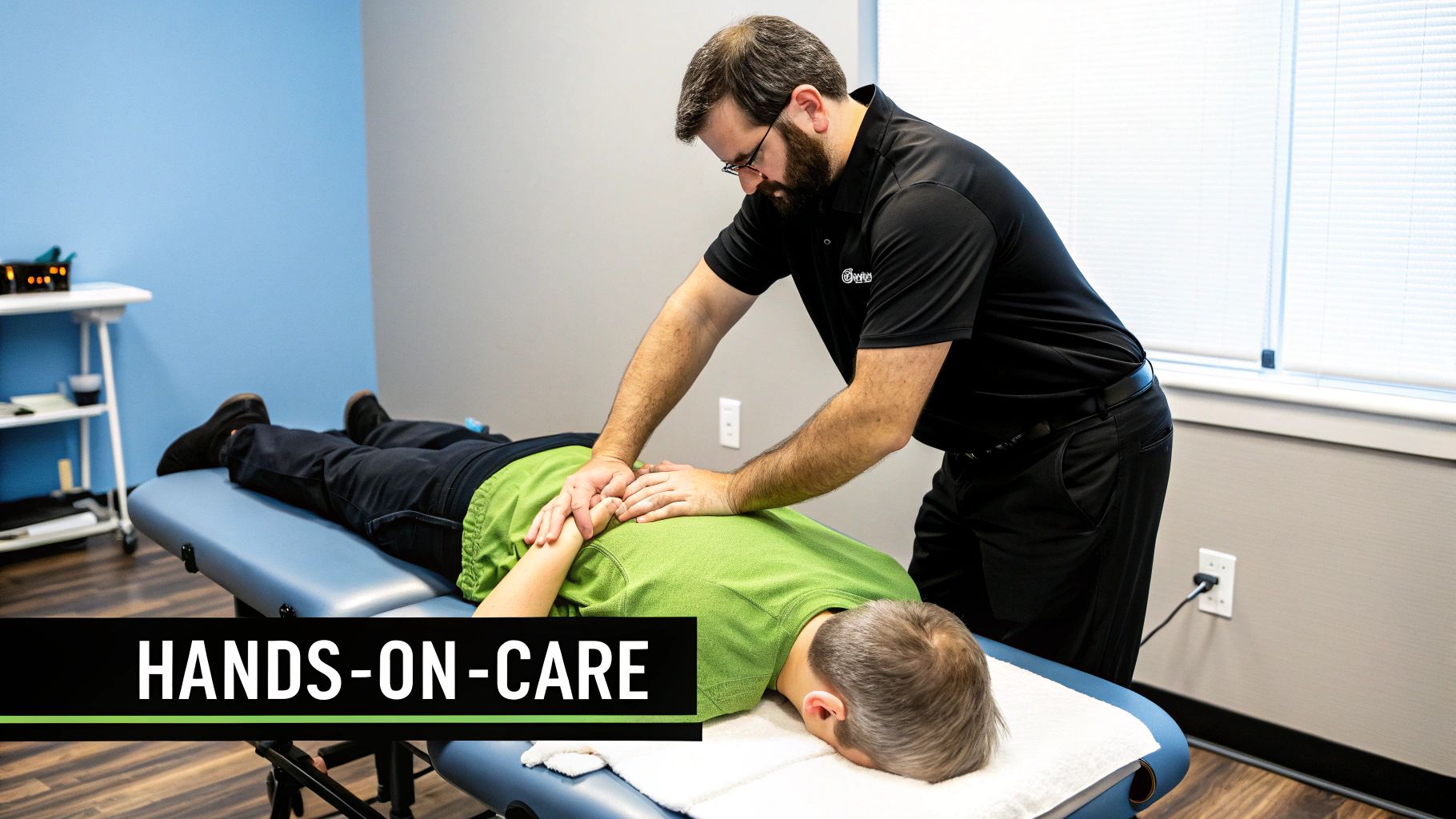
We use advanced soft tissue techniques to tackle this issue. Therapeutic massage and other manual therapies break down adhesions, smooth out muscle fibers, and dramatically improve circulation to the injured area.
More blood flow is crucial for healing. It brings in oxygen and nutrients needed to repair damaged tissue and flushes out inflammatory byproducts that cause pain and stiffness.
This hands-on work releases deep tension in the forearm muscles, often providing immediate relief and creating a healthier environment for the tendon to mend itself.
Shockwave Therapy for Persistent Cases
For stubborn cases of tennis elbow that haven't responded to other treatments, we offer Extracorporeal Shock Wave Therapy (ESWT). This non-invasive technology is a powerful tool for stimulating the body's natural healing processes.
During a session, a handheld device sends acoustic pressure waves into the injured tendon. This does two key things:
- Stimulates Healing: The shockwaves create a new, controlled inflammatory response, essentially "restarting" the healing process and encouraging the formation of new blood vessels.
- Provides Pain Relief: The waves can also have an analgesic effect, helping to dull pain by over-stimulating nerve fibers.
For anyone in the Hershey area looking for an effective, non-surgical fix for stubborn tendon pain, shockwave therapy can be a game-changer. It’s one way we provide advanced, evidence-based care to help our community get back to an active life.
Your Recovery Plan at Hershey Family Chiropractic
Deciding to seek professional care is a significant step, especially when you're in pain. At Hershey Family Chiropractic, we’ve made the process as clear, welcoming, and patient-focused as possible.
From your first visit, you’ll find a supportive environment dedicated to helping our Hershey neighbors find lasting relief. Your journey back to a pain-free life is a partnership, and we believe in empowering you every step of the way. Your recovery is unique to you.
What to Expect on Your First Visit
Your initial consultation is about discovery. We listen to your story, understand how this pain is impacting your life, and uncover the root cause. This first appointment with Dr. Davis, Dr. Epstein, or Dr. Tressler is thorough and designed to give us a complete picture of your health.
Here's what to expect:
- A Detailed Health History: We’ll discuss your symptoms, when they started, what makes them better or worse, and your daily activities here in the Hershey area.
- A Comprehensive Examination: This includes orthopedic and neurological tests to assess your arm's range of motion, strength, and nerve function. We’ll also evaluate your posture and check for related issues in your neck, shoulder, and wrist.
- Clear Communication: We explain our findings in plain language, ensuring you understand what’s going on with your elbow. We encourage questions—the more you know, the better you can participate in your healing.
From this foundation, we build a personalized care plan that makes sense for you.
At Hershey Family Chiropractic, your care plan is a collaborative effort. We combine our clinical expertise with your personal goals to create a roadmap for recovery that is both effective and sustainable. We want you to feel in control of your health journey.
Building Your Personalized Treatment Plan
Once we've identified the specific factors contributing to your tennis elbow, we design a multi-faceted treatment plan. This plan is dynamic, meaning we continually assess your progress and adjust our approach as you heal.
Our treatment plans often integrate several natural therapies:
- Chiropractic Adjustments: We use precise adjustments to restore proper movement to the joints in the elbow, wrist, and spine. Correcting these mechanical issues is key to taking pressure off the overworked forearm tendons, a core service for anyone seeking a chiropractor in Hershey, PA.
- Soft Tissue Therapy: Targeted massage and other manual therapies help break down scar tissue, release muscle tension, and improve blood flow.
- Rehabilitative Exercises: We guide you through specific stretches and strengthening exercises to rebuild tendon resilience and prevent the problem from returning.
- Lifestyle and Ergonomic Advice: We provide practical guidance on modifying daily activities—from your desk setup to your golf swing—to eliminate repetitive strain for good.
This integrated approach addresses your pain from all angles—mechanical, muscular, and functional.
Natural Treatment Options Comparison
Understanding your options is key. Below is a breakdown of the natural approaches we might use, highlighting their goals and when they are most effective.
| Treatment | Primary Goal | Best For |
|---|---|---|
| Chiropractic Adjustments | Restore proper joint mechanics and reduce nerve irritation. | Addressing underlying joint restrictions in the elbow, wrist, or spine. |
| Massage/Soft Tissue Work | Break down scar tissue, reduce muscle tension, and improve circulation. | Chronic cases with significant muscle tightness and restricted blood flow. |
| Rehabilitative Exercise | Rebuild tendon strength, improve flexibility, and prevent re-injury. | The recovery phase, after acute inflammation has subsided. |
| Ergonomic Modification | Eliminate the source of repetitive strain from daily activities. | Everyone, especially desk workers and athletes, for long-term prevention. |
By combining these strategies, we create a powerful synergy that not only relieves your immediate pain but also builds a stronger, more resilient arm for the future. Our commitment is to provide the Hershey community with the highest standard of natural, patient-centered care.
Common Questions About Treating Tennis Elbow
If you’re dealing with tennis elbow, you likely have questions. It's normal to wonder about recovery timelines, whether a brace will help, and when it’s time to see a professional. Here in Hershey, we hear these concerns from patients every day. Let's clear up some of the most common ones.
How Long Does Natural Healing for Tennis Elbow Take?
The honest answer is: it depends. The healing timeline for tennis elbow hinges on the severity of the tendon injury, how long you've had symptoms, and how consistently you stick to a recovery plan. Most people start feeling significant improvement within a few weeks to a couple of months.
However, full recovery to the point where the tendon has completely remodeled can take from six months to a year. That may sound long, but conservative, natural care has an incredibly high long-term success rate. Unlike quick fixes, this approach is about true, lasting healing.
The key to shortening that timeline? Consistency. Diligently modifying your activities, performing your exercises, and getting professional guidance from a chiropractor in Hershey, PA, to address the underlying mechanics can speed up the process dramatically.
Should I Use a Brace for My Tennis Elbow?
A brace can be a helpful tool, but it's not a cure. Think of it as a temporary sidekick to help you get through your day with less pain.
There are two main types of supports:
- Counterforce Straps: These bands are worn just below the elbow. They compress the upper forearm muscles, changing the angle of pull on the tendon and absorbing some of the force.
- Wrist Splints: These are more rigid and lock your wrist in a neutral position. They’re a game-changer for people whose pain flares up from repetitive wrist extension—like typing—because they stop the aggravating motion.
Remember that a brace is a temporary tool, not a long-term solution. It helps manage symptoms but doesn't fix the root cause. Over-reliance on a brace can even lead to muscle weakness.
Our typical advice is to wear a brace during specific, aggravating tasks but take it off during rest and while doing your rehab exercises.
When Should I See a Chiropractor for Elbow Pain?
At-home care is a powerful first step, but there are clear signs it’s time to bring in a professional. If you're nodding along to any of the following, scheduling a consultation with a chiropractor near me is a smart move.
It's time to seek professional help if:
- The pain isn't getting better—or is getting worse—after a few weeks of consistent self-care.
- Your pain is severe enough to disrupt your daily life, work, or sleep.
- You’ve noticed your grip strength has significantly and persistently weakened.
- The pain is starting to travel down your arm or up toward your shoulder.
- You're unsure if you’re doing the exercises correctly or need a structured, personalized plan.
How Can a Chiropractor Actually Help My Elbow?
It’s a fair question. Most people associate chiropractors with back pain, but our expertise covers the entire musculoskeletal system. For tennis elbow, we look at the whole kinetic chain—from your neck and shoulder down to your wrist.
An issue in one area can cause a problem somewhere else. For example, stiffness in your neck or a misaligned shoulder can alter your arm mechanics, forcing forearm muscles to overcompensate and strain your elbow. This is why just treating the elbow in isolation often fails.
Our systematic approach includes:
- Identify the Root Cause: We perform a thorough exam to pinpoint the underlying joint restrictions and muscular imbalances driving your pain.
- Restore Proper Function: Using gentle, specific adjustments to the elbow, wrist, and spine, we restore normal joint movement. This immediately takes abnormal stress off the overworked tendon.
- Support Tissue Healing: We use hands-on soft tissue techniques to break down scar tissue and improve circulation, creating the perfect environment for the tendon to repair itself.
By addressing the entire system, not just the spot that hurts, we help you achieve a more complete and lasting recovery.
At Hershey Family Chiropractic, Dr. Jennifer Davis, Dr. Jenifer Epstein, and Dr. Leanne Tressler are dedicated to finding the root cause of your elbow pain and guiding you back to an active, pain-free life. If you're ready to move beyond temporary solutions and start on the path to true healing, schedule your consultation today.
Find lasting relief and expert guidance by visiting us at https://hersheyfamilychiropractic.com.
