
When that sharp, radiating sciatica pain makes it impossible to sleep, finding a comfortable position can feel like a desperate search. The key is to reduce pressure on the sciatic nerve. Try sleeping on your back with a pillow under your knees to maintain your spine's natural curve, or on your side with a pillow between your knees to keep your hips aligned.
These small adjustments can offer immediate, significant relief, but they are often just the first step. For our patients here in Hershey, PA, our goal is to provide lasting solutions that go beyond temporary fixes, addressing the root cause of your pain.
Finding Immediate Relief for Sciatica Pain at Night
That sharp, radiating pain you feel is a common struggle for many of our patients here in the Hershey area. The good news is that you can take steps tonight to find relief from your back pain and reclaim your rest.
Sciatica often flares up when you lie down because spinal discs naturally rehydrate and expand overnight, which can increase pressure on an already irritated nerve. Your daytime movements also help circulate fluids and reduce inflammation—a process that slows dramatically when you're still.
But you don't have to just endure the pain. Making simple, strategic adjustments to your sleep setup can make a world of difference. The primary goal is to achieve a neutral spine position, where your ears, shoulders, and hips are aligned. This minimizes stress on your lower back and, most importantly, on the sciatic nerve.
The Best Sleeping Positions for Sciatica
Finding the right position is less about a single "correct" way to sleep and more about what provides relief for your body. As your local sciatica chiropractor, we recommend two positions, but the secret is using pillows strategically.
- Back Sleeping: Placing a pillow under your knees helps maintain the natural curve of your lumbar spine. This prevents it from flattening against the mattress and straining the area.
- Side Sleeping: A firm pillow between your knees is essential here. It stops your top leg from falling forward, which would otherwise twist your pelvis and stress your lower back.
This quick reference table breaks down how these positions help.
Quick Guide to Sciatica Sleep Positions
| Position | Pillow Placement | Why It Helps |
|---|---|---|
| Back Sleeper | Place one or two pillows under your knees. | Lifts the legs slightly to preserve the natural curve in your lower back, reducing strain and nerve pressure. |
| Side Sleeper | Place a firm pillow between your knees and ankles. | Keeps your top leg from sliding forward, which prevents pelvic twisting and maintains hip and spine alignment. |
| Stomach Sleeper | (Generally not recommended) If you must, place a pillow under your abdomen/pelvis. | Can help prevent the lower back from arching excessively, but this position still puts significant stress on the spine. |
These adjustments are designed to create a more supportive, neutral sleep environment, giving that irritated nerve a chance to calm down.
This visual guide shows the proper placement for pillows in both the back and side sleeping positions.
As you can see, both methods are designed to support spinal alignment and reduce nerve compression.
While these tips help manage nighttime pain, it's also important to consider your overall sleep hygiene. For broader strategies that apply to anyone struggling with rest, you can explore a great guide on how to sleep better at night.
Of course, your mattress plays a crucial role. For more personalized advice, check out our guide to selecting your mattress to ensure your bed is helping, not hurting, your recovery.
Have you ever noticed how your sciatica seems to play by its own rules? It might be a manageable annoyance during the day, but the moment your head hits the pillow, it turns into a relentless, throbbing pain. It’s a frustratingly common story we hear from patients here in Hershey, and I can assure you, it’s not just in your head.
There are solid physiological reasons why that sharp, radiating pain decides to ramp up the minute you lie down for the night.
During the day, you’re constantly moving. Even small shifts in your chair or a short walk to the kitchen keep your circulatory system humming along, helping to flush out inflammatory fluids from around the compressed sciatic nerve. But when you lie still for hours on end, that natural circulation grinds to a halt. This allows inflammation to pool right around the nerve root, turning up the volume on your pain.
Changes in Spinal Disc Pressure
Another huge piece of the puzzle is what happens to the discs in your spine overnight. Think of your intervertebral discs as little jelly-filled cushions between your vertebrae. All day long, gravity and your own body weight are squishing them, causing them to lose a tiny bit of fluid.
When you finally lie down, that pressure is released. This allows the discs to rehydrate and plump back up to their original size. While this is a totally normal and healthy process, an expanded disc can easily push on an already-angry sciatic nerve root, especially if you’re dealing with something like a lumbar disc herniation. That subtle increase in pressure is often all it takes to trigger a massive spike in pain.
Key Takeaway: Lying down completely changes the dynamics of your spine. Reduced movement lets inflammation settle in, while the natural nightly rehydration of your spinal discs can increase direct pressure on the sciatic nerve. For many, this makes nighttime the most painful part of the day.
Underlying Causes of Nighttime Sciatica
For most people looking for a sciatica chiropractor in Hershey, PA, the problem isn’t just random pain—it’s rooted in a specific spinal issue. Getting to the bottom of these conditions is what connects the dots between your nighttime misery and the path to real relief.
- Lumbar Disc Herniation: This is the classic culprit. It happens when the soft, gel-like center of a spinal disc pushes through a tear in its tougher outer layer, directly pressing on the sciatic nerve. This is a common cause of neck pain and back pain.
- Spinal Stenosis: This is simply a narrowing of the spinal canal. As that space shrinks, it can put the squeeze on the nerves that travel through it, including the sciatic nerve.
- Piriformis Syndrome: Sometimes the problem isn't the spine at all. The piriformis is a small muscle deep in your buttock, and if it spasms, it can clamp down on the sciatic nerve, creating nearly identical symptoms.
Recognizing that your worsening night pain is linked to these very treatable mechanical issues is the first step toward getting your life back. This isn’t something you just have to grit your teeth and endure. By getting a proper diagnosis from a trusted chiropractor near you, we can build a targeted care plan to fix the source of the problem, not just chase the symptoms.
How Chiropractic Care Helps You Reclaim Restful Nights
While strategic pillow placement and pre-bed stretches can definitely get you through a rough night, they are essentially workarounds. They manage the pain, but they don't fix the underlying reason why you're in pain to begin with.
To truly reclaim your sleep for good, we have to go deeper and correct the mechanical issue causing the problem. At Hershey Family Chiropractic, our entire focus is on finding and addressing that root cause to provide lasting relief for our patients across Hershey, PA, and the surrounding communities.
Chiropractic care directly targets the structural problems that lead to sciatica. Instead of just masking the symptoms, we work to restore proper function and movement to your spine.
Our primary tool is the chiropractic adjustment, a precise and gentle technique used to correct spinal misalignments. By restoring proper motion to the vertebrae in your lower back, we can take direct pressure off that irritated sciatic nerve. This is the first and most crucial step toward calming the inflammation and stopping that persistent, radiating pain.
A Targeted, Non-Invasive Path to Recovery
Your journey back to peaceful sleep starts with a thorough evaluation to pinpoint exactly what's causing your sciatica. Is it a herniated disc putting pressure on a nerve root? Or maybe spinal stenosis is narrowing the canal the nerve travels through? We don't guess.
Based on that specific diagnosis, we build a personalized care plan that may include a combination of powerful, non-invasive therapies:
- Spinal Adjustments: These are the cornerstone of chiropractic care, designed to decompress the sciatic nerve and restore healthy joint mobility.
- Therapeutic Massage: To release deep tension in surrounding muscles like the piriformis, which can often clamp down on and irritate the sciatic nerve.
- Advanced Shockwave Therapy: This modern therapy helps stimulate healing in damaged soft tissues and break the cycle of chronic inflammation.
This multi-faceted approach ensures we’re addressing the problem from every angle, helping your body heal correctly so you can finally sleep through the night. To get a better sense of our methods, you can learn more about how chiropractic helps with sciatica pain on our website.
Backed by Clinical Evidence
If you're tossing and turning from sciatica, you're far from alone. Up to 10% of the U.S. population deals with it every year. The great news is that chiropractic care has been shown to be an incredibly effective path to recovery.
Research published in the Journal of Manipulative and Physiological Therapeutics found that chiropractic spinal manipulation can be nearly as effective as surgery for relieving sciatica. In one trial involving patients who hadn't found relief from months of other treatments, 60% of the group receiving chiropractic care reported significant improvement after just six sessions.
By correcting the underlying structural problem, chiropractic care does more than just quiet the pain—it helps your body heal itself, paving the way for truly restorative, pain-free sleep. Our goal at Hershey Family Chiropractic is to help you get there.
At-Home Strategies to Support Your Sciatica Recovery
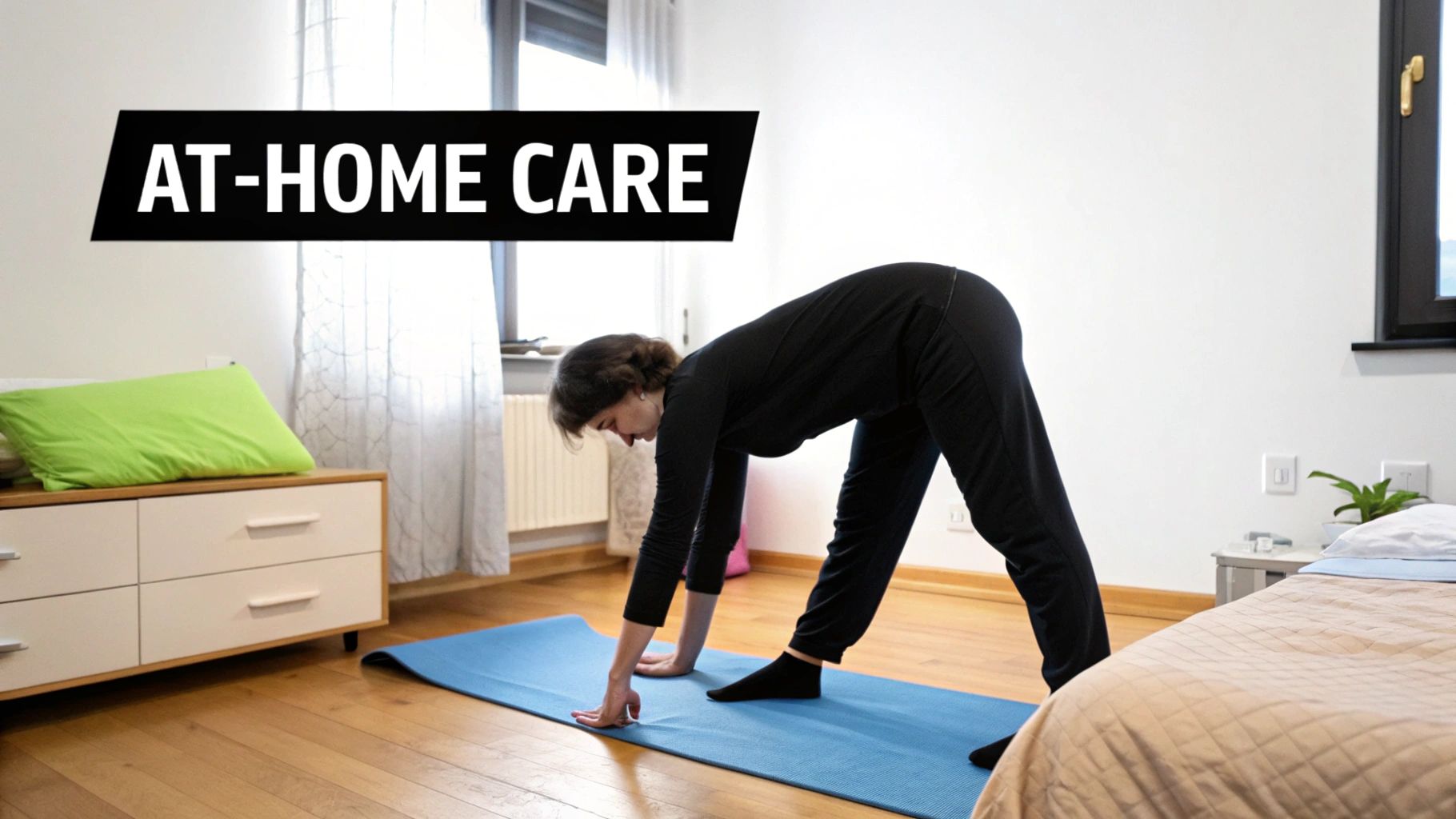
The chiropractic care you receive in our Hershey office is foundational, but what you do between visits truly accelerates your healing. Think of your at-home habits as the support system for your recovery—they reinforce the adjustments we make and empower you to manage your pain, especially during those long, difficult nights.
These are the practical, real-world tips that put you back in the driver's seat.
Gentle Stretches Before Bed
Winding down with a few gentle stretches can be a game-changer. The goal isn't an intense workout; it's about calming irritated muscles and releasing the tension that builds up in your lower back, hips, and glutes throughout the day.
Give these simple, effective movements a try:
- Piriformis Stretch: Lie on your back with both knees bent. Cross the ankle of your painful leg over the opposite knee. Now, gently pull the thigh of the bottom leg toward your chest until you feel a comfortable stretch deep in your glute. Hold it for 30 seconds.
- Knee-to-Chest Stretch: While still on your back, gently pull one knee toward your chest and hold it for 30 seconds. This is a great way to lengthen tight lower back muscles. Make sure to repeat on the other side.
Remember, these movements should always be slow and controlled. If you feel any sharp pain, stop immediately.
Choosing Your Mattress and Pillows
Your bed can either be a sanctuary for healing or a major contributor to your pain. A mattress that's too soft lets your hips sink, throwing your spine out of alignment. On the flip side, one that's too firm can create painful pressure points on your hips and shoulders.
For most people with sciatica, a medium-firm mattress strikes the right balance between support and comfort. Keeping your spine in a neutral position is one of the cornerstones of managing sciatica, and you can learn more about how to align your spine while sleeping.
Sciatica doesn't just hurt during the day—it robs you of sleep. Surveys show that up to 70% of sufferers report disrupted rest due to that radiating leg pain when they lie down.
This sleep disruption is exactly why combining professional care with smart at-home strategies is so powerful. For instance, a study from a Rhode Island Spine Centre tracked sciatica patients who were treated with Cox Flexion-Distraction and simple exercises. An incredible 90% rated their improvement as 'good' or 'excellent,' and these benefits held strong even a year later. It's solid proof that a dedicated, combined approach brings lasting relief.
When to Use Heat Versus Ice
One of the most common questions we get as a back pain chiropractor is whether to use heat or ice, especially before bed. Both are great tools, but they serve very different purposes.
- Ice for Acute Pain: If your pain is sharp, intense, and feels like a recent flare-up, ice is your best friend. Wrap an ice pack in a thin towel and apply it to your lower back for 15-20 minutes. This will help reduce inflammation and numb the sharpest pain signals.
- Heat for Chronic Aches: If your pain is more of a dull, persistent ache and your muscles feel tight and stiff, a heating pad can work wonders. Applying gentle heat for 15-20 minutes helps relax those tense muscles and boosts circulation to the area. Just be sure to never fall asleep with a heating pad on.
By integrating these supportive habits into your daily life, you become an active participant in your own healing. You’ll reinforce the progress we make during your appointments right here in Hershey and get back to sleeping peacefully.
What to Expect at Your Hershey Chiropractic Clinic

Taking that first step toward lasting relief can feel a little intimidating, especially when you’re exhausted and just want the pain to stop. We get it. That’s why we’ve designed your initial visit to Hershey Family Chiropractic to be clear, comfortable, and reassuring.
Our goal is simple: to make you feel heard and to get to the bottom of what’s causing your sciatica. From the moment you walk in, our team will greet you warmly, guide you through the initial paperwork, and make sure you feel at ease before you even meet with a doctor.
Your Comprehensive Evaluation
Your comprehensive evaluation will be with Dr. Jennifer Davis, Dr. Jenifer Epstein, or Dr. Leanne Tressler. This first meeting is all about listening. We’ll start with a detailed health history, giving you the time and space to explain your symptoms, how sleep is being affected, and what you’ve tried so far.
Next, we’ll perform a thorough physical and neurological exam. This isn't just a quick check-up; it helps us pinpoint the exact source of your sciatic nerve compression. We’ll assess your posture, range of motion, and reflexes to build a complete picture of your spinal health.
You are not alone in this fight. A landmark randomized controlled trial showed that chiropractic manipulations are highly effective for radiating pain. An incredible 55% of patients became pain-free from radiating sciatica pain, compared to just 20% in the group that didn't receive adjustments. You can explore the full study about these encouraging findings.
Creating Your Personalized Treatment Plan
Once our examination is complete, we don’t just hand you a generic plan. We sit down with you and explain our findings in plain language, showing you exactly what’s causing your pain. We believe you should be an active partner in your own recovery.
Together, we’ll create a personalized treatment plan designed to address your specific needs and goals. We’ll outline the recommended therapies, what to expect at each stage, and answer every single one of your questions.
To make getting care as easy as possible for our Hershey community, we proudly offer:
- Bilingual support in both English and Spanish.
- Convenient online scheduling so you can book an appointment anytime.
Your journey back to restful nights starts here. We’re ready to help you take that first step with confidence.
Your Questions About Sciatica and Sleep, Answered
When sciatica pain is robbing you of sleep, your mind is probably racing with questions. We hear them all the time at our Hershey, PA clinic, and getting clear, trustworthy answers is the first step toward feeling in control again. Let's tackle some of the most common ones we hear from patients just like you.
How Quickly Can Chiropractic Care Help My Nighttime Pain?
This is almost always the first question on everyone's mind, and the honest answer is: it depends. It's tied to the root cause of your sciatica and how long you've been dealing with the symptoms. Some of our patients feel a noticeable difference and sleep better after just a few visits. For others, especially those with more chronic issues, it can be a more gradual process.
Our first goal is to build momentum. The initial phase of care is all about calming things down—reducing inflammation and taking direct pressure off the sciatic nerve with targeted chiropractic adjustments. As your spine starts to find its proper alignment and the inflammation subsides, your nighttime pain should steadily decrease.
Should I Use Heat or Ice Before Bed?
Excellent question. Knowing when to grab an ice pack versus a heating pad can make a huge difference in your comfort level because they do completely opposite things.
- Reach for ice when the pain is sharp, acute, and feels fiery or inflamed. An ice pack wrapped in a towel for 15-20 minutes can help numb the area and bring down swelling right before you try to sleep.
- Go with heat when the pain is more of a dull, muscular ache or deep stiffness. A heating pad can help relax those tight, knotted muscles in your lower back and glutes, making it easier to settle into a comfortable position.
A good rule of thumb: Ice calms down fiery, sharp pain, while heat soothes deep, achy tension. Just remember to never use a heating pad for more than 20 minutes, and never, ever fall asleep with one on.
Can the Wrong Mattress Really Make My Sciatica Worse?
Absolutely. Your mattress plays a massive role in supporting—or stressing—your spine for the 7-9 hours you're supposed to be resting.
If your mattress is too soft, your hips will sink lower than your shoulders, twisting your lumbar spine and putting a constant strain on the sciatic nerve. On the flip side, a mattress that’s rock-hard creates painful pressure points on your hips and shoulders, preventing your muscles from ever fully relaxing.
For most people struggling with sciatica, a medium-firm mattress hits that sweet spot. It provides the ideal balance of support and cushion to help maintain a neutral, healthy spinal alignment all night long.
Are There Any Sleeping Positions I Should Absolutely Avoid?
Yes, there's one we strongly steer patients away from: sleeping on your stomach. This position is a recipe for disaster for anyone, but especially for someone with sciatica.
Stomach sleeping forces your lower back into an unnatural arch and makes you twist your head to the side to breathe, putting a ton of strain on your entire spine from top to bottom. It flattens the natural, healthy curve of your lumbar spine, which can directly compress the nerve roots and make your sciatica flare up badly.
Sticking to your back or side—with the right pillow support we talked about earlier—is by far the safest and most effective way to find a peaceful night's sleep.
Ready to stop letting sciatica dictate your nights? The team at Hershey Family Chiropractic is here with the expert care you need to find real, lasting relief. Schedule your consultation today and take the first step toward reclaiming restful, pain-free sleep.
