Lower back pain can disrupt everything, from your workday in Hershey to your weekend plans across Central Pennsylvania. Whether it's a dull, persistent ache from sitting too long or a sharp, debilitating pain that stops you in your tracks, you are not alone in seeking a solution. Many people in our community believe they have to live with this discomfort, but at Hershey Family Chiropractic, we know that targeted, gentle movement is a powerful tool for recovery and a key part of our patient-focused care.
This guide is designed to help you understand and perform the best exercises for lower back pain. These are foundational movements that stabilize your spine, build core strength, and improve mobility—the crucial components of the personalized care plans we develop for our patients right here in Hershey, PA. When you're searching for a "back pain chiropractor in Hershey," you need a team that not only provides expert adjustments but also empowers you with the knowledge to support your own healing.
Before starting any new exercise program, it's essential to get an accurate diagnosis. If you're looking for a "chiropractor near me" to address back pain, sciatica, or an auto injury, consider this your introduction to how our dedicated team can help you move better, feel stronger, and live pain-free. For comprehensive and lasting relief, consider incorporating essential strength training exercises to build a robust foundation for your lower back.
1. Dead Bug Exercise
The Dead Bug exercise is a foundational core stability movement that many of our patients at Hershey Family Chiropractic learn early in their recovery. Its name might sound unusual, but its effectiveness in building a strong, resilient lower back is why it's a top recommendation. It's one of the best exercises for lower back pain because it teaches your body to stabilize the pelvis and lumbar spine while your limbs are in motion.
This controlled movement strengthens the deep core muscles, including the transverse abdominis, which acts like a natural corset for your spine. By activating these muscles without placing high-impact stress on the spinal joints or discs, the Dead Bug provides a safe and effective way to build endurance, particularly for those in the acute phase of an injury or individuals who spend long hours sitting.
How to Perform the Dead Bug
Follow these steps for proper Dead Bug form:
- Starting Position: Lie on your back with your knees bent and feet flat on the floor. Raise your legs so your shins are parallel to the floor, creating a 90-degree angle at your hips and knees (the "tabletop" position). Extend your arms straight up toward the ceiling.
- Core Engagement: Gently press your lower back into the floor. You should feel your deep abdominal muscles tighten. This is the most crucial step; maintain this contact throughout the exercise.
- Controlled Movement: Take a deep breath in. As you exhale, slowly lower your right arm and left leg toward the floor simultaneously. Go only as far as you can without letting your lower back arch or lift off the floor.
- Return and Repeat: Inhale as you slowly bring your arm and leg back to the starting tabletop position. Repeat the movement on the opposite side, lowering your left arm and right leg. This completes one repetition.
Key Insight: The goal of the Dead Bug isn't speed or how low you can drop your limbs. The true benefit comes from maintaining a completely stable and neutral spine while your arms and legs move. Quality of movement is everything.
Modifications and Common Mistakes
- For Acute Pain or Beginners: If lowering both an arm and a leg is too challenging, start by lowering just one leg at a time, then progress to lowering just one arm at a time. Once that feels stable, you can combine the movements.
- Common Mistake: The most frequent error is allowing the lower back to arch off the floor. This disengages the core and can strain the lumbar spine. If you feel your back arching, reduce your range of motion.
- Pro Tip: Coordinate your breathing. Exhale as you lower your limbs and inhale as you return to the start. This helps deepen core engagement and stabilize your trunk.
At our Hershey clinic, we often integrate the Dead Bug into treatment plans to improve spinal stability, which is a key component of correcting poor posture. By strengthening the core, you provide a better support system for your spine throughout the day. You can learn more about fixing poor posture here. We recommend starting with 2-3 sets of 8-10 repetitions per side.
2. Bird Dog Hold (Quadruped Alternating Limb Extension)
The Bird Dog is another cornerstone exercise we teach at Hershey Family Chiropractic for developing a stable spine and reducing lower back pain. Performed from a hands-and-knees position, this movement strengthens the entire posterior chain, including the back extensors (erector spinae), glutes, and hamstrings, while simultaneously engaging the deep core muscles. It is one of the best exercises for lower back pain because it trains the body to maintain a neutral spine during coordinated limb movements.
This exercise is exceptionally effective because it mimics the natural cross-body patterns required for walking, running, and lifting. By building strength and endurance in the muscles that support the spine, the Bird Dog helps protect your back from the daily stresses that can lead to pain and injury. It is a low-impact movement that builds resilience without compressing the spinal discs, making it safe for a wide range of patients, including those seeking relief from sciatica.
How to Perform the Bird Dog Hold
Follow these steps for proper Bird Dog form:
- Starting Position: Begin on all fours in a tabletop position with your hands directly under your shoulders and your knees directly under your hips. Keep your back flat and your head in line with your spine.
- Core Engagement: Brace your abdominal muscles as if you are preparing for a light punch to the stomach. This will help stabilize your torso and prevent your lower back from sagging.
- Controlled Movement: Take a deep breath in. As you exhale, slowly extend your right arm straight forward and your left leg straight back at the same time. Reach through your fingertips and press back through your heel.
- Hold and Return: Hold the extended position for 1-2 seconds, focusing on keeping your hips and shoulders square to the floor. Inhale as you slowly and with control return your arm and leg to the starting position. Repeat on the opposite side, extending your left arm and right leg. This completes one repetition.
Key Insight: The primary goal is to prevent any rotation or arching in your torso. Imagine you have a glass of water balanced on your lower back that you don't want to spill. This mental cue ensures your deep core stabilizers are doing the work.
Modifications and Common Mistakes
- For Acute Pain or Beginners: If extending both an arm and a leg is too difficult, start by extending just one leg at a time. Once you can do that without losing balance or arching your back, progress to extending just one arm at a time. Then, combine the two movements.
- Common Mistake: The most common error is arching the lower back or rotating the hips when extending the leg. This places stress on the lumbar spine instead of strengthening the supporting muscles. Keep your movements slow and controlled.
- Pro Tip: Exhale as you extend your limbs to help engage your core, and inhale as you return to the start. Focus on creating a long, straight line from your fingertips to your toes.
At our Hershey clinic, we often prescribe the Bird Dog for patients with chronic sciatica or those recovering from sports injuries. It helps rebuild core function and corrects movement compensations that contribute to nerve irritation and instability. We recommend starting with 2-3 sets of 10-12 repetitions per side.
3. Cat-Cow Stretch (Spinal Flexion-Extension Mobilization)
The Cat-Cow Stretch is a gentle, flowing movement that is a cornerstone of spinal health and a fundamental exercise we teach at Hershey Family Chiropractic. It is highly recommended as one of the best exercises for lower back pain because it encourages gentle mobilization of the entire spine, from the neck down to the tailbone. This exercise helps improve flexibility, relieve tension, and promote better circulation to the spinal discs.
By moving between spinal flexion (the "Cat" position) and extension (the "Cow" position), you gently massage the paraspinal muscles that support your vertebrae. This dynamic stretch is particularly beneficial for individuals with back stiffness, especially those who work at a desk in Hershey and need to counteract the effects of prolonged sitting. It provides a safe way to reintroduce movement to a stiff or sore back without placing stressful loads on the spinal structures.
How to Perform the Cat-Cow Stretch
Follow these steps for proper Cat-Cow form:
- Starting Position: Begin on your hands and knees in a tabletop position. Your knees should be directly below your hips, and your wrists directly below your shoulders. Keep your back in a neutral, flat position.
- Cow Pose (Extension): Inhale deeply as you drop your belly toward the floor. Lift your chin and chest, and look up toward the ceiling. Allow your lower back to gently arch, opening up the front of your body.
- Cat Pose (Flexion): As you exhale, round your spine toward the ceiling. Tuck your chin into your chest and press your hands firmly into the floor to feel a stretch across your shoulder blades and lower back. Imagine a string pulling your mid-back upwards.
- Flow and Repeat: Continue to flow smoothly between the Cow pose on your inhales and the Cat pose on your exhales. This completes one repetition.
Key Insight: The power of the Cat-Cow stretch comes from the fluid, continuous motion linked to your breath. Focus on moving through each segment of your spine deliberately, rather than just hinging at your lower back. This controlled movement is what helps restore mobility and ease stiffness.
Modifications and Common Mistakes
- For Acute Pain or Beginners: Reduce the range of motion. If a deep arch or round causes pain, perform smaller, more subtle movements within a comfortable, pain-free range. You can also place a folded blanket under your knees for added comfort.
- Common Mistake: A frequent error is moving too quickly and using momentum instead of muscular control. This can irritate a sensitive back. Keep the movement slow, controlled, and synchronized with your breathing.
- Pro Tip: To deepen the stretch, pause and hold the Cat position for 10-15 seconds at the peak of your exhale to release tension in the lower back muscles. Similarly, holding the Cow position can help improve thoracic spine mobility.
At our Hershey clinic, we often recommend the Cat-Cow stretch as part of a morning routine to alleviate overnight stiffness or as a warm-up before other therapeutic exercises. It’s an excellent way to prepare the spine for the day's demands. We recommend performing 1-2 sets of 8-12 slow repetitions.
4. Glute Bridge (Hip Extension Strengthening)
The Glute Bridge is a powerful yet simple exercise that we frequently recommend at Hershey Family Chiropractic to counteract the effects of a sedentary lifestyle. Weak or underactive gluteal muscles are a primary contributor to lower back pain, especially for desk workers in Hershey and across Central Pennsylvania. This exercise is one of the best for lower back pain because it directly strengthens the gluteus maximus, your body's largest hip extensor.
Strong glutes act as a powerful support system for your pelvis and lower back, taking significant stress off the lumbar spine during daily movements like lifting, bending, and walking. By teaching your body to use your hips for power instead of your lower back, the Glute Bridge helps restore proper movement patterns, improve pelvic stability, and can even help reduce nerve compression associated with conditions like sciatica.
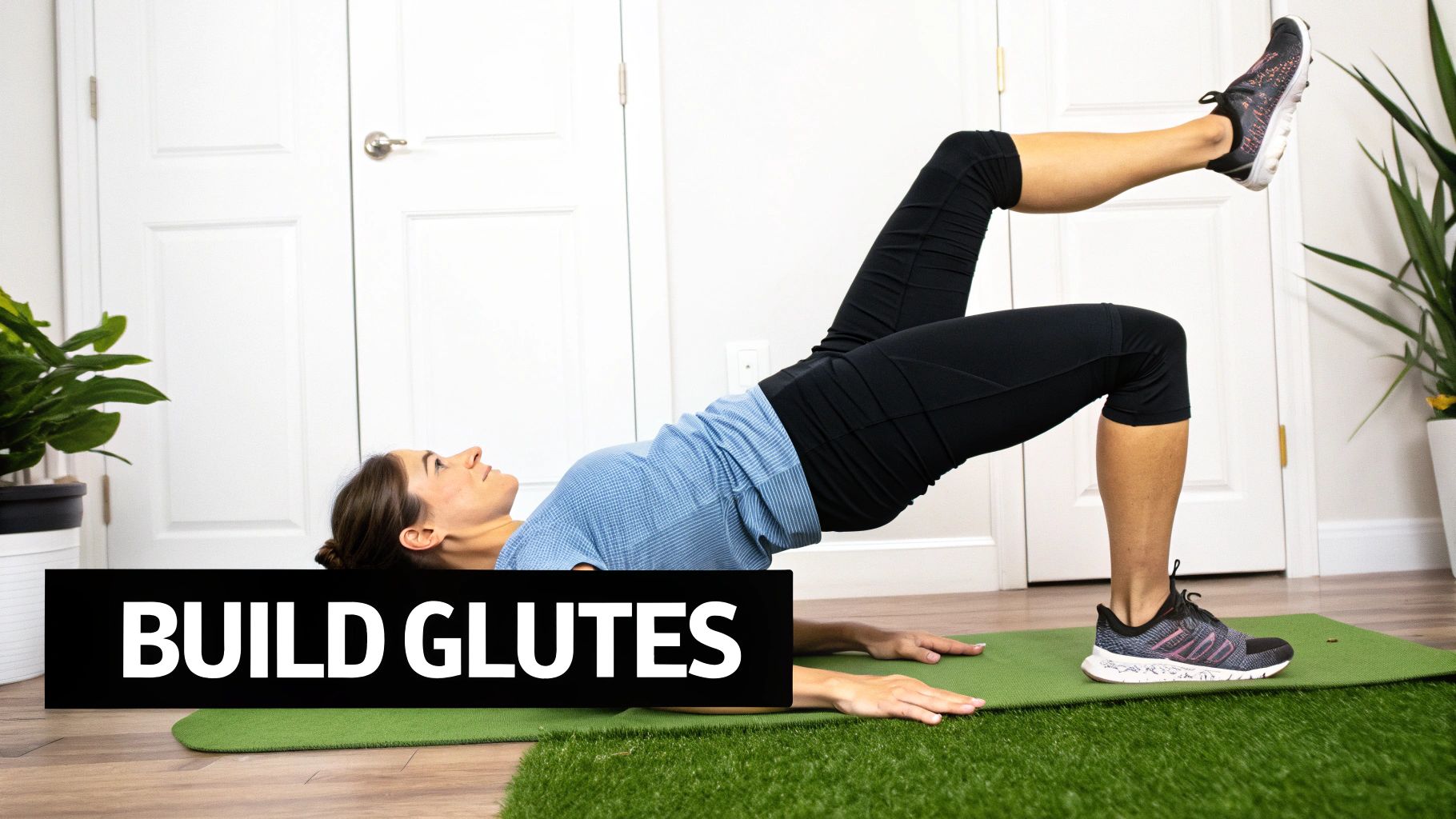
How to Perform the Glute Bridge
Follow these steps for proper Glute Bridge form:
- Starting Position: Lie on your back with your knees bent and feet flat on the floor, about hip-width apart. Position your feet so your fingertips can just barely touch your heels. Keep your arms resting at your sides with your palms down.
- Core Engagement: Gently brace your abdominal muscles and ensure your spine is in a neutral position, not overly arched or flattened against the floor.
- Controlled Movement: Take a deep breath in. As you exhale, press through your heels to lift your hips off the floor until your body forms a straight line from your shoulders to your knees. Squeeze your glutes firmly at the top of the movement.
- Return and Repeat: Inhale as you slowly lower your hips back down to the starting position with control. This completes one repetition.
Key Insight: The primary goal is to feel a strong contraction in your glutes, not your hamstrings or lower back. If you feel your lower back arching or straining, you have lifted too high. Focus on a powerful glute squeeze at the peak of the lift.
Modifications and Common Mistakes
- For Acute Pain or Beginners: Start with a smaller range of motion, only lifting your hips a few inches off the floor. You can also place a small pillow between your knees and squeeze it as you lift to help activate your inner thigh and glute muscles more effectively.
- Common Mistake: The most frequent error is hyperextending the lower back at the top. This places stress on the lumbar spine and takes the focus off the glutes. Stop the lift when your hips are in line with your shoulders and knees.
- Pro Tip: To increase glute activation, consciously push through your heels rather than the balls of your feet. This simple cue helps ensure you are using the correct muscles to drive the movement.
At our Hershey clinic, we teach the Glute Bridge to improve hip-dominant movement patterns, which is fundamental for both recovering from an injury and preventing future episodes of back pain. We recommend starting with 2-3 sets of 12-15 repetitions.
5. Quadruped Spinal Rotation (Thoracic Rotation Mobility)
The Quadruped Spinal Rotation is a crucial mobility exercise we teach patients at Hershey Family Chiropractic to address a common, yet often overlooked, source of lower back pain: a stiff upper and mid-back (thoracic spine). When this area lacks rotational mobility, the lower back is forced to over-rotate during daily movements like reaching or twisting, placing excessive strain on the lumbar discs and joints. This exercise is one of the best for lower back pain because it restores healthy rotation where it's meant to occur, protecting the lumbar spine.
By specifically mobilizing the thoracic spine, this movement helps decompress the spinal segments and improves the flexibility of the surrounding muscles. For desk workers in Central Pennsylvania, this can reverse the stiffness caused by prolonged sitting. For athletes, such as golfers or baseball players we see at our clinic, it enhances swing mechanics and prevents painful rotational injuries, making it a key part of both rehabilitation and performance care.
How to Perform the Quadruped Spinal Rotation
Follow these steps for proper form:
- Starting Position: Begin on your hands and knees in a "tabletop" position. Your hands should be directly under your shoulders, and your knees directly under your hips. Keep your back flat and your core engaged.
- Thoracic Rotation (Thread): Place one hand behind your head or neck. Keeping your hips stable, slowly rotate your torso downward, bringing your elbow toward your opposite wrist. You should feel a gentle stretch in your mid-back.
- Thoracic Rotation (Open): Exhale as you reverse the motion, rotating your torso upward and pointing your elbow toward the ceiling. Allow your eyes to follow your elbow to encourage a full, controlled rotation through your upper back.
- Return and Repeat: Inhale as you slowly return to the starting position. This completes one repetition. Perform all repetitions on one side before switching to the other.
Key Insight: The movement should originate from your upper and mid-back, not your lower back or hips. Focus on keeping your pelvis and lumbar spine as still as possible to isolate the thoracic spine and maximize the benefit of the exercise.
Modifications and Common Mistakes
- For Acute Pain or Beginners: If placing a hand behind your head is uncomfortable, simply perform the movement with your arm. Thread the active arm underneath your stable arm, then reach it toward the ceiling. Reduce the range of motion to a pain-free level.
- Common Mistake: A frequent error is allowing the hips to sway or rotate with the torso. This compensates for a stiff thoracic spine and negates the exercise's primary purpose. Keep your hips level and pointed toward the floor throughout.
- Pro Tip: Coordinate your breathing for a deeper stretch. Exhale as you rotate upward toward the ceiling and inhale as you return to the neutral starting position. This helps relax the muscles and can increase your range of motion.
At our Hershey clinic, we integrate Quadruped Spinal Rotations to improve spinal mechanics and reduce compensatory strain on the lower back. By restoring mobility to the thoracic spine, you create a more resilient and functional core. We recommend starting with 2 sets of 6-8 repetitions per side.
6. Prone Superman Hold (Posterior Chain Isometric Strengthening)
The Prone Superman Hold is a classic yet powerful exercise for building strength and endurance along the entire backside of your body. We often recommend this movement at Hershey Family Chiropractic because it directly targets the posterior chain—the group of muscles including your glutes, hamstrings, and especially the erector spinae muscles that run alongside your spine. It stands out as one of the best exercises for lower back pain because it strengthens these crucial postural muscles without requiring any equipment.
This exercise is particularly beneficial for counteracting the effects of prolonged sitting, which often leads to weak back extensors and glutes. By isometrically contracting these muscles, the Superman hold improves your spine's ability to maintain a healthy, upright posture and provides the muscular support needed to protect your lumbar spine during daily activities like lifting, bending, and carrying.
How to Perform the Prone Superman Hold
Follow these steps for proper Prone Superman Hold form:
- Starting Position: Lie face down on a comfortable, flat surface. Extend your arms straight out in front of you and your legs straight behind you, with your neck in a neutral position, gazing at the floor.
- Core Engagement: Before lifting, gently squeeze your glutes and brace your abdominal muscles as if you are preparing for a light punch to the stomach. This pre-activates your core to support your lower back.
- Controlled Movement: Take a breath in. As you exhale, simultaneously lift your arms, chest, and legs a few inches off the floor. Keep your arms and legs straight, and focus on using your back and glute muscles to initiate the lift.
- Hold and Return: Hold this elevated position for 10-20 seconds, maintaining steady breathing. Slowly and with control, lower your limbs back to the floor to complete one repetition.
Key Insight: The height of your lift is not important. The goal is to feel a strong, controlled contraction in your lower back and glutes. A small, stable lift is far more effective and safer than trying to lift as high as possible, which can strain the neck and back.
Modifications and Common Mistakes
- For Acute Pain or Beginners: If the full hold is too intense, modify by lifting only your upper body (arms and chest) while keeping your legs on the floor. Alternatively, lift only your legs while your upper body remains on the ground. You can also alternate lifting your opposite arm and leg, similar to a swimming motion.
- Common Mistake: A frequent error is craning the neck backward to look up. This places unnecessary stress on the cervical spine. Keep your gaze directed toward the floor to maintain a long, neutral neck position.
- Pro Tip: To maximize glute activation, focus on squeezing your buttocks together before and during the entire lift. This helps ensure your glutes are doing their share of the work, taking pressure off the smaller lumbar muscles.
In our Hershey clinic, we find the Superman hold invaluable for patients transitioning from pain management to active strengthening. It builds foundational endurance that supports spinal health during more demanding activities. We recommend starting with 3-5 sets, holding each repetition for 10-20 seconds.
7. Pelvic Tilts (Lumbar Spine Segmental Mobility & Proprioception)
The Pelvic Tilt is a subtle yet powerful movement that we consider a gateway exercise at Hershey Family Chiropractic. It is often one of the first exercises we teach patients because it builds a foundational awareness of the lumbar spine and pelvis. This movement is one of the best exercises for lower back pain because it directly addresses the poor postural habits and lack of spinal control that contribute to most pain syndromes.
By gently rocking the pelvis back and forth, you re-educate the muscles that control spinal position and improve proprioception—your brain's awareness of your body's position in space. For individuals who spend hours at a desk or have trouble distinguishing between a neutral spine and an overly arched back, this exercise is essential. It safely mobilizes stiff lumbar joints and activates deep core muscles without strain, making it a cornerstone of effective back pain rehabilitation.
How to Perform Pelvic Tilts
Follow these steps for proper Pelvic Tilt form:
- Starting Position: Lie on your back with your knees bent and your feet flat on the floor, about hip-width apart. Keep your arms relaxed by your sides. Your spine should be in a "neutral" position, with a small, natural curve under your lower back.
- Posterior Tilt (Flattening): Exhale and gently engage your lower abdominal muscles to press your lower back firmly but gently into the floor. Imagine you are trying to tip your pelvis backward, bringing your pubic bone slightly up toward your navel.
- Anterior Tilt (Arching): Inhale and slowly reverse the motion, gently arching your lower back away from the floor. Imagine you are tipping your pelvis forward, creating a larger space between your low back and the floor. Avoid pushing into pain.
- Return and Repeat: Slowly and deliberately move between these two positions (flattening and arching). Each full cycle of flattening and arching counts as one repetition.
Key Insight: The movement should be small, slow, and controlled, originating from your abdominal and low back muscles, not from pushing with your legs. The goal is to isolate the movement to the pelvis and lumbar spine to build control and awareness.
Modifications and Common Mistakes
- For Acute Pain or Beginners: Focus only on the posterior tilt (flattening the back). Hold the flattened position for 3-5 seconds, then relax back to neutral. This helps activate the core without moving into a potentially irritating arched position.
- Common Mistake: Using the glutes or legs to create the movement. The power should come from your deep abdominal muscles. Also, avoid arching too far, as this can compress the lumbar joints. The movement should always be pain-free.
- Pro Tip: To progress, try performing pelvic tilts while standing against a wall. This is a great "microbreak" exercise for desk workers to reset their posture throughout the day.
At our Hershey clinic, we use pelvic tilts to establish a mind-body connection that is crucial for all other core exercises. By mastering this fundamental movement, you build the spinal awareness needed to relieve lower back pain naturally and prevent future issues. We recommend starting with 2-3 sets of 10-12 slow, controlled cycles.
8. Pallof Press (Anti-Rotation Core Strengthening)
The Pallof Press is a powerful anti-rotation exercise that builds functional core strength in a way few other movements can. We often introduce this exercise at Hershey Family Chiropractic to teach patients how to resist the twisting forces that can compromise the lumbar spine during daily activities. It’s one of the best exercises for lower back pain because it specifically targets the deep core muscles, like the obliques and transverse abdominis, that are responsible for stabilizing your trunk against rotational stress.
Unlike traditional exercises like crunches that focus on spinal flexion, the Pallof Press trains your core to prevent unwanted motion, which is its primary job. This type of stability is crucial for protecting your spinal discs and joints whether you're lifting groceries, playing golf, or simply catching your balance. For our patients, from manual laborers to athletes, mastering this control is a key step in building a truly resilient lower back.
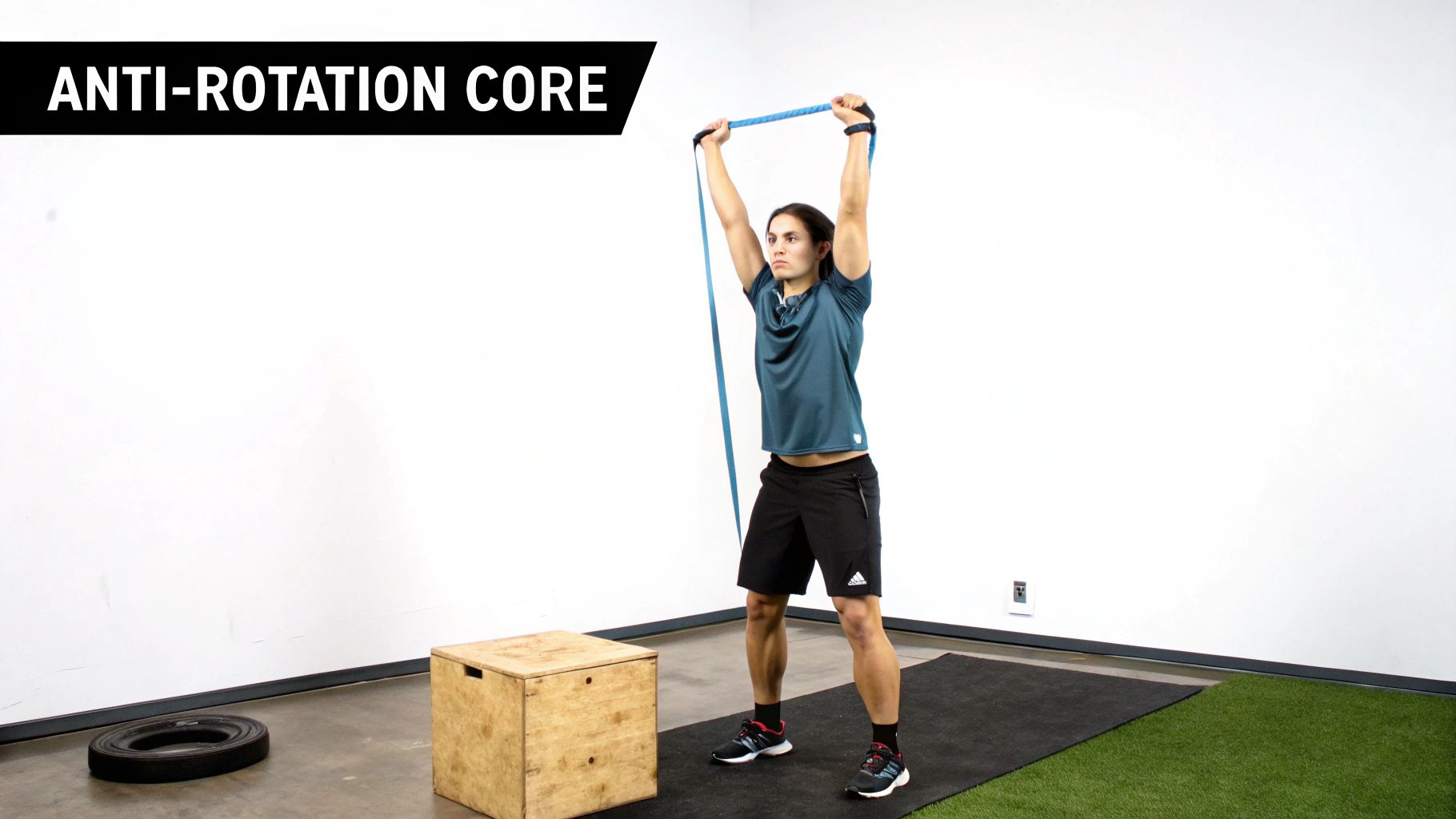
How to Perform the Pallof Press
Follow these steps for proper Pallof Press form:
- Starting Position: Anchor a resistance band or set a cable machine handle to chest height. Stand perpendicular to the anchor point, holding the handle with both hands at the center of your chest. Step away from the anchor until you feel tension in the band.
- Core Engagement: Stand with your feet shoulder-width apart, knees slightly bent, and your core braced as if you're about to take a punch. Your body should be a straight line from head to heels.
- Controlled Movement: Keeping your hips and shoulders square, slowly press the handle straight out in front of your chest until your arms are fully extended. The resistance will try to pull you and rotate your torso toward the anchor point; your job is to resist this pull.
- Return and Repeat: Hold the extended position for a 2-3 second count, then slowly bring the handle back to your chest with complete control. This completes one repetition. Perform all reps on one side before switching to face the other direction.
Key Insight: The magic of the Pallof Press happens in resisting the rotational force. The goal is to keep your torso completely still, preventing any twisting or leaning. Your hips, torso, and shoulders should remain facing forward throughout the entire movement.
Modifications and Common Mistakes
- For Acute Pain or Beginners: Start with a very light resistance band. You can also widen your stance for a more stable base, making it easier to resist the rotation.
- Common Mistake: A frequent error is allowing the torso to rotate toward the anchor point as the arms extend. Another is shrugging the shoulders up toward the ears. Keep your shoulders down and back.
- Pro Tip: Your breathing is key for stabilization. Exhale forcefully as you press the band away from your body to maximize core tension, and inhale as you slowly return to the starting position.
At our Hershey chiropractic clinic, we integrate the Pallof Press to improve motor control and protect the spine from the rotational forces common in sports and daily life. It’s an essential part of building a strong, stable foundation to support your spinal health. We recommend starting with 2-3 sets of 8-12 repetitions per side.
8-Exercise Comparison for Lower Back Pain Relief
| Exercise | Implementation complexity | Resource requirements | Expected outcomes | Ideal use cases | Key advantages |
|---|---|---|---|---|---|
| Dead Bug Exercise | Low — focuses on controlled limb lowering | Minimal (mat) | Deep core endurance; lumbar stability | Early-stage rehab, desk workers, beginners | Low spinal load; scalable; safe |
| Bird Dog Hold | Low–Moderate — coordination and balance needed | Minimal (mat) | Core + posterior chain stability; anti-rotation | Athletes, chronic pain, functional restoration | Integrates multiple muscles; improves coordination |
| Cat-Cow Stretch | Very low — gentle, rhythmic motion | None (mat optional) | Spinal mobility; reduced stiffness; calming | Morning mobility, early rehab, desk workers | Gentle mobilization; pairs with breathing |
| Glute Bridge | Low — emphasis on correct glute activation | Minimal (mat); bands/weights optional | Hip extensor strength; pelvic stability | Hip strengthening, postural correction, athletes | Targets glutes; offloads lumbar spine |
| Quadruped Spinal Rotation | Low–Moderate — requires segmental control | None (mat) | Thoracic mobility; safer rotation patterns | Rotational athletes, desk workers, laborers | Restores thoracic rotation; reduces lumbar compensation |
| Prone Superman Hold | Moderate — requires posterior chain endurance | Minimal (mat) | Back extensor endurance; posterior chain strength | Postural endurance, chronic pain, heavy lifting prep | Builds spinal extensor endurance; whole-chain activation |
| Pelvic Tilts | Very low — foundational motor control drill | None (mat) | Lumbar proprioception; neutral spine awareness | Acute pain, beginners, foundational training | Teaches neutral spine; very low load |
| Pallof Press | Moderate–High — technique and anti-rotation skill | Band or cable (equipment) | Anti-rotation core stability; functional strength | Athletes, manual laborers, advanced core work | Trains functional, integrated core resilience |
What to Expect When Visiting Our Hershey Chiropractic Clinic
Navigating lower back pain can feel overwhelming, but these exercises are a powerful first step. However, lasting relief often requires a comprehensive approach that addresses the root cause of your pain. Think of these exercises as one crucial component of your recovery strategy. While they build strength and improve mobility, they achieve their maximum potential when combined with professional care that addresses the underlying cause of your pain. A misaligned vertebra, a compressed nerve root, or chronic postural strain won't resolve with movement alone. This is where expert chiropractic care becomes essential.
At Hershey Family Chiropractic, we bridge the gap between doing the exercises and ensuring they are the right exercises for your specific diagnosis. We are the trusted local chiropractor for countless residents in Hershey, Hummelstown, and Palmyra who are seeking a definitive solution for their back pain. Our patient-focused process includes:
- A Thorough Consultation: We listen to your history, symptoms, and health goals.
- A Detailed Examination: We assess your spine, posture, and movement patterns to pinpoint the cause of your pain.
- A Personalized Care Plan: We develop a treatment strategy tailored to you, which may include specific chiropractic adjustments, spinal decompression, and therapeutic exercises.
We don't just provide adjustments; we provide a partnership in your health. Your care plan at our Hershey clinic is a collaborative effort designed to empower you. We ensure that the exercises you perform at home directly support the progress made during your in-office treatments. We'll guide you on proper form, help you modify movements for your unique needs, and educate you on how to build a lifestyle that supports a healthy spine.
Furthermore, a holistic approach includes nourishing your body for healing. Supporting your muscles goes beyond the movements themselves. Ensuring your diet is rich in the right nutrients is a game-changer for tissue repair and reducing inflammation. Understanding what foods that help muscle recovery can significantly enhance the benefits you get from these exercises and your chiropractic care.
By combining the consistent practice of these foundational exercises with the expert, hands-on care from a dedicated chiropractor in Hershey, PA, you create a powerful synergy. You are not just managing pain; you are building a stronger, more functional body from the inside out. Don't let back pain dictate your life any longer. Embrace this proactive approach and take the definitive next step toward lasting well-being.
Ready to find the root cause of your back pain and start a personalized path to recovery? The team at Hershey Family Chiropractic is here to create a treatment plan that helps you feel and move your best. Schedule your consultation today to begin your journey toward a pain-free future in Hershey.