Sciatica, the sharp, radiating pain traveling from your lower back down your leg, can be debilitating. If you're struggling with this persistent discomfort in Hershey, PA, you've likely searched for a "chiropractor near me," hoping to find a lasting solution. The good news is that relief is not only possible but can be achieved with the right combination of professional chiropractic care and targeted at-home exercises.
At Hershey Family Chiropractic, we understand the frustration sciatica causes. As a trusted local chiropractor serving patients in Hershey, Hummelstown, and throughout Central Pennsylvania, we've seen how nerve pain can disrupt daily life. This guide addresses your pain points by outlining the 8 best exercises for sciatica relief, directly informed by our clinical experience. To truly unlock sciatica relief, it's crucial to understand and incorporate foundational mobility exercises into your routine, which sets the stage for the targeted stretches we'll cover.
These movements, when performed correctly, can help decompress the sciatic nerve, reduce inflammation, and strengthen the muscles supporting your spine. This isn't just a list of generic stretches; it's a strategic plan to help you reclaim control over your body. Each entry provides clear instructions and crucial modifications. Let's explore how these specific exercises can complement the personalized chiropractic care you'll receive at our Hershey clinic, putting you on the path to long-term recovery from back and leg pain.
1. Piriformis Stretch
When sciatica flares up, the piriformis muscle is a common culprit. Located deep within your gluteal muscles, this small but powerful muscle runs from your lower spine to the top of your thigh bone. Because the sciatic nerve passes directly underneath or, in some people, through the piriformis, tightness or inflammation here can lead to significant nerve compression. This is why the Piriformis Stretch is one of the most foundational and effective exercises for sciatica relief we recommend to our patients seeking a chiropractor in Hershey. It directly targets this muscle, helping to lengthen its fibers and create space around the sciatic nerve.
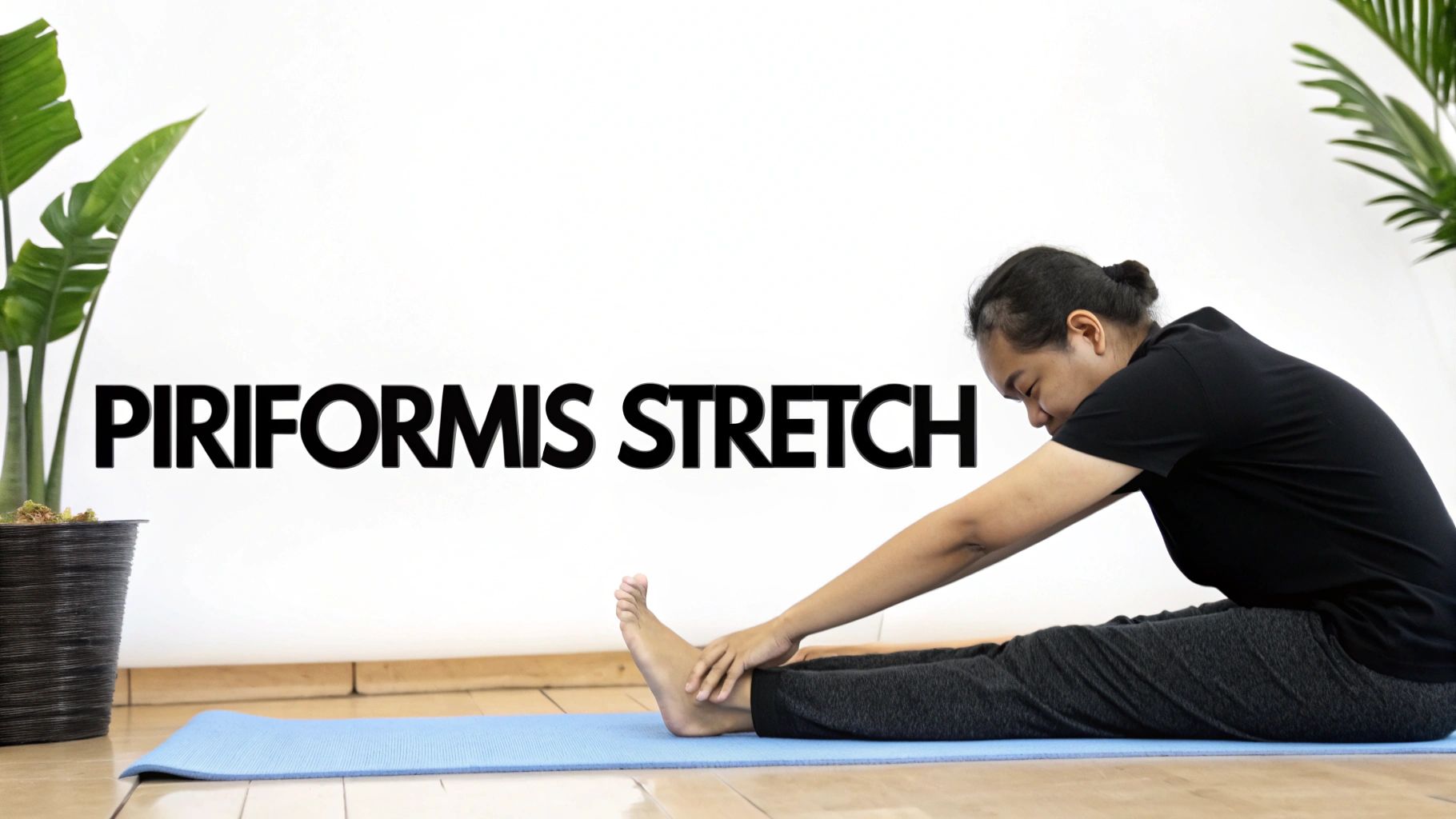
This gentle stretch helps to reduce the radiating pain, numbness, or tingling that characterizes sciatica, making it an essential tool for both acute flare-ups and long-term prevention. Many of our patients in the Hershey area, from desk workers to athletes, find that incorporating this simple movement into their daily routine provides substantial relief and helps manage their symptoms effectively alongside their chiropractic care plan.
How to Perform the Lying Piriformis Stretch
- Starting Position: Lie on your back with both knees bent and your feet flat on the floor.
- Cross Your Leg: If you have right-sided sciatica, cross your right ankle over your left knee, creating a "figure-four" shape with your legs.
- Initiate the Stretch: Gently pull your left thigh toward your chest until you feel a comfortable stretch in your right gluteal area.
- Hold and Breathe: Hold this position for 30 seconds, focusing on deep, relaxed breathing. You should feel a stretch, not sharp pain.
- Repeat: Slowly release and repeat on the other side, even if it's not painful, to maintain muscular balance.
Chiropractor's Insight: For this stretch to be effective, consistency is key. We often advise performing it in the morning to loosen up and in the evening to release daily tension. Getting your sleep posture right is also crucial; you can discover more by reading our guide on how to sleep with sciatica pain.
Modifications and Dosage
- Dosage: Aim for 2-3 repetitions on each side, holding for 30-60 seconds, twice daily.
- Seated Modification: For those with limited mobility or at the office, perform this stretch while seated. Cross one ankle over the opposite knee and gently lean your torso forward until you feel the stretch.
- Pregnancy Modification: The lying version is often more comfortable during pregnancy. Use pillows to support your head and shoulders as needed. Prenatal chiropractic care can also provide significant relief.
- When to Stop: Discontinue immediately if you feel sharp, shooting, or increased nerve pain down your leg. A gentle muscular pull is normal, but nerve pain is a red flag. If this happens, it's time to seek a professional evaluation at Hershey Family Chiropractic.
2. Knee-to-Chest Stretch
When lower back tension and spinal alignment issues contribute to sciatica, gentle decompression is often the answer. The Knee-to-Chest Stretch is a fundamental movement that specifically targets and lengthens the muscles of the lower back and glutes. This simple action helps to gently open up the lumbar spine, reducing pressure on the nerve roots. For conditions like lumbar disc injury or spinal stenosis, this can provide immediate, comforting relief. We frequently recommend this as one of the best exercises for sciatica relief because it directly addresses compression at its source.
This stretch effectively reduces mechanical stress on the intervertebral discs and spinal joints, which in turn alleviates nerve irritation. Many of our patients in Hershey, especially older adults or individuals recovering from back injuries, find the Knee-to-Chest Stretch to be an incredibly safe and accessible way to manage their symptoms. It's a foundational exercise that helps restore mobility and decrease the sharp, radiating pain associated with sciatica.
How to Perform the Single Knee-to-Chest Stretch
- Starting Position: Lie comfortably on your back on a firm surface, like a yoga mat, with both knees bent and your feet flat on the floor.
- Draw Your Knee: If you have right-sided sciatica, gently draw your right knee toward your chest, using your hands to clasp behind your thigh or over your shin.
- Initiate the Stretch: Pull the knee closer until you feel a gentle, relieving stretch in your lower back and gluteal area. Keep the opposite leg relaxed on the floor.
- Hold and Breathe: Hold the position for 30 seconds, focusing on deep, diaphragmatic breathing to help your muscles relax. Avoid holding your breath.
- Repeat: Slowly release the leg back to the starting position and repeat on the other side to maintain balance in your pelvic and lower back muscles.
Chiropractor's Insight: This stretch is particularly beneficial first thing in the morning and before bed. For it to work, you must listen to your body. The goal is a gentle release, not an aggressive pull. If you're experiencing pain, let our team at Hershey Family Chiropractic assess the root cause to ensure you receive the proper care.
Modifications and Dosage
- Dosage: Aim for 2-3 repetitions on each leg, holding for 30 seconds each time. Perform this routine at least once or twice daily.
- Bilateral Stretch: For a more comprehensive lower back release, perform the stretch by drawing both knees toward your chest simultaneously. Hold for 30-60 seconds.
- Acute Pain Modification: If pulling your knee is too intense during a flare-up, simply place your hands behind your thigh instead of over your shin to reduce the angle of flexion.
- When to Stop: If you experience a sharp increase in pain, tingling, or numbness that radiates down your leg, stop immediately. This stretch should feel relieving; any increase in nerve symptoms warrants a professional evaluation with a local chiropractor.
3. Sciatic Nerve Flossing (Neural Mobilization)
When stretching doesn't provide the relief you need, it might be time to consider the nerve itself. Sciatic Nerve Flossing, also known as neural mobilization, is a dynamic technique designed to gently move the sciatic nerve back and forth through its pathway. Unlike a static stretch that holds a muscle in an elongated position, flossing encourages the nerve to slide more freely, which can help reduce irritation, inflammation, and adhesions.
This approach is one of the best exercises for sciatica relief, particularly when the pain is caused by nerve entrapment or scar tissue from a previous disc injury. Many patients in Hershey who have not responded to traditional stretching find that this gentle, gliding motion is the key to unlocking lasting relief. By improving nerve mobility, you can directly address the mechanical irritation causing your sciatic symptoms.
How to Perform Seated Sciatic Nerve Flossing
- Starting Position: Sit upright in a chair with your knees bent at a 90-degree angle and your feet flat on the floor. Maintain good posture, keeping your back straight.
- Extend and Flex: Slowly straighten one leg (the affected side) while simultaneously pointing your toes toward you. As you do this, gently tilt your head and neck downward, bringing your chin toward your chest. You should feel a gentle pull down the back of your leg.
- Return and Release: Slowly lower your leg back to the starting position while lifting your head to look forward. This coordinated movement "flosses" the nerve.
- Repeat Smoothly: Continue this slow, rhythmic, and controlled movement. The goal is a gentle glide, not a forceful stretch.
- Switch Sides: Perform the same number of repetitions on the other leg to maintain balance, even if it is symptom-free.
Chiropractor's Insight: The key to nerve flossing is to be gentle. Nerves are sensitive, and aggressive movements can make symptoms worse. Think of it as gently untangling a delicate thread. If you feel sharp, shooting pain, you're pushing too hard. It's always best to have your form checked by a professional at Hershey Family Chiropractic to ensure you're performing it safely and effectively.
Modifications and Dosage
- Dosage: Aim for 10-15 slow repetitions on each side. Perform 2-3 sets per day.
- Lying Modification: Lie on your back with your head on a pillow. Grasp behind one thigh and pull it toward your chest. From here, slowly straighten and bend the knee to mobilize the nerve.
- Intensity Adjustment: To reduce intensity, don't straighten your knee or flex your ankle as far. The movement should always remain in a pain-free range.
- When to Stop: Discontinue immediately if the exercise causes a sharp increase in pain, numbness, or tingling that travels down your leg. This indicates nerve irritation, and it’s a sign you need a professional evaluation to adjust your treatment plan.
4. Glute Bridge
While stretching is crucial for immediate relief, strengthening key muscle groups is essential for long-term sciatica management. The Glute Bridge is an active exercise that targets the gluteus maximus, helping to stabilize your lower back and pelvis. Weak gluteal muscles often force smaller muscles, like the piriformis, to overcompensate, leading to tightness and sciatic nerve compression. By strengthening your glutes, you create a more stable foundation, reducing strain on your lumbar spine.
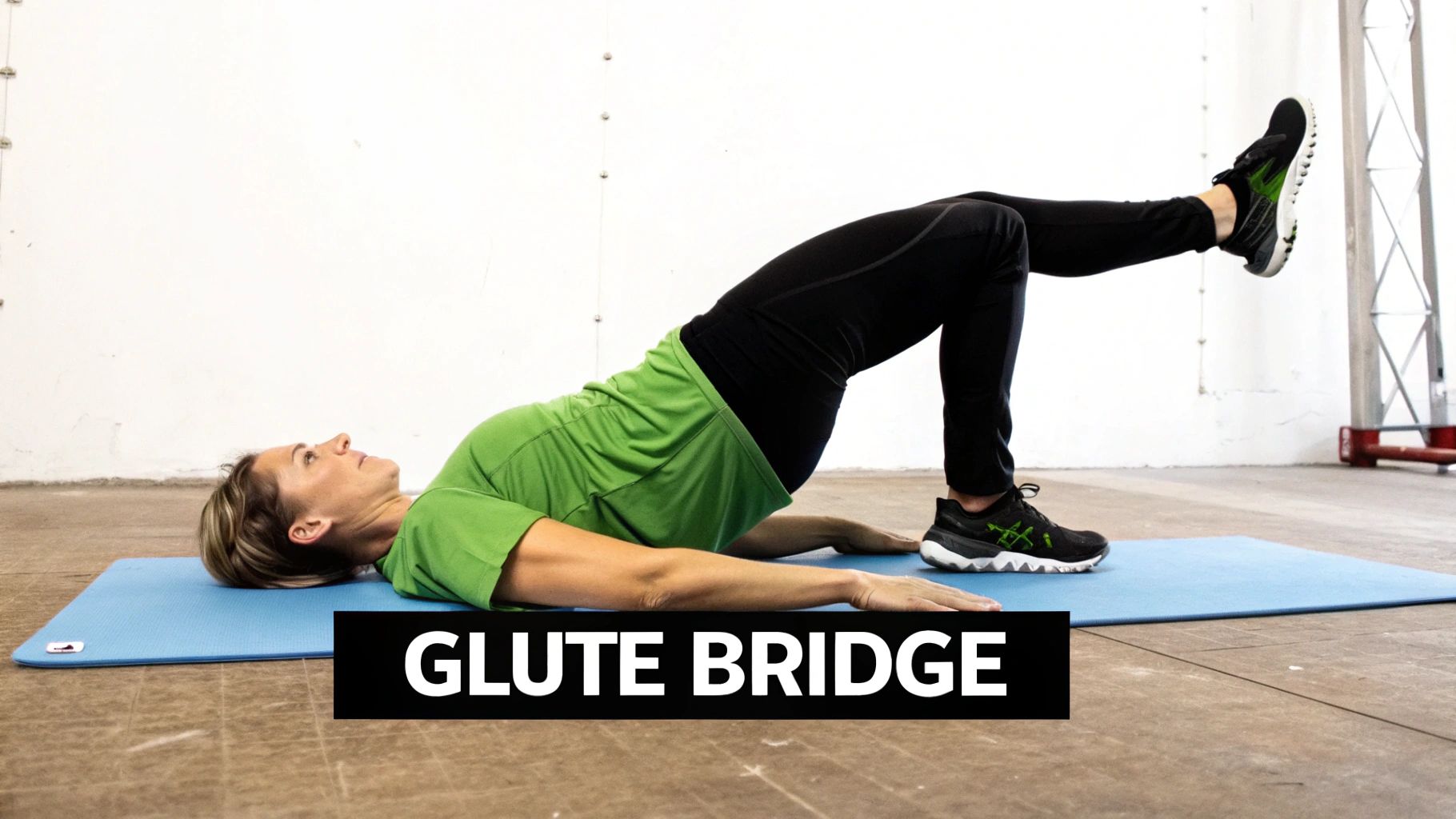
This exercise transforms sciatica management from passive stretching to active stabilization, a cornerstone of the chiropractic care we provide at our Hershey, PA clinic. A desk worker with chronic sciatica and weak glutes, for instance, might see a significant reduction in pain after incorporating glute bridges. This powerful movement helps build the muscular support needed to prevent future flare-ups, making it one of the best exercises for lasting sciatica relief.
How to Perform the Glute Bridge
- Starting Position: Lie on your back with your knees bent, feet flat on the floor about hip-width apart, and your arms resting by your sides.
- Engage and Lift: Brace your core and drive through your heels to lift your hips toward the ceiling. Squeeze your glutes firmly at the top of the movement.
- Form a Straight Line: Your body should form a straight line from your shoulders to your knees. Avoid arching your lower back excessively.
- Hold and Lower: Hold the top position for 1-2 seconds, then slowly lower your hips back to the starting position with control.
- Repeat: Perform the desired number of repetitions, focusing on form and glute activation.
Chiropractor's Insight: The key to a successful glute bridge is mindful muscle engagement. Don't just go through the motions. Concentrate on squeezing your glutes to lift your hips rather than using your lower back or hamstrings. This targeted activation provides the stability needed to improve spinal alignment and protect your sciatic nerve.
Modifications and Dosage
- Dosage: Aim for 2-3 sets of 12-15 repetitions, performing the exercise 3-4 times per week.
- Progression: Once you have mastered the basic form, you can progress to a single-leg glute bridge to increase the challenge and further enhance pelvic stability.
- Acute Flare-up Modification: If you are in significant pain, reduce the range of motion. Only lift your hips as high as you can without pain.
- When to Stop: Stop immediately if you experience a sharp increase in pain down your leg or in your lower back. This could indicate nerve irritation, and it's a sign that you should consult with our team at Hershey Family Chiropractic for a proper assessment.
5. Lumbar Spinal Traction and Decompression Stretches
When sciatica is caused by pressure on a nerve root from a bulging disc or spinal stenosis, creating more space is the key to relief. Lumbar spinal traction and decompression stretches are designed to do just that. This technique gently elongates your lower spine, reducing the compressive forces on your vertebral discs and nerve roots. By creating a slight vacuum effect, it can help retract herniated disc material and relieve direct pressure on the sciatic nerve.
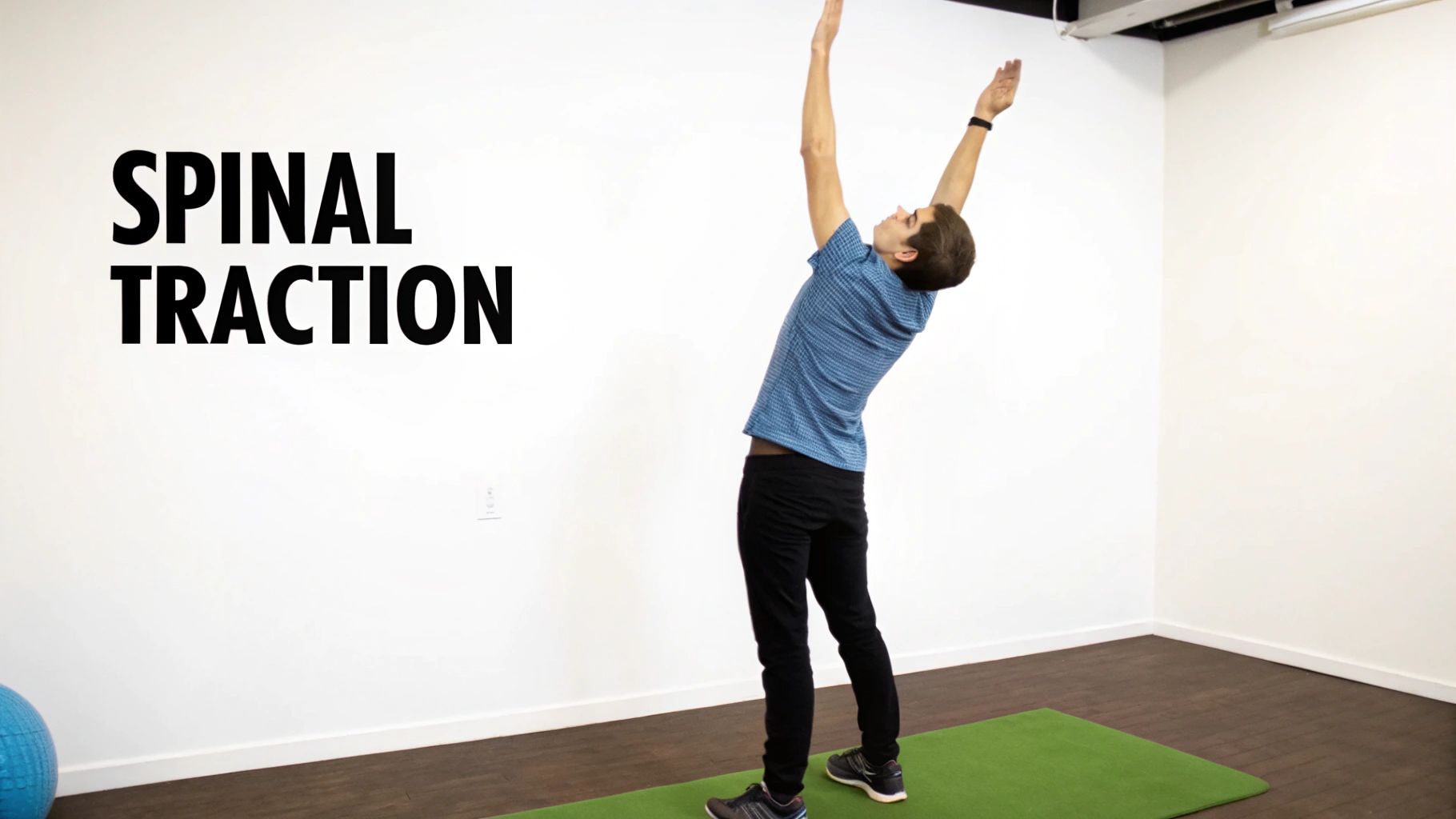
These stretches are particularly effective for patients whose pain worsens with sitting or bending forward. For many patients in Hershey, incorporating simple, self-directed traction provides a powerful way to manage disc-related sciatica. Our clinic also offers specialized spinal decompression therapy as a more advanced form of disc injury treatment.
How to Perform a Standing Elongation Stretch
- Starting Position: Stand with your feet shoulder-width apart, maintaining a stable and balanced posture.
- Raise Your Arms: Inhale as you slowly raise both arms straight overhead, reaching toward the ceiling.
- Initiate the Stretch: Gently arch your upper and mid-back, lifting your chest up and slightly back. Imagine you are trying to make your spine as long as possible.
- Hold and Breathe: Hold this elongated position for 15-30 seconds, breathing deeply and continuously. You should feel a gentle stretch in your lower back, not a sharp pinch.
- Repeat: Exhale as you slowly lower your arms back to the starting position.
Chiropractor's Insight: Think "up and over" rather than just "back." The goal is to create length in the spine first, then introduce a gentle extension. This is crucial for decompressing the disc safely. When combined with professional care, these exercises can significantly accelerate recovery. Learn more about how chiropractic care can help with sciatica pain.
Modifications and Dosage
- Dosage: Perform 3-5 repetitions of this stretch, holding for 15-30 seconds each. Aim to do this 2-3 times throughout the day, especially after long periods of sitting.
- Pull-up Bar Hang: For a deeper decompression, you can hang from a pull-up bar for 20-30 seconds, allowing gravity to gently traction your spine. Ensure you can support your body weight safely.
- Inversion Table Use: Inversion tables can be effective but require caution. Start at a very gentle angle (20-30 degrees) for only 1-2 minutes, 3-4 times per week.
- When to Stop: Cease immediately if you experience dizziness, a sharp increase in back or leg pain, or headaches. Always consult with us at Hershey Family Chiropractic before using inversion equipment, especially if you have high blood pressure, glaucoma, or heart conditions.
6. Hamstring Stretches (Straight-Leg and Seated)
Tight hamstrings are a surprisingly common contributor to sciatica pain. These large muscles run down the back of your thigh, and when chronically tight, they can pull on your pelvis, altering its alignment. This postural shift increases stress on the lower back and, consequently, on the sciatic nerve. This is why hamstring stretches are a fundamental exercise we prescribe to our sciatica patients here in Hershey. By lengthening these muscles, you reduce this detrimental pull and alleviate direct tension on the sciatic nerve.
This simple stretching routine helps restore proper pelvic mechanics and improves overall flexibility, creating a healthier environment for your lower back and sciatic nerve. Many patients, from sedentary office workers to young athletes, find that consistent hamstring stretching not only relieves current sciatica symptoms but also serves as a powerful preventative measure.
How to Perform the Lying Hamstring Stretch
- Starting Position: Lie flat on your back with both legs extended. You can bend the non-stretching leg and place the foot flat on the floor for more stability.
- Lift and Support: Keeping your leg mostly straight (a slight bend in the knee is okay), slowly raise one leg toward the ceiling. Hold your leg behind the thigh or calf.
- Initiate the Stretch: Gently pull your leg toward your chest until you feel a mild to moderate stretch along the back of your thigh.
- Hold and Breathe: Hold this position for 30 seconds, breathing deeply and avoiding any bouncing movements. The stretch should feel gentle, not painful.
- Repeat: Slowly lower your leg and repeat on the other side. Stretching both legs is crucial for maintaining pelvic balance.
Chiropractor's Insight: The biggest mistake we see is people forcing this stretch into pain, which can aggravate the sciatic nerve. The goal is mild tension, not intense discomfort. Consistency is far more important than intensity. We often remind our patients that it's better to do a gentle stretch every day than an aggressive one once a week.
Modifications and Dosage
- Dosage: Perform this stretch 2-3 times on each leg, holding for 30-60 seconds each time. Aim to do this once or twice daily, preferably when your muscles are warm.
- Seated Modification: Sit on the floor with one leg straight out in front of you and the other bent with the sole of your foot against your inner thigh. Gently lean forward from your hips toward the outstretched foot until you feel a stretch.
- Towel/Strap Assist: If you can't reach your leg comfortably in the lying position, loop a towel or yoga strap around the arch of your foot and use it to gently guide your leg into the stretch.
- When to Stop: If you experience a sharp, shooting pain down your leg or an increase in numbness or tingling, stop immediately. This could indicate nerve irritation. If this occurs, it's a clear sign that you need a professional assessment at Hershey Family Chiropractic.
7. Cat-Cow Stretch (Spinal Mobility)
When your spine feels stiff and locked up, even simple movements can trigger sciatic pain. The Cat-Cow Stretch, a gentle and dynamic movement, is a cornerstone of spinal mobility and one of the most beneficial exercises for sciatica relief we recommend to our Hershey patients. This exercise encourages fluid motion through each vertebra, which helps nourish the spinal discs, reduce nerve irritation, and decrease the stiffness that often accompanies sciatica. It works by gently mobilizing the lower back where the sciatic nerve roots originate.
This foundational movement helps to re-establish a healthy mind-body connection, teaching your nervous system that movement can be safe and pain-free. For anyone struggling with the fear of movement due to chronic sciatica, incorporating the Cat-Cow stretch into a morning routine can be a transformative step toward starting the day with less pain and greater confidence.
How to Perform the Cat-Cow Stretch
- Starting Position: Begin on your hands and knees in a tabletop position. Your wrists should be directly under your shoulders, and your knees should be directly under your hips. Keep your spine in a neutral, straight line.
- Cow Pose (Inhale): As you inhale, gently drop your belly toward the floor. Lift your chin and chest, and look up toward the ceiling without straining your neck. This creates a gentle arch in your spine.
- Cat Pose (Exhale): As you exhale, round your spine toward the ceiling, tucking your chin to your chest. Actively press your hands into the mat and draw your navel toward your spine, feeling a stretch in your mid-back.
- Flow with Breath: Continue flowing between Cow on the inhale and Cat on the exhale, creating a smooth, continuous movement.
- Repeat: Perform 10-15 slow and controlled cycles.
Chiropractor's Insight: The key to this stretch is the rhythm between movement and breath. Inhaling into extension (Cow) and exhaling into flexion (Cat) helps calm the nervous system and release muscular tension. Move slowly and intentionally, focusing on the sensation in your spine rather than how far you can arch or round.
Modifications and Dosage
- Dosage: Aim for 1-2 sets of 10-15 cycles, performed once or twice daily, especially in the morning to alleviate stiffness.
- Seated Modification: If kneeling is uncomfortable, you can perform this exercise while seated in a chair. Place your hands on your knees, sit up tall, and alternate between arching your back (Cow) and rounding it (Cat) using the same breathing pattern.
- Acute Pain Modification: During a severe sciatica flare-up, reduce the range of motion significantly. Focus on very small, gentle movements that do not provoke your symptoms. The goal is gentle mobility, not a deep stretch.
- When to Stop: Stop immediately if you feel any sharp, shooting pain down your leg or a significant increase in your localized back pain. This movement should feel relieving, not painful. If pain persists, it's a sign that you need a professional evaluation at Hershey Family Chiropractic to determine the precise cause of your sciatica.
8. Quadriceps and Hip Flexor Stretching
Many people don't realize the connection between the muscles at the front of their hips and thighs and the sciatic pain in their back and legs. The quadriceps and hip flexors can become extremely tight, especially in those who sit for long periods. This tightness pulls the pelvis forward into an anterior pelvic tilt, which increases the curve in the lower back and can directly compress the sciatic nerve roots where they exit the spine.
This is why quadriceps and hip flexor stretching is one of the most important exercises for sciatica relief we recommend in our Hershey clinic. By lengthening these muscles, you can restore a more neutral pelvic position, reduce unnecessary strain on your lumbar spine, and create more space for the sciatic nerve. Addressing this postural imbalance often provides a significant breakthrough in managing chronic sciatica.
How to Perform a Half-Kneeling Hip Flexor Stretch
- Starting Position: Kneel on a soft surface like a mat. Step one foot forward so your front knee is bent at a 90-degree angle and your ankle is directly below your knee. Your back knee should be on the floor.
- Engage Your Core: Gently tuck your tailbone and engage your abdominal muscles to prevent your lower back from arching. This stabilizes your pelvis.
- Initiate the Stretch: Slowly lean your hips forward until you feel a comfortable stretch along the front of your hip and thigh of the back leg.
- Hold and Breathe: Hold this position for 30 seconds, maintaining steady, deep breaths. The stretch should feel gentle, not sharp.
- Repeat: Carefully return to the starting position and switch legs, repeating on the other side to ensure muscular balance.
Chiropractor's Insight: This stretch is especially crucial for desk workers. We often see patients in our Hershey practice whose sciatica is directly linked to prolonged sitting. Performing this stretch in the morning and after work can counteract the effects of sitting and is a key part of the comprehensive care we provide alongside chiropractic adjustments.
Modifications and Dosage
- Dosage: Aim for 2-3 repetitions on each leg, holding for 30-60 seconds, once or twice daily.
- Standing Quad Stretch: If kneeling is uncomfortable, stand and hold onto a wall for balance. Grab your ankle and gently pull your heel toward your glute, keeping your knees aligned.
- Pregnancy Modification: The half-kneeling stretch is generally safe, but place a pillow under your back knee for comfort. Avoid leaning too deeply and listen to your body.
- When to Stop: Stop immediately if you feel any sharp pain in your knee, hip, or lower back, or if the stretch increases your sciatic symptoms. Pain is a signal to stop and seek a professional evaluation.
8-Exercise Comparison for Sciatica Relief
| Exercise | Implementation complexity | Resource requirements | Expected outcomes | Ideal use cases | Key advantages |
|---|---|---|---|---|---|
| Piriformis Stretch | Low — simple holds & positions | None or mat | Rapid relief for piriformis-related sciatic pain | Piriformis syndrome, buttock-origin sciatica, desk workers | Immediate symptom relief; easy and low risk |
| Knee-to-Chest Stretch | Low — gentle single or bilateral pull | Flat surface or mat | Lumbar decompression, reduced disc pressure | Disc bulge, spinal stenosis, post-op or elderly patients | Safe, gentle traction; targets disc-related symptoms |
| Sciatic Nerve Flossing (Neural Mobilization) | Moderate — movement pattern training required | None but initial clinician instruction recommended | Improved nerve mobility, reduced adhesions and irritation | Nerve entrapment, scar tissue, chronic sciatica unresponsive to static stretches | Addresses nerve-specific dysfunction; progressive as tolerated |
| Glute Bridge | Low–Moderate — requires proper form & progression | Mat; optional resistance for progression | Stronger glutes, pelvic stabilization, reduced compensatory strain | Weak glutes, recurrent sciatica, rehab and prevention programs | Treats root cause (weak glutes); scalable strength gains |
| Lumbar Spinal Traction & Decompression Stretches | Moderate — technique or equipment dependent | Varies: none to inversion table or clinical devices | Increased intervertebral space, reduced nerve root compression | Disc herniation, significant foraminal narrowing, stenosis | Effective for disc-related compression; complementary to care |
| Hamstring Stretches (Straight-Leg & Seated) | Low — basic flexibility work | Minimal (mat or chair) | Greater hamstring flexibility, reduced nerve tension over weeks | Tight hamstrings, pelvic malalignment, sedentary individuals | Easy to learn; complements other treatments; low risk |
| Cat-Cow Stretch (Spinal Mobility) | Low — dynamic spinal movement | Padded surface | Improved spinal mobility, reduced stiffness, better disc nutrition | Limited mobility, warm-up before therapy or exercise | Gentle full-spine mobilization; safe for acute/chronic cases |
| Quadriceps & Hip Flexor Stretching | Low–Moderate — multiple variations | Minimal (mat or support) | Improved pelvic neutral position, reduced anterior tilt over weeks | Anterior pelvic tilt, desk workers, posture-related sciatica | Targets postural root causes; prevents recurrence |
Take the Next Step Toward Sciatica Relief at Hershey Family Chiropractic
Navigating the path to recovery from sciatica can feel overwhelming, but you've now equipped yourself with a powerful toolkit. This guide has detailed some of the best exercises for sciatica relief, from gentle stretches to dynamic movements. Each exercise serves a specific purpose: to release tension, improve mobility, strengthen supporting muscles, and ultimately, alleviate the debilitating pain that radiates along the sciatic nerve.
Mastering these exercises is a crucial step in taking control of your health. However, it's essential to remember that exercises are one component of a comprehensive recovery strategy. True, lasting relief comes from addressing the root cause of your sciatica, which requires a precise diagnosis and a professionally guided treatment plan.
From Self-Care to Expert Care: Why a Diagnosis Matters
While the exercises we've covered are generally safe, their impact is maximized when they are part of a plan tailored specifically to you. The source of sciatic nerve compression varies widely. It could be a herniated disc, piriformis syndrome, spinal stenosis, or an underlying issue with your spinal alignment. Performing an exercise intended for one condition might not help, or could even aggravate, another.
This is where professional chiropractic care becomes indispensable. At Hershey Family Chiropractic, our team of dedicated doctors, including Dr. Jennifer Davis, Dr. Jenifer Epstein, and Dr. Leanne Tressler, specializes in diagnosing the precise cause of your pain. We don't just treat symptoms; we investigate the underlying issues to provide a solution that lasts. When you visit our clinic in Hershey, PA, you are a valued member of our community seeking a partner in your health journey.
Your Personalized Path to a Pain-Free Life in Hershey, PA
A comprehensive evaluation at our Hershey clinic is the first step toward reclaiming your life from sciatica. We combine our clinical expertise with an understanding of your lifestyle and health goals. This allows us to build a multi-faceted treatment plan that integrates at-home exercises with our proven, in-office therapies.
Your personalized care plan may include:
- Specific Chiropractic Adjustments: To gently correct spinal misalignments, relieve pressure on the sciatic nerve, and restore proper nervous system function.
- Advanced Therapeutic Modalities: Such as targeted shockwave therapy to break up scar tissue and promote healing.
- Therapeutic Massage: To release muscle tension in the glutes, piriformis, and lower back that contributes to nerve compression.
- Guided Exercise Prescription: We will refine your routine, ensuring you are performing the best exercises for your specific sciatica cause, with correct form.
Our integrated approach ensures that you are not only finding immediate relief but also building a stronger, more resilient foundation. For residents of Hershey, Palmyra, and the surrounding Central Pennsylvania area looking for a trusted sciatica chiropractor, our clinic offers a clear path forward. You don't have to navigate this painful journey alone.
Ready to move beyond temporary fixes and find lasting relief? Schedule your comprehensive evaluation at Hershey Family Chiropractic to receive a precise diagnosis and a personalized treatment plan that combines the best exercises for sciatica relief with expert, hands-on care. Visit Hershey Family Chiropractic to book your appointment and take the first step toward a pain-free life.