If you're a runner in Hershey, PA, that familiar ache around your kneecap—often called runner's knee or patellofemoral pain—can be incredibly frustrating, sidelining you from the trails and roads you love. You might feel it as a dull ache behind the kneecap, especially when going up or down stairs, squatting, or after a long run. This isn't just a sign to stop; it's a signal from your body that there's an underlying imbalance that needs attention from a trusted local chiropractor.
Often, the root cause isn't in the knee itself but stems from weakness or instability in the hips and poor movement patterns originating from spinal misalignments. At Hershey Family Chiropractic, we see dedicated runners from across Central Pennsylvania who believe they have to live with this pain. The great news is, you don't. As your "chiropractor near me" in Hershey, we specialize in diagnosing the biomechanical issues that lead to runner's knee. A comprehensive treatment plan combines targeted chiropractic care with specific rehabilitative exercises to not only alleviate your current pain but also build the strength and stability needed to prevent it from coming back.
This guide outlines some of the very best exercises for runner's knee, curated by our expert team, to help you get back to running strong and pain-free. While this list provides a powerful starting point, a well-rounded approach is key to long-term success. To learn more about various proven strategies and quick relief tips, check out this guide on the best exercises for runner's knee to supplement your recovery plan. If you're looking for a chiropractor in Hershey, PA who truly understands sports injuries, you've come to the right place to begin your journey back to a pain-free run.
Understanding Runner's Knee and How Chiropractic Care Helps
Runner's knee, or patellofemoral pain syndrome, typically feels like a dull, aching pain at the front of the knee, around or behind the kneecap. It's an overuse injury often caused by a combination of factors, including:
- Hip and Glute Weakness: When the muscles that stabilize your pelvis are weak, your thigh can rotate inward, causing the kneecap to track improperly.
- Muscle Imbalances: Tight quadriceps, hamstrings, or IT bands can pull the kneecap out of alignment.
- Spinal and Pelvic Misalignment: An improperly aligned pelvis or lower back can alter your entire gait, placing excessive stress down the kinetic chain to your knees. This is a common issue our auto injury and sciatica patients face.
As your local Hershey chiropractor, our approach is to identify and correct these root causes. Through gentle, specific chiropractic adjustments, we restore proper alignment to the spine and pelvis, which takes the undue pressure off your knees. We then combine this with a guided rehabilitation plan featuring exercises like the ones below to strengthen supporting muscles and ensure the problem doesn't return. This integrated approach provides lasting back pain, neck pain, and joint pain relief.
1. Clam Shells (Hip Abduction)
The clam shell is a foundational exercise in physical therapy and chiropractic rehabilitation for good reason. It’s an isolation movement that specifically targets the gluteus medius, a key muscle on the side of your hip responsible for stabilizing your pelvis and preventing your knee from collapsing inward. For many runners, weak hip abductors are a primary contributor to runner's knee. By strengthening this muscle, clam shells directly address a root cause of patellofemoral pain.
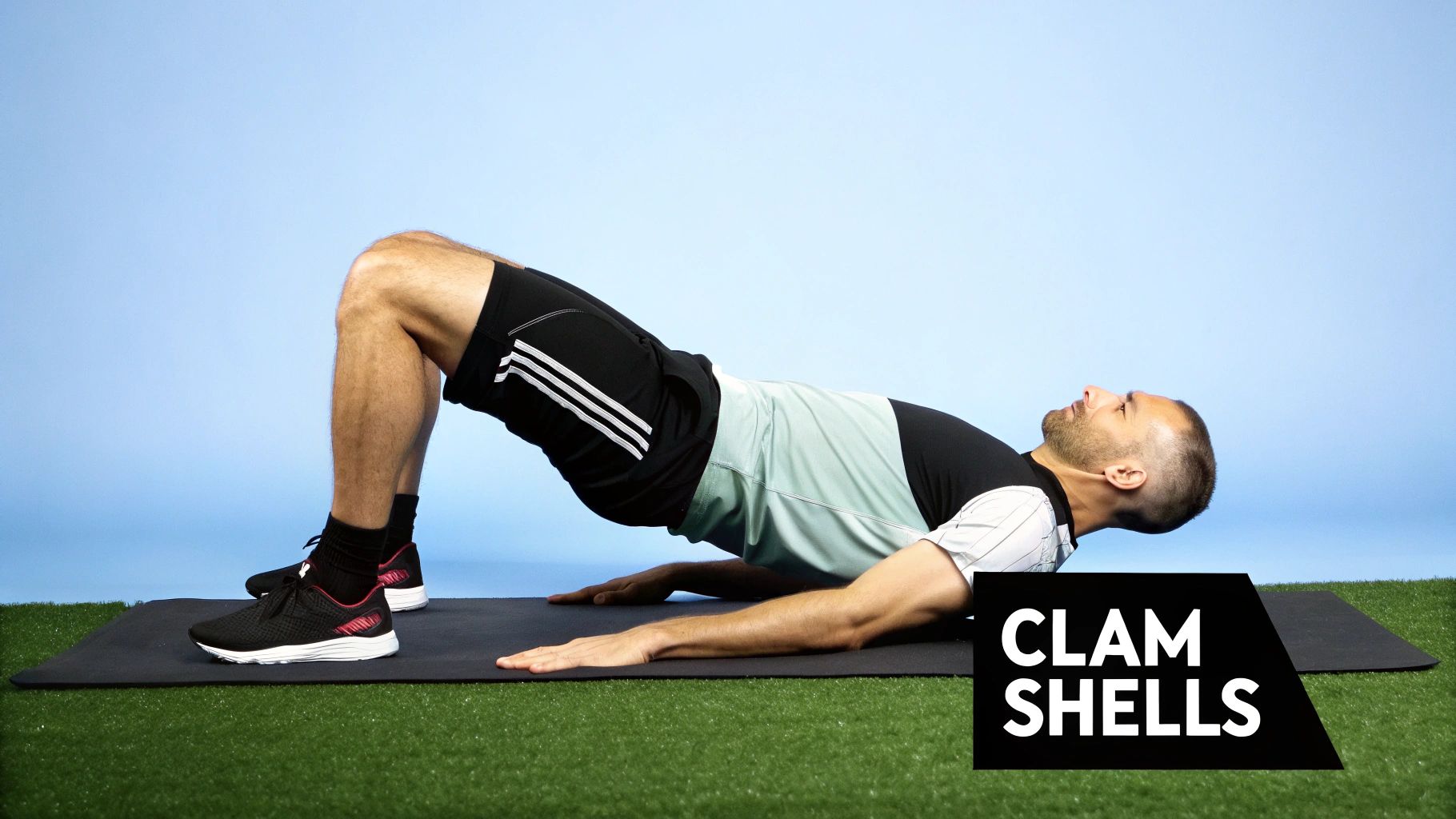
This exercise is particularly effective because it teaches your body to activate the gluteus medius without engaging larger, more dominant muscles. It’s a crucial first step in re-establishing proper neuromuscular control and is a staple in the recovery plans we provide to our patients in Hershey.
How to Perform Clam Shells
Follow these steps for proper execution:
- Starting Position: Lie on your side with your hips and shoulders stacked vertically. Bend your knees to a 45-degree angle and rest your head on your lower arm.
- Engage Your Core: Gently brace your abdominal muscles to keep your spine stable and prevent your hips from rolling backward.
- The Movement: Keeping your feet together, slowly lift your top knee toward the ceiling as far as you can without rocking your pelvis.
- Hold and Squeeze: Pause at the top of the movement for 1-2 seconds, focusing on squeezing the muscle in your outer hip.
- Return: Slowly lower your knee back to the starting position.
Key Insight: The goal is quality, not quantity. A small, controlled movement that isolates the glute medius is far more effective than a large, sloppy one that uses momentum or involves the lower back.
Sets, Reps, and Progression
- Recommendation: Start with 2–3 sets of 12–15 repetitions on each side.
- Progression: Once you can complete all sets and reps with perfect form, add a resistance band loop just above your knees to increase the challenge.
- Chiropractic Integration: At our Hershey clinic, we often prescribe clam shells after a chiropractic adjustment to help stabilize the pelvis and hips. This strengthens the supporting musculature, helping your body hold the new, correct alignment and preventing the recurrence of pain. This is a vital part of a comprehensive rehab plan that may also include manual therapy and guided exercise.
2. Quadriceps Strengthening (Isometric and Dynamic)
The quadriceps, the large muscle group at the front of your thigh, acts as the primary shock absorber and stabilizer for your knee joint. When these muscles are weak or imbalanced, particularly the inner quad muscle known as the vastus medialis oblique (VMO), the kneecap (patella) can fail to track properly in its groove. By strengthening the quadriceps, you directly improve patellar stability and control, reducing abnormal stress on the joint.
Starting with gentle, non-weight-bearing exercises is essential, as aggressive movements can aggravate an already sensitive knee. Isometric contractions (tensing the muscle without moving the joint) are a cornerstone of early-stage rehabilitation, allowing you to activate the VMO and re-establish neuromuscular control without causing pain. This is a key component of our patient-focused treatment plans at Hershey Family Chiropractic.
How to Perform Quadriceps Strengthening
Begin with isometrics and progress to gentle dynamic movements.
- Starting Position (Isometric Quad Set): Sit or lie on the floor with your legs straight out in front of you.
- Engage Your Core: Maintain a stable and neutral spine.
- The Movement: Focus on one leg. Tighten the thigh muscle (quadriceps) as if you are trying to press the back of your knee down into the floor.
- Hold and Squeeze: Hold this contraction firmly for 5–10 seconds. You should feel a strong engagement in your quadriceps but no sharp pain in the knee joint.
- Return: Relax the muscle completely.
Key Insight: To better target the VMO, try to externally rotate your foot slightly as you contract the quadriceps. This subtle shift can help prioritize the activation of that crucial inner quad muscle.
Sets, Reps, and Progression
- Recommendation: Begin with 2–3 sets of 10–15 repetitions (5–10 second holds) per leg.
- Progression: Once you can perform isometric sets without pain, advance to short-arc quads (placing a small roll under the knee and straightening the leg).
- Chiropractic Integration: At our Hershey clinic, quadriceps activation is a critical component of our guided rehabilitation plans. After a chiropractic adjustment to ensure proper pelvic and lower-limb alignment, we prescribe these exercises to reinforce correct patellar mechanics. This combination of manual therapy and targeted strengthening helps restore function and provides a more comprehensive, lasting solution for runner's knee.
3. Monster Walks (Hip Strengthening with Resistance Band)
Monster walks take hip strengthening to the next level by moving from an isolated, static position to a dynamic, functional movement. This exercise uses a resistance band to activate and strengthen key hip stabilizers, including the gluteus medius and maximus, while you are on your feet and moving. This is crucial for runners because it trains these muscles to fire correctly in weight-bearing positions that more closely mimic the demands of running, directly combating the knee collapse that often causes runner's knee.
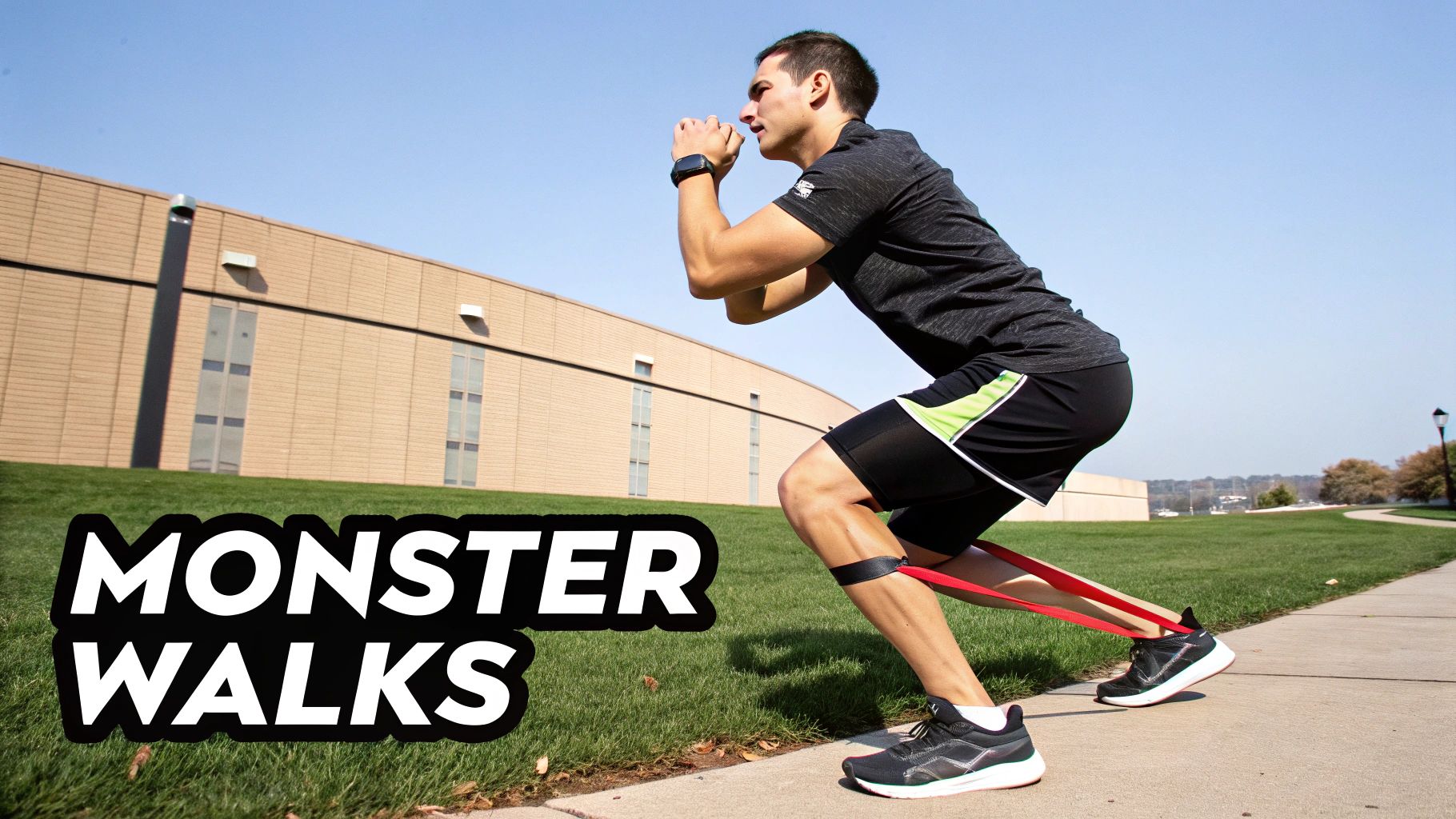
This exercise is a staple in the warm-up routines of professional running programs for its ability to "wake up" the glutes before a run. It teaches neuromuscular coordination, ensuring your hips, not just your knees, are doing their job to absorb impact and maintain proper spinal alignment.
How to Perform Monster Walks
Follow these steps for proper execution:
- Starting Position: Place a resistance band loop around both legs, just above your knees. Stand with your feet hip-width apart and lower into a slight squat, keeping your chest up and back straight.
- Engage Your Core: Brace your abdominal muscles to keep your torso stable.
- The Movement: Keeping tension on the band at all times, take a small, controlled step forward and diagonally to the side with one foot. Follow with the other foot, returning to the hip-width stance.
- Change Direction: After 10-15 steps forward, reverse the movement by stepping backward and diagonally.
- Maintain Form: Ensure your knees track over your feet and do not collapse inward. Keep your steps small and deliberate.
Key Insight: The magic of the monster walk is in maintaining constant tension. Never let your feet get so close that the band goes slack. This continuous engagement is what builds endurance in your hip stabilizers.
Sets, Reps, and Progression
- Recommendation: Start with 2–3 sets of 10–15 steps in each direction (forward and backward).
- Progression: As you get stronger, progress by using a band with higher resistance.
- Chiropractic Integration: At our Hershey clinic, we incorporate functional exercises like monster walks into guided rehabilitation plans. After performing manual therapy or a spinal adjustment to restore proper joint mechanics in the pelvis and lower back, we use this exercise to retrain the muscles to support that new alignment. This integrated approach ensures lasting relief from runner's knee.
4. Foam Rolling the IT Band and Hip Muscles
While not a strengthening exercise, self-myofascial release using a foam roller is a crucial component of a comprehensive plan to address runner's knee. The iliotibial (IT) band and its associated hip muscles can become tight and restricted. This tightness alters knee mechanics, pulling the patella out of alignment and contributing directly to patellofemoral pain.
Foam rolling applies sustained pressure to these tissues, helping to break down adhesions, improve tissue mobility, and restore normal movement patterns around the knee. This technique is widely used by physical therapists and running coaches to reduce pain and improve flexibility.
How to Perform IT Band Foam Rolling
Follow these steps for proper execution:
- Starting Position: Lie on your side with the foam roller positioned under your outer thigh, just below your hip bone. Support your upper body with your forearm.
- Engage Your Core: Brace your abdominal muscles to keep your spine and pelvis stable throughout the movement.
- The Movement: Using your supporting arm and leg, slowly roll your body down the length of your outer thigh, moving from your hip toward the outside of your knee.
- Hold and Breathe: When you find a particularly tender spot, pause on it for 20–30 seconds. Focus on relaxing the muscle and breathing deeply.
- Return: Slowly roll back up toward your hip. Avoid rolling directly over the bony prominence of your knee joint or hip.
Key Insight: The goal is to apply moderate, sustained pressure, not to inflict severe pain. If you are tensing up from pain, the technique will be less effective.
Sets, Reps, and Progression
- Recommendation: Perform for 1–2 minutes on each leg. This can be done daily, especially after a run.
- Progression: As your tolerance improves, you can increase the pressure by stacking your top leg directly on top of the bottom leg.
- Chiropractic Integration: At our Hershey clinic, we view foam rolling as an essential self-care tool that complements our in-office treatments. After performing manual therapy or soft tissue work to release restrictions, we teach patients how to use a foam roller at home. This empowers you to maintain mobility between appointments and accelerates your recovery.
5. Single-Leg Balance and Proprioceptive Training
Runner's knee often involves more than just muscle weakness; it can stem from poor neuromuscular control and proprioception—your brain's awareness of your body's position in space. Single-leg balance exercises directly address this by training your nervous system to better stabilize the knee, hip, and ankle. This training is crucial for correcting the subtle, uncontrolled movements that lead to improper knee tracking and patellofemoral pain.
This type of training is a cornerstone of rehabilitation for many lower-body injuries. We utilize it to re-educate the body's stabilizer muscles, strengthening the hip abductors and external rotators that are essential for dynamic knee control. Improving proprioception is a powerful strategy for not only resolving current knee pain but also for preventing it from returning.
How to Perform Single-Leg Balance
Follow these steps for proper execution:
- Starting Position: Stand on a firm, flat surface. Shift your weight onto one leg, lifting the other foot a few inches off the floor.
- Engage Your Core: Brace your abdominal muscles and keep your gaze fixed on a stationary point in front of you.
- The Movement: Hold the single-leg stance, focusing on keeping your hips level and preventing your standing knee from collapsing inward.
- Hold and Stabilize: Maintain this position for the recommended duration, making small, controlled adjustments to stay balanced.
- Repeat: After the hold, switch to the other leg.
Key Insight: The small, twitch-like muscle contractions you feel in your foot and ankle are the goal. This is your nervous system actively learning to stabilize the entire leg from the ground up.
Sets, Reps, and Progression
- Recommendation: Start with 3 sets of a 30–60 second hold on each leg.
- Progression: Once you can hold the position steadily, challenge your system by closing your eyes or balancing on an unstable surface like a foam pad.
- Chiropractic Integration: At our Hershey clinic, we integrate proprioceptive training into a comprehensive runner's knee rehab plan. After chiropractic adjustments align the pelvis and spine, these exercises help retrain the neuromuscular pathways to support that new alignment, helping your body build the stability needed for a pain-free return to running.
6. Hip Flexor and Quadriceps Stretching
While strengthening exercises are crucial, improving flexibility is an equally vital component of any plan to combat runner's knee. Tight hip flexors and quadriceps are incredibly common among runners and can wreak havoc on knee mechanics. Chronically tight quads can increase the compressive forces on the patella, while tight hip flexors can pull the pelvis into an anterior tilt, shifting stress down to the knee joint.
This dual-focus stretching is a cornerstone of both pre-run warm-ups and post-run cool-downs. By alleviating the constant muscular tension pulling on the knee, these stretches provide both immediate relief and long-term prevention. This is particularly important for headache and migraine relief, as poor pelvic posture can create tension that travels up the spine.
How to Perform Hip Flexor and Quadriceps Stretches
Follow these steps for two essential stretches:
Kneeling Hip Flexor Stretch:
- Starting Position: Kneel on your right knee. Step your left foot forward, creating a 90-degree angle at both your left knee and hip.
- Engage Your Core: Gently tuck your pelvis forward and brace your core.
- The Movement: Keeping your torso upright, gently press your hips forward until you feel a comfortable stretch in the front of your right hip.
- Hold and Breathe: Hold the stretch for 30–60 seconds.
- Return and Repeat: Slowly return to the start and switch sides.
Standing Quadriceps Stretch:
- Starting Position: Stand tall, holding onto a wall or chair for balance if needed.
- The Movement: Grab your right foot and gently pull your heel toward your buttock, feeling a stretch in the front of your thigh.
- Maintain Alignment: Keep your knees parallel and your pelvis neutral.
- Hold and Breathe: Hold for 30–60 seconds.
- Return and Repeat: Slowly release your foot and repeat on the other side.
Key Insight: Consistency is more important than intensity. A gentle, daily stretching routine will produce far better results for runner’s knee than infrequent, aggressive stretching.
Sets, Reps, and Progression
- Recommendation: Perform 2–3 sets of 30–60 second holds per stretch on each side after your runs.
- Progression: As your flexibility improves, you can deepen the stretch in the kneeling position.
- Chiropractic Integration: At our Hershey practice, we often find that chronic muscle tightness is linked to underlying joint restrictions in the pelvis and lumbar spine. We use chiropractic adjustments to restore proper joint motion first. Prescribing these stretches afterward helps the muscles adapt to this new, improved alignment, ensuring a more durable recovery.
7. Glute Bridge and Single-Leg Glute Bridge
The glute bridge is a powerhouse exercise for runners, targeting the gluteus maximus. When running, this muscle is responsible for driving you forward and stabilizing your pelvis. Weak or inactive glutes can force other joints, particularly the knee, to overcompensate. This faulty movement pattern is a major contributor to patellofemoral pain. By activating and strengthening the glutes, the glute bridge helps restore proper force distribution, taking unnecessary stress off the knee joint.
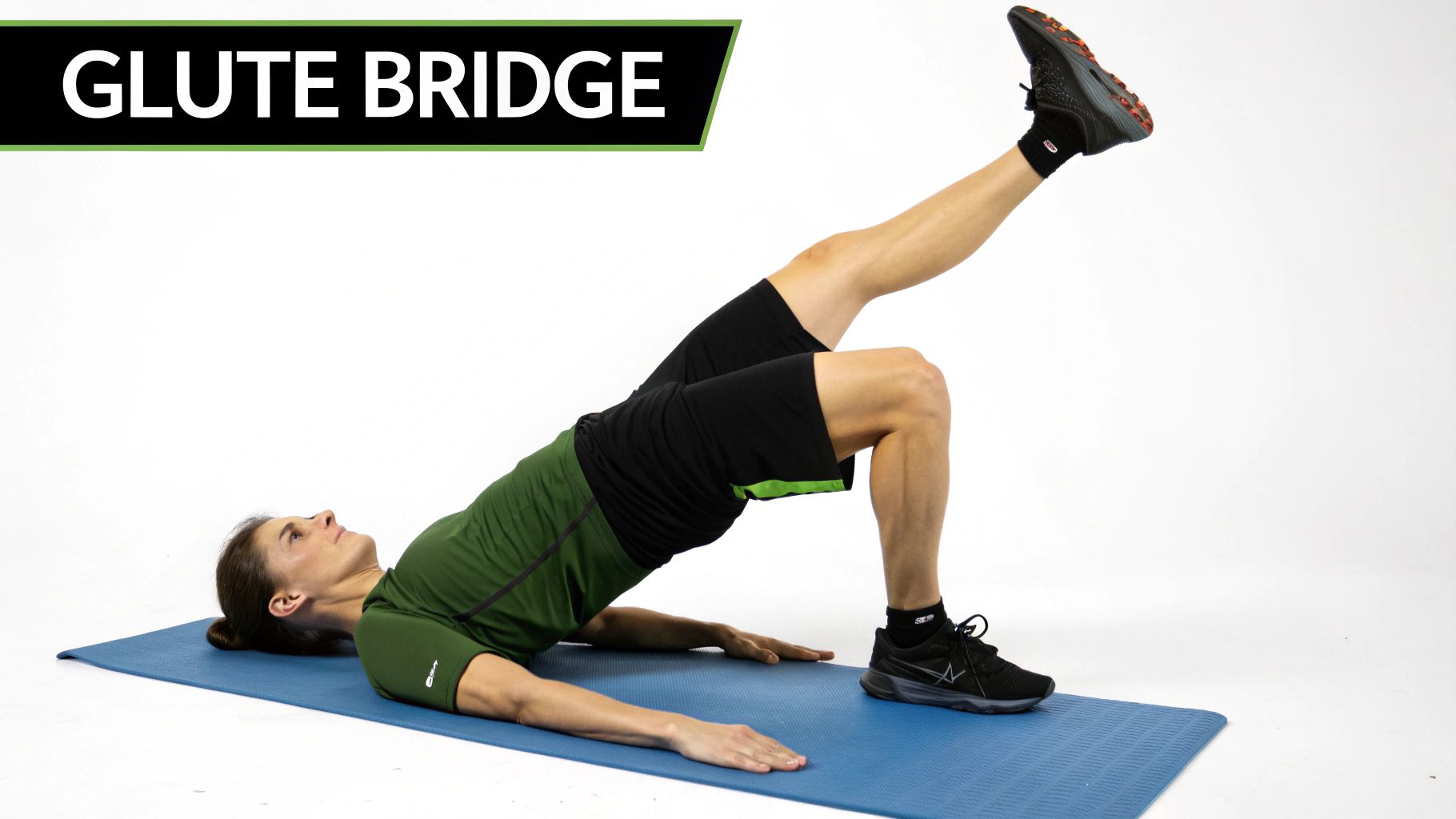
This exercise is fundamental in both rehabilitation and pre-habilitation settings because it re-establishes the crucial mind-muscle connection with the glutes. The progression to a single-leg bridge directly mimics the demands of running. Strengthening this posterior chain is a core principle in strategies that teach runners how to prevent sports injuries and build a more resilient foundation.
How to Perform Glute Bridges
Follow these steps for proper execution:
- Starting Position: Lie on your back with your knees bent and your feet flat on the floor, hip-width apart.
- Engage Your Core: Gently brace your abdomen to maintain a neutral spine.
- The Movement: Squeezing your glutes, drive your hips toward the ceiling until your body forms a straight line from your shoulders to your knees.
- Hold and Squeeze: Pause at the top for 1-2 seconds, focusing on a strong glute contraction.
- Return: Slowly lower your hips back to the starting position with control.
Key Insight: To ensure you're using your glutes and not your hamstrings or lower back, focus on pushing through your heels.
Sets, Reps, and Progression
- Recommendation: Start with 2–3 sets of 15–20 repetitions of the two-legged bridge.
- Progression: Once you can complete all sets and reps with perfect form, progress to the single-leg glute bridge. To do this, lift one foot off the ground, keeping your hips level, and perform the movement as described above.
- Chiropractic Integration: In our Hershey chiropractic office, we use the glute bridge as a corrective exercise to reinforce pelvic stability after a spinal adjustment. When the pelvis is properly aligned, activating the glutes helps "lock in" that new position, improving your biomechanics and reducing the likelihood of pain returning.
8. Lateral Band Walks (Hip Abduction in Stance)
While isolation exercises like clam shells are excellent for initial muscle activation, lateral band walks strengthen your hip abductors in a more functional, weight-bearing position. This exercise directly targets the gluteus medius and minimus, muscles crucial for maintaining pelvic stability and preventing the knee from collapsing inward during your run. By training these muscles to fire correctly while you are on your feet, you more closely mimic the demands of running.
This dynamic movement is a staple in running-specific warm-ups recommended by physical therapists and athletic trainers. It effectively "wakes up" the glutes, ensuring they are ready to stabilize your hips and knees from the very first stride. Integrating lateral band walks addresses a key biomechanical fault linked to runner's knee.
How to Perform Lateral Band Walks
Follow these steps for proper execution:
- Starting Position: Place a resistance band loop around your thighs, just above your knees. Stand with your feet hip-width apart and lower into a slight squat.
- Engage Your Core: Brace your abdominal muscles to maintain a stable and upright torso.
- The Movement: Keeping tension on the band, take a small, controlled step to the side with your right foot. Follow with your left foot, returning to the hip-width stance.
- Maintain Form: Ensure your knees track over your toes and do not collapse inward.
- Repeat: Continue taking 10–12 steps in one direction, then repeat in the opposite direction.
Key Insight: Focus on maintaining constant tension in the band throughout the entire movement. Avoid dragging the trailing foot or letting the band go slack.
Sets, Reps, and Progression
- Recommendation: Start with 2–3 sets of 10–12 steps in each direction.
- Progression: As you get stronger, increase the challenge by using a band with higher resistance or by placing the band around your ankles.
- Chiropractic Integration: In our Hershey clinic, we use lateral band walks as part of a guided rehabilitation plan to reinforce proper hip and pelvic alignment achieved through chiropractic adjustments. This helps patients build functional stability, reducing the likelihood of patellofemoral pain returning.
Take the Next Step: Partner with Your Local Hershey Chiropractor
You've just explored a comprehensive toolkit of the best exercises for runner's knee. Mastering these movements is a significant step toward reclaiming your stride and silencing that nagging ache around your kneecap. The key takeaway is that true, lasting relief from patellofemoral pain isn't just about the knee itself; it's about building a resilient, balanced system from the ground up, focusing on hip strength, core stability, and proper spinal alignment.
However, performing exercises in isolation is only part of the equation. True recovery often requires a personalized strategy that addresses your unique biomechanics. This is where a professional diagnosis and guided rehabilitation plan from your Hershey chiropractor become invaluable.
What to Expect at Hershey Family Chiropractic
When you visit our clinic in Hershey, PA, you can expect a patient-focused and reassuring experience.
- Thorough Evaluation: We conduct a comprehensive assessment to pinpoint the precise source of your pain. Is it weak glutes? Poor ankle mobility? A misaligned pelvis from a previous auto injury or sciatica? Answering these questions allows us to create a truly effective recovery roadmap.
- Personalized Treatment Plan: Your care plan is tailored to you. It will likely include chiropractic adjustments to restore proper joint function, guided rehabilitation exercises to build strength, and advice on ergonomics and lifestyle to prevent re-injury.
- Advanced Care: We may integrate other services like prenatal or pediatric chiropractic care if needed, ensuring a holistic approach for your entire family's well-being.
This is why so many runners searching for a "sports injury chiropractor in Hershey" find lasting relief with our integrated approach. Beyond the physical exercises, ensuring proper hydration is crucial for a runner's recovery. For an ultimate guide to hydration, explore the best electrolyte powder for runners.
Ultimately, overcoming runner's knee is about empowering yourself with knowledge and partnering with a team that understands the complexities of a runner's body. By combining these powerful exercises with a professionally guided, holistic treatment plan, you can move beyond managing pain and start building a body that's resilient enough to carry you through countless miles, pain-free.
Ready to stop letting knee pain control your running schedule? Partner with Hershey Family Chiropractic for a personalized assessment and a comprehensive treatment plan that addresses the root cause of your pain. Schedule your consultation today and take the first confident step toward a pain-free finish line.