
Neck pain can be a constant, draining problem, making everything from working at your desk in Hershey to enjoying a drive through Central Pennsylvania a challenge. The persistent ache, stiffness, and radiating discomfort are more than just an annoyance; they signal that your body needs support. Many people in our community try to push through the pain, but ignoring it can lead to chronic issues that impact your quality of life. At Hershey Family Chiropractic, we understand how debilitating neck pain can be. Led by Dr. Jennifer Davis, Dr. Jenifer Epstein, and Dr. Leanne Tressler, our team is dedicated to providing natural, patient-focused care to help our neighbors in Hershey, PA find lasting relief.
While professional chiropractic care is essential for addressing the root cause of spinal misalignment, specific exercises can empower you to manage symptoms, improve posture, and support your recovery at home. This guide outlines some of the best exercises for neck pain, carefully selected by our experts to help you regain mobility and live pain-free. We will provide step-by-step instructions for each movement, including neck isometrics, chin tucks, and shoulder blade squeezes, to ensure you perform them safely and effectively. For immediate relief and ongoing prevention, you can also explore a variety of quick desk stretches for neck and shoulders designed to alleviate tension during your workday. If you're looking for a neck pain chiropractor in Hershey, consider this your first step toward building a stronger, more resilient neck and achieving sustainable recovery.
1. Neck Isometric Exercises
When you're dealing with neck pain, especially in its acute phase, the idea of moving your neck can seem daunting or even counterproductive. This is precisely why neck isometric exercises are one of the best exercises for neck pain. They are a cornerstone of early-stage rehabilitation, allowing you to strengthen crucial stabilizing muscles without any actual movement of the neck joint itself.
What Are Isometric Exercises and Why Do They Work?
Isometric exercises involve a muscle contraction against an immovable force. Imagine pushing against a wall; the wall doesn't move, but your muscles are working hard. When applied to the neck, you use your hand to provide gentle resistance, and your neck muscles contract to hold your head steady. This static contraction strengthens the deep cervical stabilizers, the small muscles responsible for maintaining proper posture and supporting the weight of your head.
By building strength without aggravating inflamed tissues, isometrics can reduce strain on your cervical spine, improve endurance, and prepare your neck for more dynamic movements later in your recovery. They are exceptionally safe and effective, making them a go-to recommendation for patients in Hershey seeking gentle yet powerful relief.
How to Perform Neck Isometrics Correctly
To get the most out of these exercises, maintain a neutral spine posture. Sit or stand tall with your shoulders relaxed and your chin slightly tucked, as if you're holding a piece of fruit under it.
- Forward Flexion: Place your palm on your forehead. Gently press your head forward into your hand, while your hand provides equal resistance to prevent any movement.
- Extension: Place your palm on the back of your head. Gently press your head backward into your hand, again ensuring your head does not move.
- Side Bending (Left & Right): Place your right palm on the right side of your head, just above your ear. Gently press your head into your hand. Repeat on the left side.
Key Insight: The goal is activation, not overpowering force. Apply only about 30% of your maximum effort. Hold each contraction for 5-10 seconds, performing 3 sets for each of the four directions. As you get stronger, you can gradually increase the hold time to 15-20 seconds. If you work at a desk, try performing a set every two hours to combat postural strain.
2. Neck Stretches (Levator Scapulae and Upper Trapezius)
When stress, poor posture, or repetitive strain takes its toll, certain neck muscles bear the brunt of the tension. This is why targeted neck stretches are one of the best exercises for neck pain, offering immediate relief by lengthening chronically tight tissues. Specifically, focusing on the levator scapulae and upper trapezius muscles can undo the knots that contribute to stiffness and headaches.
What Are These Stretches and Why Do They Work?
These exercises are gentle, sustained stretches designed to improve flexibility in the muscles that connect your cervical spine to your shoulder blades and upper back. The upper trapezius runs from the base of your skull down to your shoulders, while the levator scapulae connects your neck to your shoulder blade. When tight, they pull on your neck, limit your range of motion, and can refer pain up into your head.
By carefully and consistently stretching these muscles, you are restoring their natural length and releasing built-up tension. This reduces the mechanical strain on your cervical vertebrae, improves blood flow to the area, and alleviates the pulling sensation that so often accompanies neck pain. For patients in Hershey struggling with "text neck" or desk-related pain, these stretches are a foundational component of effective, lasting relief.
How to Perform Neck Stretches Correctly
For optimal results, perform these stretches after a short walk or applying gentle heat to warm up the muscles. Remember to move slowly and avoid any bouncing movements.
- Upper Trapezius Stretch: Sit tall with relaxed shoulders. Gently tilt your right ear toward your right shoulder until you feel a mild stretch along the left side of your neck. To deepen the stretch, you can place your right hand on your head and apply very light pressure.
- Levator Scapulae Stretch: From the same seated position, turn your head about 45 degrees to the right. Gently tuck your chin down toward your right collarbone until you feel a stretch along the back-left side of your neck. Use your right hand to apply gentle overpressure if needed. Repeat both stretches on the opposite side.
Key Insight: The goal is a gentle, relaxing release, not a forceful pull. Hold each stretch for 30-60 seconds, breathing deeply to encourage the muscle to relax. Perform 2-3 repetitions on each side, once or twice daily. If you work at a desk, make it a habit to perform a set every couple of hours to counteract the effects of prolonged sitting and prevent tension from accumulating.
3. Chin Tucks (Cervical Retraction)
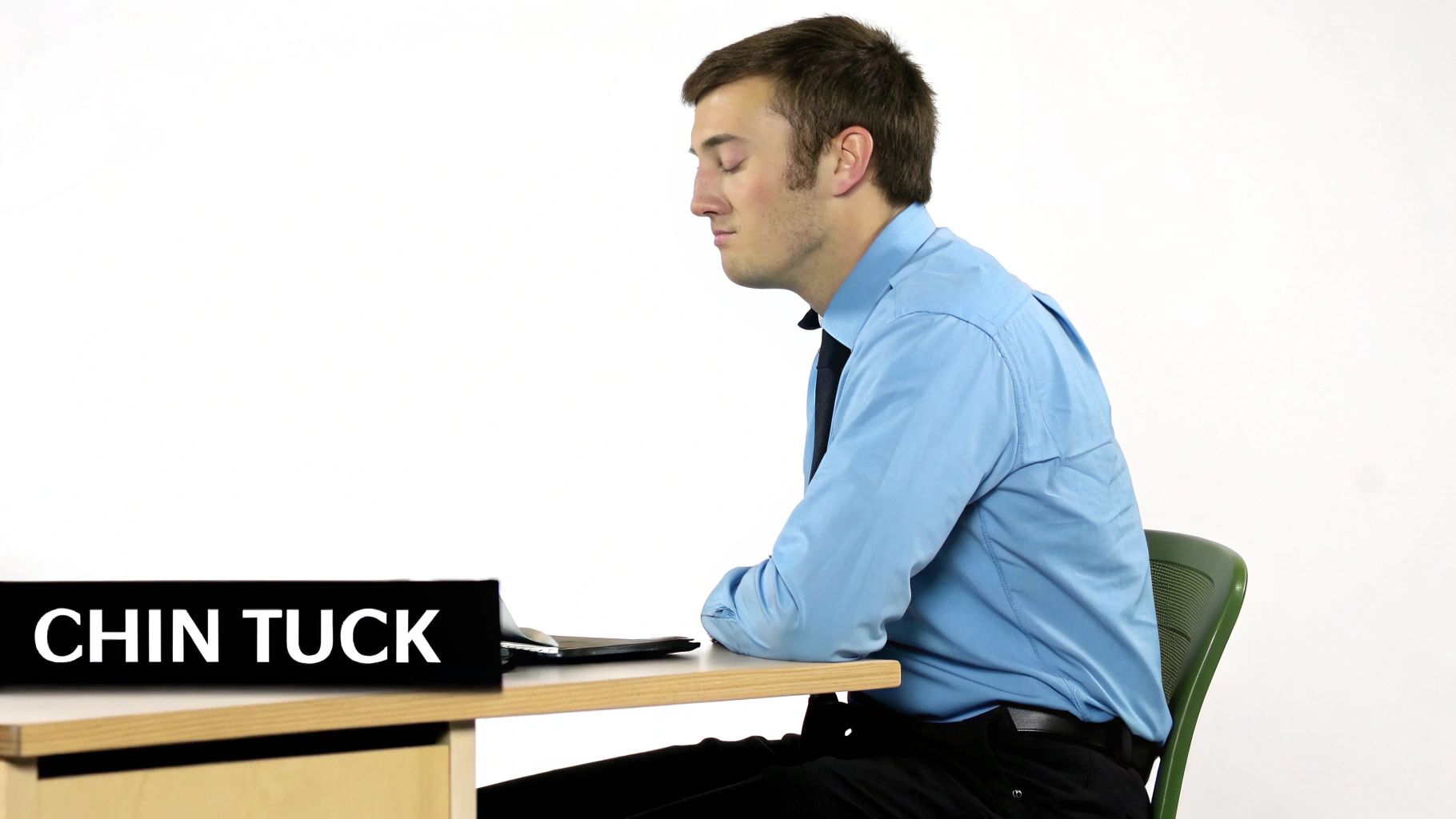
If there is one foundational movement that belongs in every neck care routine, it's the chin tuck. Also known as cervical retraction, this simple yet powerful exercise directly counters the effects of "text neck" and forward head posture, two of the biggest contributors to chronic neck strain. It is one of the best exercises for neck pain because it targets the deep, stabilizing muscles at the front of your neck that are often weakened by our modern, screen-focused lifestyles.
What Are Chin Tucks and Why Do They Work?
A chin tuck involves gently pulling your head and chin straight back, creating a "double chin" effect without tilting your head up or down. This seemingly small movement activates the deep cervical flexor muscles, like the longus colli, which are essential for holding your head in proper alignment over your shoulders. When these muscles are weak, your head drifts forward, placing immense strain on the posterior neck muscles and cervical joints.
By regularly performing chin tucks, you are actively strengthening these crucial postural muscles while simultaneously stretching the tight suboccipital muscles at the base of your skull. This dual action helps restore the natural curve of your cervical spine, reduces compressive forces on your discs, and alleviates the tension that often leads to headaches and upper back pain. It's a fundamental reset for anyone spending hours at a desk or on their phone in Hershey.
How to Perform Chin Tucks Correctly
Correct form is crucial for activating the right muscles. Start in a seated position with your spine straight and your shoulders relaxed and pulled back. Look straight ahead, not down.
- Step 1: Retract: Gently draw your chin and head straight back as if you are making a double chin. Imagine a string is pulling the back of your head horizontally backward. Avoid tilting your chin down or up.
- Step 2: Hold: You should feel a gentle stretch at the back of your neck and an activation of muscles deep in the front. Hold this position for 3-5 seconds.
- Step 3: Release: Slowly return to your neutral starting position and relax for a moment before the next repetition.
- Progression: Once comfortable, you can perform this exercise standing against a wall, gently pressing the back of your head into the wall as you tuck your chin.
Key Insight: Consistency is more important than intensity. Aim to perform 10-15 repetitions every 1-2 hours, especially during prolonged periods of sitting. This re-educates your postural muscles and prevents them from falling back into a forward-head pattern. For persistent postural issues, ensuring your sleep posture is also supportive is key; you can explore options like a custom-fitted pillow to maintain proper alignment overnight.
4. Shoulder Blade Squeezes (Scapular Retraction)
It's a common misconception that neck pain is an isolated problem. In reality, the health of your neck is deeply connected to the posture of your upper back and shoulders. This is why Shoulder Blade Squeezes, also known as scapular retractions, are one of the best exercises for neck pain. They directly combat the source of much modern-day neck strain: poor, forward-rounded posture.
What Are Shoulder Blade Squeezes and Why Do They Work?
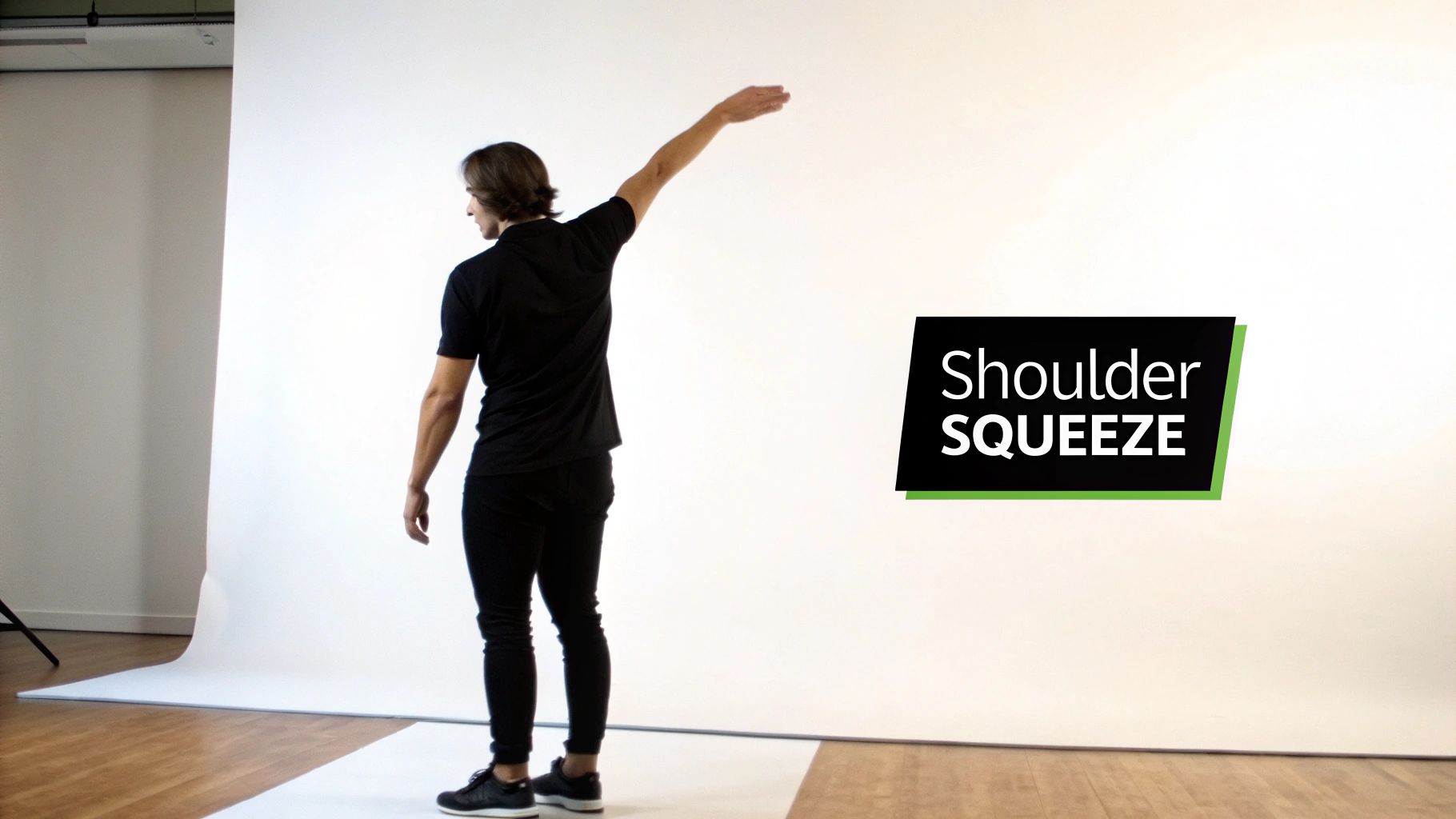
A shoulder blade squeeze is a simple but powerful movement where you pull your shoulder blades back and down, as if trying to pinch a pencil between them. This exercise specifically targets the rhomboid and middle trapezius muscles. These key postural muscles often become weak and overstretched from hours spent hunched over desks, steering wheels, or phones, leading to the classic "forward head posture."
By strengthening these upper back muscles, you create a stable foundation for your neck. This counteracts the forward pull of tight chest muscles, allowing your head to sit more naturally atop your spine. This reduces the chronic strain on your neck's stabilizing muscles and ligaments, providing significant and lasting relief for patients in Hershey and beyond.
How to Perform Shoulder Blade Squeezes Correctly
This exercise can be done seated or standing, making it perfect for a quick break at work. The key is maintaining good form to isolate the correct muscles.
- Sit or stand tall with your spine in a neutral position and your arms relaxed at your sides.
- Keeping your shoulders down and away from your ears, gently squeeze your shoulder blades together and slightly downward.
- Imagine you are trying to make your shoulder blades touch in the middle of your back.
- Hold the squeeze for 2-3 seconds, feeling the muscles between your shoulder blades engage.
- Slowly release back to the starting position and repeat.
Key Insight: Avoid shrugging your shoulders up toward your ears or arching your lower back. The movement should be slow, controlled, and focused entirely in your upper back. Aim for 2-3 sets of 12-15 repetitions. For desk workers, performing a set every hour is a fantastic way to reset your posture and prevent neck strain from accumulating throughout the day.
5. Neck Rotations (Controlled Range of Motion)
When your neck feels stiff and locked up, even simple movements like looking over your shoulder can trigger pain. This is where gentle, controlled neck rotations become one of the best exercises for neck pain. Unlike aggressive twisting, these movements are designed to carefully mobilize the small facet joints of your cervical spine and stretch the tight muscles on the sides of your neck, gradually restoring critical motion.
What Are Controlled Rotations and Why Do They Work?
Controlled neck rotations involve slowly and deliberately turning your head from side to side within a pain-free range. This active movement helps to lubricate the cervical joints, reduce muscle guarding, and improve the proprioceptive feedback from your neck to your brain. Restricted rotation is a hallmark of many neck pain conditions, from whiplash to postural strain, and directly impacts daily activities like driving and interacting with your environment.
By performing these gentle rotations, you are retraining your body that movement is safe. This can decrease the fear-avoidance cycle that often contributes to chronic stiffness. For patients in Hershey dealing with a stiff or guarded neck, this exercise is a foundational step in re-establishing healthy, functional movement and breaking the cycle of pain.
How to Perform Neck Rotations Correctly
Proper form is crucial to ensure you are mobilizing your joints without causing irritation. Start in a seated position with a tall, neutral spine and your shoulders relaxed down and away from your ears.
- Inhale at Center: Take a gentle breath in while looking straight ahead.
- Exhale and Rotate: As you exhale, slowly turn your head to the right, as if trying to look over your right shoulder.
- Move to Comfort: Only go as far as you can without feeling sharp pain. A gentle stretch is okay, but pain is a signal to stop.
- Return to Center: Inhale as you slowly bring your head back to the starting position.
- Repeat on Left: Exhale and repeat the movement to the left side. This completes one full repetition.
Key Insight: Focus on the quality of the movement, not the quantity or speed. The goal is smooth, deliberate rotation. Aim for 10-15 repetitions to each side, performing 1-2 sets daily. You can hold the end position for a 3-5 second gentle stretch if it feels good. Incorporate these into hourly movement breaks, especially if you work at a desk, to counteract the effects of static posture.
6. Doorway Pectoral Stretches
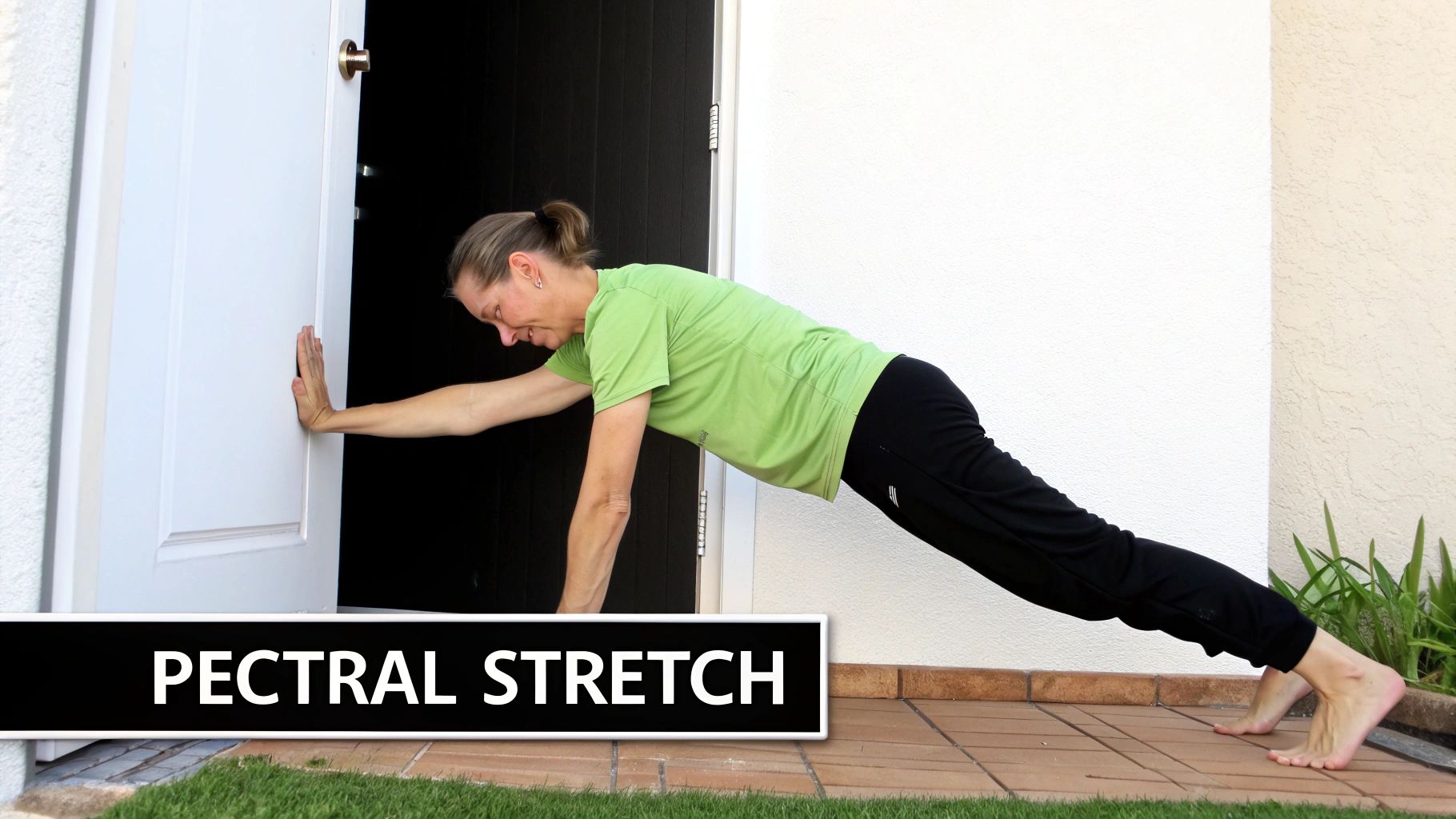
Much of the neck pain we experience today doesn't start in the neck itself; it's a consequence of our daily posture. Hours spent hunched over desks, steering wheels, or smartphones cause the chest muscles to become tight and shortened. This is why the Doorway Pectoral Stretch is one of the best exercises for neck pain, as it directly counteracts this forward pull, relieving the chronic strain placed on your neck and upper back muscles.
Why Does Stretching Your Chest Help Your Neck?
The concept behind this stretch is postural balance. When your pectoral muscles are tight, they pull your shoulders forward and inward, creating a rounded-shoulder posture. To compensate and keep your eyes level, your head juts forward, forcing the muscles at the back of your neck and upper back to work overtime just to hold your head up. This constant tension is a major source of pain, stiffness, and even headaches.
By lengthening the pectoral muscles, you allow your shoulders to retract into a more neutral, healthy position. This reduces the forward head posture, alleviates the burden on your posterior neck muscles, and restores proper alignment to the cervical spine. For patients in Hershey struggling with desk-related pain, this stretch is a non-negotiable part of a successful recovery plan.
How to Perform Doorway Pectoral Stretches Correctly
This stretch is simple, accessible, and can be done almost anywhere you can find a doorway or corner. Proper form is crucial to target the chest muscles effectively without straining the shoulder joint.
- Positioning: Stand in a doorway and place your forearm on the frame, with your elbow bent at a 90-degree angle and roughly at shoulder height.
- Execution: Gently step forward with the leg opposite the arm you are stretching until you feel a comfortable stretch across the front of your chest and shoulder.
- Hold and Repeat: Hold the stretch for 30-60 seconds, breathing deeply and evenly throughout. Do not hold your breath. Return to the starting position and repeat on the other side. Aim for 2-3 sets per side.
Key Insight: Keep your shoulder blade gently pulled back and down, away from your ear. Shrugging the shoulder during the stretch will reduce its effectiveness. For a deeper stretch as you gain flexibility, you can gradually move your hand higher up the door frame. Performing this stretch after a warm shower can enhance muscle relaxation and improve results.
7. Thoracic Spine Extensions (Cat-Camel and McKenzie Extensions)
When neck pain strikes, it's natural to focus solely on the neck itself. However, the root of the problem often lies just below in the upper and mid-back, known as the thoracic spine. This is why incorporating thoracic spine extensions is a crucial strategy, making them one of the best exercises for neck pain for long-term relief and postural correction.
What Are Thoracic Extensions and Why Do They Work?
Thoracic spine extensions involve gently and purposefully bending your upper back backward, mobilizing vertebrae that often become stiff from prolonged sitting and forward-leaning postures. Your neck (cervical spine) sits directly on top of your thoracic spine. If your thoracic spine is stiff and rounded forward (a condition called kyphosis), your neck is forced to overextend and compensate just to keep your head level. This creates immense strain on your neck muscles, joints, and ligaments.
By performing exercises like the Cat-Camel and McKenzie-style prone extensions, you directly improve the mobility of your mid-back. This restores a healthier postural foundation, allowing your head and neck to sit more neutrally and efficiently. This, in turn, reduces the compensatory strain on your cervical spine, alleviates muscle tension, and helps prevent future flare-ups, making it an essential part of a comprehensive care plan for patients in Hershey.
How to Perform Thoracic Extensions Correctly
The goal is to focus the movement in your upper and mid-back, not your lower back or neck. Start gently and work within a comfortable range of motion.
- Cat-Camel: Begin on your hands and knees with your wrists under your shoulders and your knees under your hips.
- Cat: Exhale as you gently round your spine upward toward the ceiling, tucking your chin toward your chest.
- Camel (Cow): Inhale as you slowly arch your back, dropping your belly and lifting your chest and head. Alternate between the two movements for 15-20 smooth repetitions.
- McKenzie Prone Extensions: Lie on your stomach with your hands under your shoulders, like you're about to do a push-up. Keeping your hips on the floor, gently press up with your arms to lift your chest off the ground. Feel the stretch in your mid-back.
Key Insight: Isolate the movement. During prone extensions, focus on bending through the area between your shoulder blades rather than excessively arching your low back. Hold the extension for 3-5 seconds and perform 10-15 repetitions. For desk workers, performing a set of Cat-Camels every few hours can be transformative for breaking up postural stiffness and reducing neck strain.
8. Resistance Band Neck Exercises (Progressive Strengthening)
Once you've mastered isometric exercises and your acute pain has subsided, it's time to progress to dynamic strengthening. Resistance band exercises are the perfect next step and one of the best exercises for neck pain because they introduce movement against controlled, progressive resistance. This helps build not just strength but also endurance in the muscles that support your head and maintain good posture.
What Are Resistance Band Exercises and Why Do They Work?
Unlike static isometrics, these exercises involve moving your neck through its natural range of motion while an elastic resistance band provides a challenge. The band's tension increases as it stretches, forcing your neck muscles to work harder through the entire movement. This dynamic, variable resistance is crucial for developing functional strength that translates into real-world activities, from turning your head to check traffic to maintaining a stable neck position during exercise.
For patients in Hershey recovering from neck strain or chronic postural issues, this method is invaluable. It safely bridges the gap between basic activation and advanced strengthening, helping to create a resilient, durable neck that is less susceptible to future injury. By training the muscles to control movement, you're building a stronger foundation for long-term neck health.
How to Perform Resistance Band Neck Exercises Correctly
Proper form is key to preventing re-injury. Start with the lightest resistance band and focus on slow, controlled movements. Sit or stand tall with your shoulders down and back, and your chin slightly tucked.
- Banded Neck Flexion: Loop the band around the back of your head, holding the ends in front of you. Gently tuck your chin and nod your head forward against the band's resistance.
- Banded Neck Extension: Place the band across your forehead, holding the ends behind you (or anchoring them to a stable object). Gently press your head backward into the band.
- Banded Lateral Flexion: Loop the band over the right side of your head, holding the end with your right hand. Gently tilt your left ear toward your left shoulder against the resistance. Repeat on the other side.
- Banded Rotation: Anchor the band at face height to your side. Loop the other end around your head. Slowly rotate your head away from the anchor point. Repeat facing the opposite direction.
Key Insight: The goal is smooth, controlled movement, not speed or jerky motions. Perform 2 sets of 12-15 repetitions for each direction, 3-4 times per week. As the exercises become easier, progress to a stronger band. This is an excellent way to progress your care for a persistent muscle strain; you can learn more about the best treatment for muscle strain from our experts.
8-Exercise Comparison for Neck Pain
| Exercise | Implementation complexity | Resource requirements | Expected outcomes | Ideal use cases | Key advantages |
|---|---|---|---|---|---|
| Neck Isometric Exercises | Very low — simple static contractions | Minimal (hand or light band optional) | Foundational cervical stability; pain-safe strengthening | Acute neck pain, early rehab, desk-based workers | Safe for acute phases; no equipment; easy to perform correctly |
| Neck Stretches (Levator Scapulae & Upper Trapezius) | Very low — gentle sustained holds | Minimal (hands or support) | Reduced muscle tension; improved ROM; short-term relief | Daily maintenance, work breaks, post-adjustment care | Rapid tension relief; low risk; improves rotational mobility |
| Chin Tucks (Cervical Retraction) | Low–moderate — requires correct cueing | None (mirror optional) | Improves forward head posture; activates deep neck flexors | Postural correction for desk/phone users; daily practice | Evidence-backed; addresses root postural issue; immediate feedback |
| Shoulder Blade Squeezes (Scapular Retraction) | Low — visible, simple movement | Minimal (bodyweight; bands optional) | Stronger scapular retractors; improved thoracic/shoulder posture | Rounded shoulders, postural rehab, desk routines | Easily progressed; complements chin tucks; clear activation cue |
| Neck Rotations (Controlled ROM) | Low — gentle, pain-free motion | None (hand assistance optional) | Restored cervical rotation; better proprioception | Mobility maintenance, post-adjustment, drivers/athletes | Scalable (active/assisted/passive); immediate mobility feedback |
| Doorway Pectoral Stretches | Very low — static chest stretch | Doorway or wall | Reduced anterior tightness; improved shoulder openness | Rounded-shoulder posture, between visits, desk workers | Directly addresses anterior chain; highly accessible; rapid effect |
| Thoracic Spine Extensions (Cat-Camel, McKenzie) | Moderate — focus on form to avoid lumbar compensation | Minimal (mat; ball optional) | Increased thoracic extension and spinal mobility; reduced cervical compensation | Kyphosis, sedentary desk workers, posture-focused rehab | Targets thoracic driver of neck pain; improves posture and breathing |
| Resistance Band Neck Exercises (Progressive Strengthening) | Moderate–high — requires progression and technique | Bands, anchors; varying resistances | Increased cervical strength and endurance; functional stability | Intermediate/advanced rehab, athletes, maintenance training | Progressive overload; multi-plane strengthening; portable and scalable |
Take the Next Step: Your Personalized Path to a Pain-Free Neck in Hershey, PA
Navigating the landscape of neck pain can feel overwhelming, but this guide has provided you with a powerful toolkit. We have explored some of the best exercises for neck pain, from gentle isometric holds and targeted stretches like the Levator Scapulae stretch, to foundational postural correctors like Chin Tucks and Shoulder Blade Squeezes. Each movement, whether it's a controlled Neck Rotation or a deep Doorway Pectoral Stretch, is a step toward regaining control, reducing stiffness, and building a more resilient neck.
The true key to lasting relief, however, isn't just knowing the exercises; it's understanding how to apply them correctly and consistently. The exercises detailed in this article serve as the building blocks for a healthier neck, but they are most effective when integrated into a structured plan that addresses the root cause of your discomfort. Lasting change comes from creating a sustainable habit, a daily commitment to mindful movement that counteracts the stresses of modern life, from desk work to daily commutes.
From Information to Lasting Transformation
The journey from pain to wellness is a highly personal one. While the exercises in this guide are widely beneficial, your body has a unique history and specific needs. What works wonders for one person may need modification for another. This is where professional guidance becomes not just a luxury, but a necessity for safe and effective recovery.
A common question we hear from patients in Hershey is where to turn for help. For individuals with persistent or severe neck pain, it's often beneficial to seek professional guidance. Fully understanding the difference between a personal trainer and a physical therapist can help you choose the right expert for your recovery journey. At a chiropractic clinic, the focus is on the structural source of the problem, addressing the spinal misalignments and nerve irritation that often initiate the cycle of pain and muscle tension.
At Hershey Family Chiropractic, we bridge the gap between general advice and personalized care. Our approach begins with a comprehensive evaluation to uncover the specific biomechanical issues contributing to your neck pain. We don't just hand you a list of exercises; we create a holistic treatment plan that may include:
- Precise Chiropractic Adjustments: To restore proper motion and alignment to the vertebrae in your neck and upper back, relieving pressure on nerves.
- Targeted Soft Tissue Therapies: To release chronic muscle tension and break down scar tissue in overworked neck and shoulder muscles.
- Customized Therapeutic Exercise Plans: We guide you on which of the best exercises for neck pain are right for you, ensuring proper form and progression.
Our goal is to empower you. We want you to leave our Hershey office not only feeling better but also equipped with the knowledge to maintain your progress and prevent future flare-ups. By combining expert hands-on care with a tailored exercise strategy, we help you build a foundation of strength, mobility, and stability for long-term health.
Don't let neck pain dictate your life any longer. If you're ready to move beyond temporary fixes and address the root cause of your discomfort, the dedicated team at Hershey Family Chiropractic is here to guide you with a personalized care plan that integrates expert adjustments with the best exercises for neck pain. Schedule your consultation today at Hershey Family Chiropractic and start your journey toward lasting relief.
